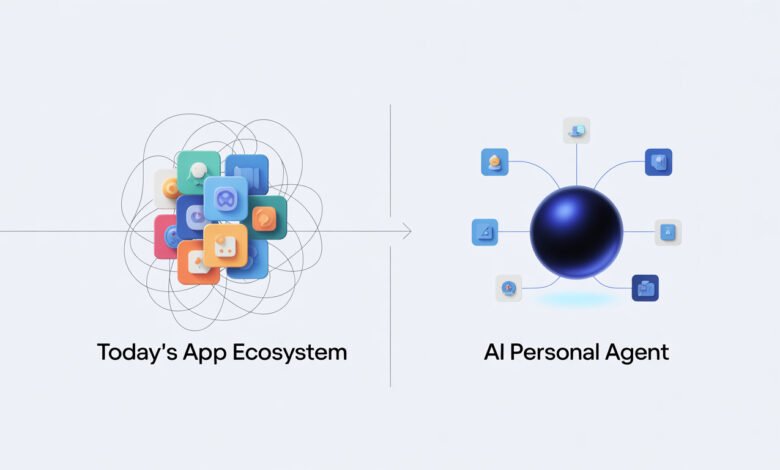
A 2026 Deep Dive Into the Future of Agentic AI
AI personal agents are no longer a concept reserved for science fiction or enterprise research labs. By 2026, they will have become the most consequential shift in human-computer interaction since the smartphone — and they are moving faster than most users realise. The global market for intelligent personal assistant software is projected to surpass $41.03 billion by 2030, and the trajectory is accelerating. This guide examines exactly what AI personal agents are, how agentic AI technology works, and why the dedicated app — the dominant interface paradigm of the past 15 years — is facing its most credible challenger yet.
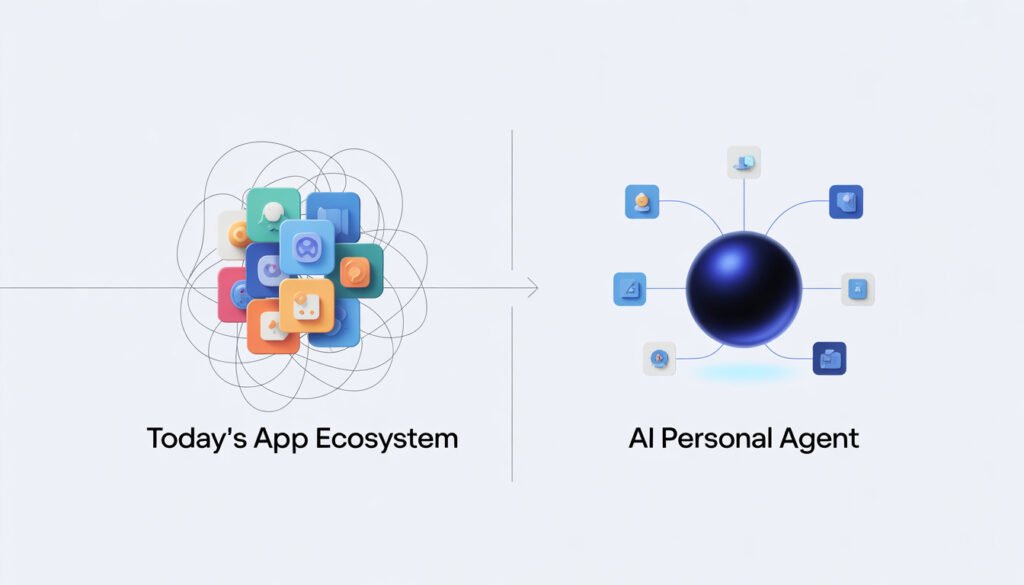
For over a decade, smartphones have served as curated collections of individual applications, each purpose-built for a single task. That architecture has served users reasonably well. But it is beginning to show its age. The average user now navigates more than 80 installed applications yet actively engages fewer than 10 on any given day. Agentic AI — proactive, context-aware, and deeply integrated — challenges the fundamental assumption that every task requires its own dedicated tool.
⚠️ Tech Disclaimer: This guide explores 2026 AI trends for educational purposes. AI capabilities and software performance vary by platform; this is not professional, technical, or financial advice. Always verify with certified experts for a critical system
What Exactly Is an AI Personal Agent?
An AI personal agent is not simply a smarter version of Siri or Alexa. While conventional voice assistants operate on a command-and-response basis — waiting for explicit instructions before acting — a true AI personal agent operates with a degree of autonomy that more closely resembles a capable human colleague than a reactive software tool.
These agents are built on Large Language Models (LLMs) such as GPT-4o, Gemini 2.0, and Claude 3.7 Sonnet, which allow them to parse natural language with remarkable nuance, maintain conversational context across extended interactions, and perform multi-step AI reasoning. Beyond language understanding, AI personal agents connect with external services via APIs, retrieve and synthesise information from multiple sources, and execute actions — booking appointments, sending messages, managing finances — without requiring the user to open a single dedicated application.
What separates an AI personal agent from earlier digital assistants is the combination of proactivity, deep personalisation, and cross-platform AI integration. Rather than responding to isolated queries, these systems learn user habits over time, anticipate future needs, and act across an entire digital ecosystem from a single conversational interface.
Key Characteristics of AI Personal Agents
- Contextual Understanding: Agents maintain awareness of prior interactions, user goals, and real-world context — not just the last sentence spoken.
- Proactivity: They surface relevant information and suggest actions without waiting to be asked.
- Deep Personalisation: Through continuous machine learning, agents adapt to individual preferences, schedules, and communication styles.
- Multimodal Capability: Advanced agents process and respond via text, voice, image, and structured data — simultaneously.
- Cross-Platform Integration: Via APIs and system-level permissions, agents interact with third-party applications, services, and connected devices.
Strategic Comparison: AI Personal Agents vs Voice Assistants vs Traditional Apps
| Feature | AI Personal Agents | Voice Assistants (Siri / Alexa) | Traditional Apps |
| Proactivity | High — anticipates needs | Low — command-response only | None |
| Context Retention | Multi-session memory | Single-session only | App-specific |
| Cross-Platform | Native (via APIs) | Limited | No |
| Personalisation | Deep behavioural learning | Basic preferences | Manual settings |
| Task Automation | Multi-step, autonomous | Single-step | Manual execution |
| Privacy Risk | High (data concentration) | Moderate | Distributed |
| Learning Curve | Minimal — natural language | Low | Per-app varies |
🧠 KNOWLEDGE ASSESSMENT — Test Your Understanding:
Q1: What primarily distinguishes an AI personal agent from a conventional voice assistant?
- A) It has a louder speaker and a longer battery life
- B) It operates proactively, learns user habits, and executes multi-step tasks autonomously
- C) It only works on iOS devices with the latest chipset
- D) It requires dedicated hardware to function
Q2: Which core technology enables AI personal agents to understand natural language and perform multi-step reasoning?
- A) Bluetooth 5.0 Low Energy Protocol
- B) Robotic Process Automation (RPA) scripts
- C) Large Language Models (LLMs) — such as GPT-4o and Gemini 2.0
- D) Augmented Reality overlays
Q3: What is “permission sprawl” and why does it matter?
- A) An app that consumes excessive device storage
- B) The accumulation of broad data permissions across many apps, creating a significant privacy risk
- C) A type of cloud infrastructure failure
- D) A screen layout rendering bug in older operating systems
Answer Key
- Q1: B — It operates proactively, learns user habits, and executes multi-step tasks autonomously
- Q2: C — Large Language Models (LLMs) — such as GPT-4o and Gemini 2.0
- Q3: B — The accumulation of broad data permissions across many apps creates a significant privacy risk
- Score: 3/3 — You are ready for the advanced sections of this guide.
The Limitations of Today’s App-Centric World
Before assessing where AI personal agents are heading, it is worth being precise about the problem they are solving. The current app-based paradigm was a genuine leap forward when it emerged in the late 2000s. Today, however, its structural weaknesses are increasingly apparent.
Fragmentation and Workflow Inefficiency
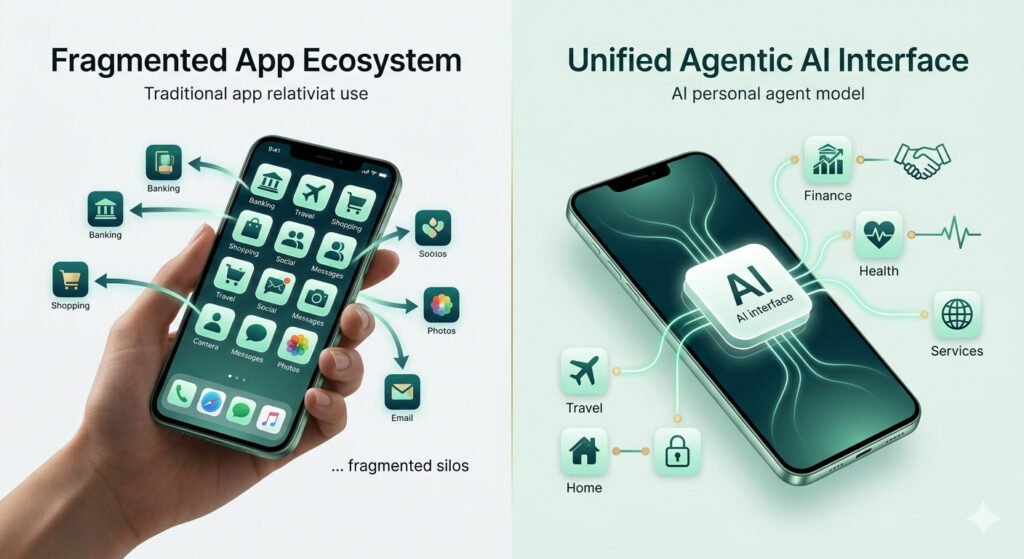
The average smartphone user has approximately 80 applications installed, yet actively uses fewer than 10 on any given day. Completing even a moderately complex task — arranging a business lunch — requires navigating several apps in sequence: contacts, calendar, maps, restaurant discovery, review platforms, and messaging. Each transition introduces friction. Each app demands its own mental model. The cumulative cost is measured not in seconds, but in cognitive energy.
Information Silos
Data generated within one application rarely flows seamlessly into another. A user’s dietary preferences recorded in a nutrition app are invisible to a restaurant booking platform. Travel preferences stored in one service cannot be leveraged by another. This siloed architecture forces users to re-enter information repeatedly and prevents any single tool from developing a genuinely holistic understanding of their needs — the very foundation of AI agent personalisation.
Onboarding Fatigue and Permission Sprawl
Each new application introduces its own interface conventions, settings hierarchies, and interaction patterns. Research from Nielsen Norman Group consistently identifies interface complexity as a primary driver of digital fatigue and technology abandonment.[2] For users managing dozens of apps, the cumulative cognitive overhead is substantial. Compounding this is permission sprawl — granting data permissions to a large number of applications creates an expansive and difficult-to-audit data-sharing surface. Many users remain unaware of the breadth of permissions they have granted.
| ⚖️ Counter-Argument: Permission Sprawl May Actually Favour AI Agents. Some researchers argue that AI agents reduce privacy risk compared to the current app ecosystem, because they consolidate data within a single, auditable system rather than distributing it across dozens of opaque third-party applications. ⚖️A unified agent with transparent data governance may be easier for regulators and users to monitor than the current fragmented reality. |
💡 For more information, explore the complete segments of our AI & Personal Technology Series
How AI Personal Agents Are Replacing Apps: 10 Real-World Use Cases
The case for AI personal agents is most compelling not in the abstract, but in the concrete mechanics of everyday tasks. Below are ten domains where the replacement of discrete apps by an intelligent agent layer is both technically feasible and user-experience-driven.
1. Unified Communication and Scheduling
Traditional workflow: Open contacts → Open calendar → Check availability → Open maps → Search restaurants → Open review app → Make a reservation → Open messaging app → Send invite. That is eight sequential steps across six or more applications. Agent-assisted workflow: “Schedule a lunch with Sarah for next Tuesday, find a well-reviewed Italian restaurant near her office, and send her the details.” The agent executes the entire chain through a single natural-language AI instruction. The efficiency gain is structural, not marginal.
2. Personalised Information Retrieval and Synthesis
Search engines return links. AI personal agents return answers — synthesised, contextualised, and tailored to the user’s prior interests and expertise level. A researcher asking for “key breakthroughs in solid-state battery technology from the last 90 days” receives a curated summary drawing on peer-reviewed sources, industry reports, and verified news — not a list of URLs to manually sift through.
3. Streamlined Financial Management
Managing personal finances currently involves switching between banking apps, budgeting tools, investment platforms, and bill payment portals. An AI personal agent introduces a unified financial layer capable of monitoring accounts for unusual activity, notifying users of upcoming payment obligations, generating consolidated spending overviews, and offering AI-driven savings insights calibrated to stated risk tolerance.
Note: AI-generated financial observations should be treated as informational inputs only. Users should consult a qualified financial adviser before acting on any AI-generated guidance.
4. Enhanced Travel Planning
Planning international travel traditionally requires cross-referencing flight comparison platforms, hotel booking sites, review aggregators, visa information portals, and travel advisories. An AI travel planning agent compresses this research cycle into a single conversation — complete, actionable itinerary as the output, in minutes rather than hours.
5. Seamless Smart Home Integration
Current smart home ecosystems suffer from the same fragmentation that afflicts the broader app landscape. AI personal agents act as a natural-language command layer above all connected devices, enabling complex, context-sensitive smart home AI automations without requiring users to navigate multiple manufacturer apps or configure intricate rules manually.
6. Proactive Health and Wellness Monitoring
By integrating with wearable APIs and health data platforms, an AI personal agent may help users identify patterns in sleep quality, physical activity, and stress indicators. Rather than presenting raw data, the agent synthesises trends and may surface relevant lifestyle observations — always positioned as informational rather than diagnostic.
7. Autonomous Shopping and Procurement
From recurring household items to considered purchases, AI shopping agents can monitor price fluctuations, compare options across retailers, and execute purchases against pre-defined preferences — reducing the decision overhead associated with routine procurement.
8. Continuous Learning and Professional Development
An AI personal learning agent can curate reading lists, summarise industry developments, recommend courses, and track professional development goals — adapting its recommendations as the user’s skills and interests evolve over time.
9. Automated Document and Email Management
Routine document drafting, email triage, meeting summarisation, and follow-up scheduling represent a substantial portion of knowledge worker time. AI agent automation in this domain is already demonstrating measurable productivity gains in enterprise deployments, with Microsoft’s Copilot integration in the 365 ecosystem serving as the most large-scale commercial example.
10. Cross-Service Identity and Preference Management
Rather than re-entering preferences, payment details, and accessibility requirements across dozens of services, an AI personal agent maintains a unified user profile and applies it consistently across every integrated platform — a capability that directly addresses the core friction of today’s fragmented app ecosystem.
The Technology Powering AI Personal Agents
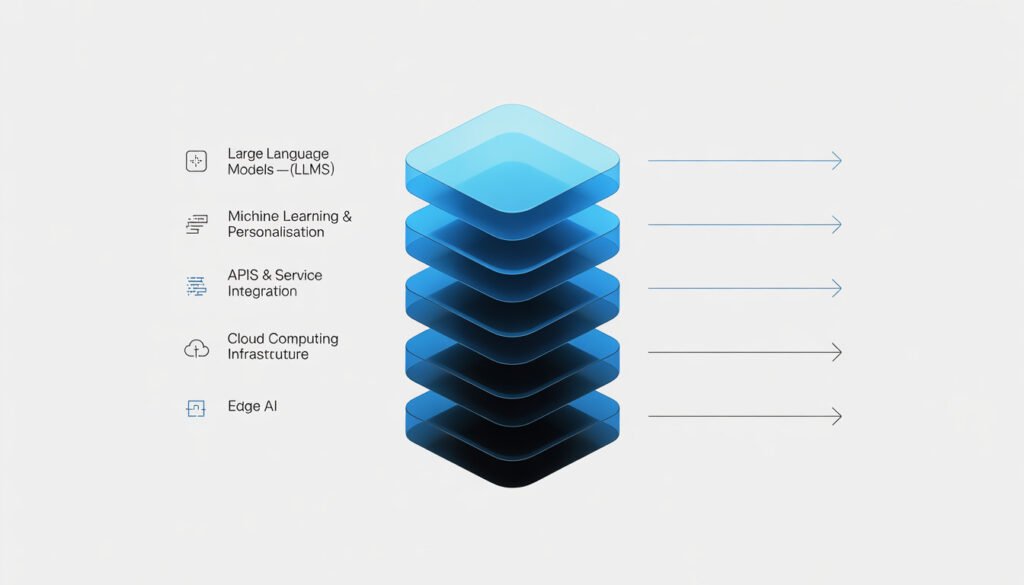
AI personal agents are not a single technology — they are an integration of several converging advancements, each of which was necessary for the category to become viable.
Large Language Models (LLMs)
LLMs such as GPT-4o, Gemini 2.0, and Claude 3.7 Sonnet provide the natural language AI comprehension and generation capabilities that make conversational interaction feel intuitive. Their capacity for multi-step AI reasoning enables agents to decompose complex requests into discrete subtasks and execute them in sequence or in parallel.
Machine Learning and Behavioural Personalisation
Beyond language understanding, machine learning algorithms enable agents to construct progressively richer user models — inferring preferences, anticipating needs, and adapting communication style based on observed behaviour. This is what distinguishes a personalised AI agent from a generic chatbot.
APIs and Service Integration
An AI personal agent that cannot act is merely a sophisticated chatbot. APIs are the connective tissue that allows agents to interact with third-party services — booking systems, financial institutions, productivity platforms, and IoT devices — turning conversational instructions into real-world outcomes.
Cloud Computing and Edge AI
The computational demands of large-scale AI models at low latency require elastic cloud infrastructure. Amazon Web Services, Microsoft Azure, and Google Cloud are each investing heavily in AI-optimised infrastructure as a direct response to agent-based workloads [3]. Complementing this is Edge AI — processing performed locally on a device — which addresses latency and privacy constraints for time-sensitive tasks. The balance between cloud and on-device AI processing will be a defining architectural question for agent platforms over the next several years.
| ⚖️ Counter-Argument: Cloud Dependency Is a Structural Vulnerability Critics of cloud-dependent AI agents argue that centralised processing creates both latency risks and single points of failure. ⚖️Advocates for on-device Edge AI processing counter that declining hardware costs and advancing model compression techniques will shift more agentic computation to the device level by 2027–2028, reducing both latency and privacy exposure. |
💡 For more information, explore the complete segments of our AI & Personal Technology Series
Expert Perspectives and Industry Signals
The transition toward agent-based computing is not speculative — it is being actively validated by the organisations that define the direction of the technology industry.
According to Gartner’s 2025 research, by 2028, 33% of enterprise software applications will include agentic AI functionality, compared to fewer than 1% in 2024 [4]. That trajectory — a 33-fold increase in four years — represents one of the most rapid capability expansions in enterprise software history.
OpenAI’s Operator product and Google’s Project Astra are among the most prominent early examples of agentic AI systems designed to navigate real software environments autonomously. Microsoft’s integration of Copilot agents into its 365 ecosystem represents a large-scale commercial deployment of AI agent technology within established productivity workflows.
Dr. Andrew Ng, co-founder of Google Brain and founder of DeepLearning.AI, has framed the next phase of AI as agents that can “reason, plan, and execute complex tasks on behalf of users” [5] — capturing precisely the architectural shift that distinguishes AI personal agents from prior generations of AI tooling.
IDC projects the global AI software market will reach $307 billion by 2027, representing a compound annual growth rate of approximately 20% [6] — with agent platforms forming an increasingly large share of that total.
Challenges and Ethical Considerations
A measured assessment of AI personal agents requires equal attention to the risks and uncertainties that accompany their promise.
Privacy and Data Security
An AI personal agent that is genuinely useful must have access to a substantial volume of personal data: calendars, communications, financial accounts, location history, and health metrics. The concentration of this data creates a high-value target for malicious actors. Regulatory frameworks such as the EU’s GDPR and the EU AI Act are beginning to address data ownership and third-party sharing obligations for AI systems [7], but the regulatory landscape remains incomplete across jurisdictions.
Algorithmic Bias
LLMs and the broader ML systems that underpin AI agents are trained on large datasets that inevitably reflect the biases present in their source material. When agents make recommendations — particularly in domains like finance, employment, or healthcare — biased outputs can have meaningful real-world consequences. Ongoing auditing, diverse training data, and transparent model documentation are necessary safeguards.
Job Transformation
AI agents will automate tasks currently performed by humans. Sectors involving high volumes of routine information processing — scheduling, data entry, basic research — face the most immediate exposure. Historically, technological automation has tended to transform job categories rather than eliminate employment in aggregate, but the transition can be difficult for workers in affected roles.
⚖️ Counter-Argument: Job Displacement :
May Be More Severe Than Historical Patterns Suggest. Several economists warn that the pace of AI-driven automation may outstrip historical patterns of job transformation—particularly because AI agents target cognitive work rather than physical labour.
⚖️Unlike prior automation waves that replaced manual tasks, AI personal agents are displacing information work, which has traditionally been considered relatively safe from automation.
Over-Reliance and Skill Atrophy
A more subtle risk is the gradual erosion of user capability in areas where AI agents have assumed responsibility. Navigating information, evaluating sources, and planning complex tasks are cognitive skills that benefit from regular exercise. As agents assume these functions, users may find their own critical thinking capacity diminishing — a risk that warrants deliberate attention from both designers and users.
Transparency and Controllability

For users to trust AI agents with consequential decisions, they must understand — at least at a high level — how those agents make decisions, what data they access, and how their actions can be reviewed or reversed. Explainability and user control are not merely desirable features; they are prerequisites for meaningful adoption of AI agent technology.
The Road Ahead: Evolution, Not Overnight Replacement
Despite the scale of the shift underway, apps will not disappear overnight. What is more likely — and already observable — is a phased evolution unfolding over the remainder of this decade.
| Phase | Stage | What Happens |
| Phase 1 — 2026–2027 | Orchestration | AI agents act as orchestrators of existing apps, coordinating actions across multiple platforms via APIs without replacing apps outright. |
| Phase 2 — 2028–2029 | Integration | Deeper OS-level integration; agents handle complex multi-step workflows and reliance on individual apps visibly declines. |
| Phase 3 — 2030+ | Selective Replacement | For most high-frequency everyday tasks, discrete single-purpose apps become redundant as AI agents deliver direct, conversational functionality. |
What emerges is not a world without apps, but a world where the primary interface layer for most users is conversational and agent-driven, with specialised applications accessible beneath that layer when genuinely necessary.
Key Takeaways
- The emergence of AI personal agents represents one of the most consequential shifts in human-computer interaction since the smartphone.
- Advances in Large Language Models, machine learning, API integration, and cloud infrastructure drive this transformation.
- AI personal agents are rapidly evolving from research curiosities into commercial products — with deployments already live in enterprise software.
- For most everyday tasks — communication, scheduling, financial oversight, travel, and information retrieval — the dedicated app may soon become optional rather than essential.
- Privacy, algorithmic bias, job transformation, and transparency remain genuine and unresolved challenges that demand both policy and technical attention.
- The most productive question is not “Will AI personal agents replace apps?” but rather “How do we ensure this transition serves users well?”
(FAQ)
Q1: Will AI personal agents completely replace all apps?
A complete replacement of all applications is unlikely in any near-term timeframe. Specialised professional tools, creative software, and deep-domain applications will retain their relevance. The more likely outcome is that AI personal agents consolidate the everyday apps used for routine tasks — messaging, scheduling, search, and financial management — while specialist applications persist.
Q2: How do AI personal agents differ from current voice assistants?
Current voice assistants are fundamentally reactive: they respond to direct commands, operate within narrow functional boundaries, and have limited memory of prior interactions. AI personal agents are proactive, context-retaining, and capable of executing complex, multi-step tasks across multiple services without explicit instruction at each step — comparable to the difference between a calculator and a full financial planning platform.
Q3: When will AI personal agents become mainstream?
Early commercial deployments are already live as of 2025–2026. Widespread consumer adoption is most credibly projected for the 2027–2029 window, contingent on continued advances in model capability, cross-platform AI integration standards, and user trust.
Q4: How do AI agents handle complex multi-app tasks?
AI agents use APIs to communicate with third-party services, acting as intelligent middleware. When a user asks an agent to plan a trip, the agent simultaneously queries flight booking APIs, hotel reservation systems, review platforms, and travel advisories, then synthesises the results into a single unified output.
Q5: What role do Large Language Models play?
LLMs are the cognitive core of AI personal agents. They provide natural language understanding, contextual reasoning, response generation, and conversational memory — enabling intuitive interaction that goes far beyond simple keyword recognition.
AI & Personal Technology Series
This article is part of the AI & Personal Technology Series — a practical collection of guides exploring how autonomous AI systems are reshaping productivity, privacy, and the future of human-technology interaction.
References
- Statista — Mobile App Usage Statistics 2024
https://www.statista.com/statistics/277125/share-of-website-traffic-coming-from-mobile-devices/ - Nielsen Norman Group — Cognitive Load and Interface Complexity in Mobile UX
https://www.nngroup.com/articles/minimize-cognitive-load/ - Amazon Web Services — Machine Learning on Amazon EKS
https://docs.aws.amazon.com/eks/latest/userguide/machine-learning-on-eks.html - Gartner — Top Strategic Technology Trends 2025: Agentic AI
https://www.gartner.com/en/articles/top-technology-trends-2025 - DeepLearning.AI — Agentic AI Systems and the Future of Work
https://www.deeplearning.ai/the-batch/how-agents-can-improve-llm-performance/ - IDC — Worldwide AI Software Forecast 2024–2027
https://www.idc.com/getdoc.jsp?containerId=US53660625 - European Commission — EU AI Act — Regulatory Framework for Artificial Intelligence
https://digital-strategy.ec.europa.eu/en/policies/regulatory-framework-ai