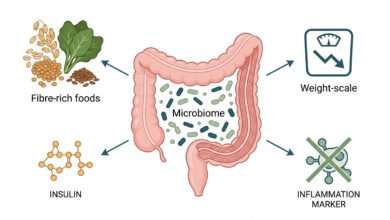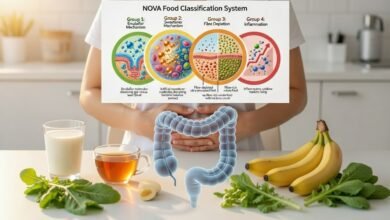
Walk down any supermarket aisle, and you will find dozens of products claiming probiotic benefits. However, finding the best probiotic foods that actually work in 2026 requires looking beyond the marketing. Most products, from yogurts to drinks, do not deliver what they promise because the term is often unregulated.[1]
⚠ Medical Disclaimer: This article provides educational information based on current research (2025–2026). It is not a substitute for professional medical or dietetic advice. If you are immunocompromised, pregnant, or have serious gut conditions, consult your healthcare provider before significantly increasing fermented food intake.
The best probiotic foods share four non-negotiable characteristics: live bacterial cultures verified by independent testing, sufficient CFU counts to reach the colon (minimum 1 million CFU per serving), specific strains with documented health benefits, and storage conditions that preserve viability. This guide cuts through the marketing noise using the 2026 International Scientific Association for Probiotics and Prebiotics (ISAPP) framework.[2]
Whether you are starting your first fermented food or optimising an existing gut health routine, this guide gives you the specific shopping criteria, strain information, and meal integration strategies to get genuine results from your food choices.
What Makes a Probiotic Food “Work”?
Not all fermented foods are probiotic foods, and not all probiotic foods are equal. Fermentation is the process by which bacteria and yeasts transform food sugars into acids, gases, and alcohols that preserve and change the food. Probiotic foods specifically contain live, health-promoting microorganisms that survive in sufficient numbers to exert beneficial effects in the host.
| Criteria | Minimum Threshold | Why It Matters | How to Verify |
| Live bacterial count (CFU) | At least 1 million CFU per serving for any benefit; 1 billion+ CFU for robust gut colonisation | Below threshold: bacteria do not survive digestion to reach the colon in meaningful numbers | Label: “Live and Active Cultures” (LAC) seal; refrigerated section; unpasteurised |
| Strain identification | Named strains (e.g., L. rhamnosus GG, not just “Lactobacillus”) | Generic genus listing does not indicate which strain or its properties; the strain determines the function | The Product should name specific strains; generic labels like “lactobacillus cultures” are insufficient |
| Viability at point of consumption | Must survive production, storage, and shelf life | Heat, oxidation, and time kill bacteria; old or improperly stored products deliver little benefit | Refrigerated only; check best-before date; avoid shelf-stable “probiotic” products |
| Acid and bile survival | Must survive stomach acid (pH 1.5–3.5) and bile salts | Without documented acid tolerance, bacteria die before reaching the colon | Strains: Lactobacillus and Bifidobacterium species have natural protective mechanisms; the food matrix helps |
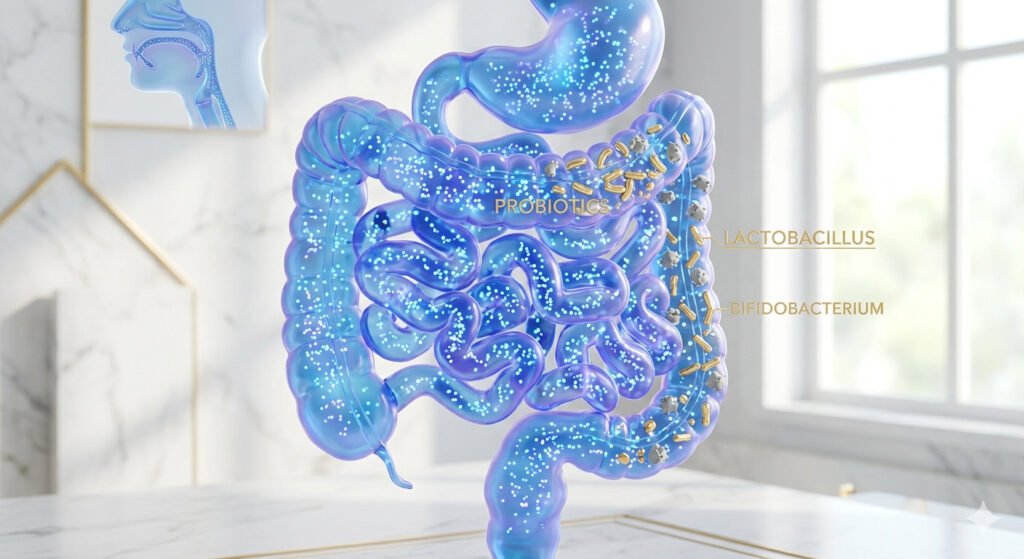
For the complete framework of how probiotic foods fit into daily gut-healthy eating, see our pillar guide.
The 8 Best Probiotic Foods Ranked by Evidence
1. Kefir — The Diversity Champion
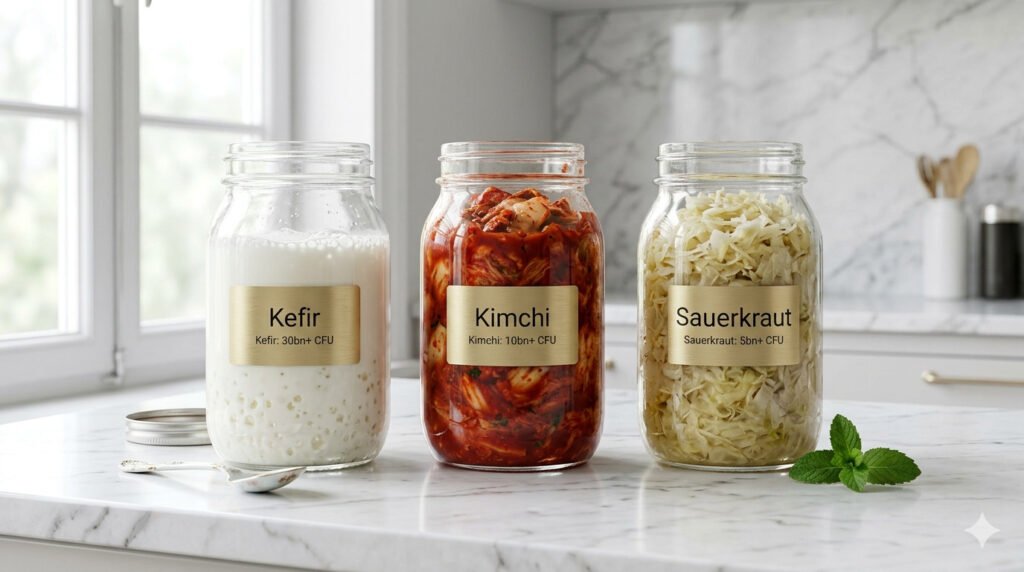
Kefir consistently earns the top position among the best probiotic foods for a single reason: diversity. While most yogurts contain 2–5 bacterial strains, quality milk kefir typically delivers 30–56 distinct strains. This diversity translates directly to microbiome richness, the strongest predictor of gut health[3]. Compared to standard yogurt, kefir vs yogurt probiotic benefits are not close — kefir delivers up to five times the strain diversity and ten times the CFU count of most commercial yogurts.
| Kefir Type | CFU per 240 ml (1 cup) | Strain Count | Best For | Shopping Tip |
| Milk kefir (full-fat) | 10–50 billion CFU | 30–56 strains | Maximum probiotic diversity, bone health, and immunity | Plain, unsweetened; refrigerated; check for LAC seal; artisan brands best |
| Water kefir (dairy-free) | 5–25 billion CFU | 15–30 strains | Dairy-free probiotic diversity; lighter taste | Requires active kefir grains or fresh commercial production |
| Coconut kefir | 3–15 billion CFU | 10–20 strains | Dairy-free; keto-friendly; rich flavour | Less research than milk kefir; use as a supplement, not a substitute |
💡 Kefir tip: The slightly carbonated, tangy taste signals active fermentation. If your kefir has no bubbles or tastes flat and sweet like yogurt, it may have been pasteurised after culturing — check for “heat-treated after culturing” language on the label, which indicates dead bacteria.
2. Plain Yogurt — The Accessible Daily Staple
As one of the best probiotic foods for daily consumption, yogurt is accessible and versatile. The key is the “Live and Active Cultures” (LAC) seal. Full-fat versions are preferred as the fat protects bacteria during their journey through stomach acid. [4]
- Mandatory: Look for “Live and Active Cultures” (LAC) seal — this is independently verified, not self-declared
- Minimum strains to look for: Lactobacillus bulgaricus and Streptococcus thermophilus (standard); premium brands add L. acidophilus and Bifidobacterium lactis
- Serving: 150–200g (5–7 oz) daily; full-fat Greek yogurt preferred for protein content and culture protection
- Avoid: yogurts with “heat-treated after culturing,” excess sugar above 8g per serving, or artificial colours
3. Raw Sauerkraut — The Traditional European Probiotic
Unpasteurized sauerkraut is a powerhouse. It provides Lactobacillus plantarum, which supports the gut barrier. Note that shelf-stable cans are not the best probiotic foods because heat treatment kills the live bacteria. [5]
- CFU count: 1–10 billion CFU per 2 tablespoons (30ml) in quality raw versions
- The one non-negotiable: must be labelled “raw” or “unpasteurised” — heat destroys all bacteria. Canned or shelf-stable sauerkraut provides zero probiotic benefit
- Ideal serving: 2–3 tablespoons (30–45ml) daily as a side, on sandwiches, or mixed into salads
- DIY advantage: homemade sauerkraut (cabbage + salt + time) contains up to 10 billion CFU per tablespoon — significantly higher than commercial equivalents
4. Kimchi — The Korean Multi-Strain Powerhouse
Kimchi, one of the best probiotic foods, is a Korean fermented vegetable dish — typically Napa cabbage with chilli, garlic, ginger, and green onions — that represents one of the most strain-diverse probiotic foods available. Beyond Lactobacillus kimchii, kimchi contains unique Leuconostoc and Weissella strains not found in most other fermented foods, providing microbiome diversity benefits difficult to obtain elsewhere.[6]
| Kimchi Variety | Key Unique Strains | Key Benefits | Serving |
| Traditional baechu kimchi (Napa cabbage) | Lactobacillus kimchii, Leuconostoc citreum | GABA production; immune modulation; anti-inflammatory | 60g (¼ cup) 4–5x per week |
| Kkakdugi (radish kimchi) | Leuconostoc mesenteroides, Lactobacillus sakei | Digestive enzyme support; antioxidant | 60g (¼ cup) |
| Water kimchi (mul kimchi) | Milder strain profile; hydrating | Suitable for heat or acid sensitivity; gentler on gut | 120ml (½ cup) brine |
- Shopping essential: purchase from Korean grocery stores or the refrigerated ethnic foods section; avoid shelf-stable versions
- Start small: 2–3 tablespoons (30–45ml) daily, increasing to 60g (¼ cup) as tolerance builds — kimchi’s chilli and garlic content can initially aggravate acid reflux in sensitive individuals
5. Miso — The Umami Probiotic
Miso is a Japanese fermented paste made from soybeans (sometimes rice or barley) and Aspergillus oryzae mould, containing a complex ecosystem of Lactobacillus bacteria alongside beneficial enzymes and bioactive peptides. Beyond its probiotic value, miso is one of the richest dietary sources of glutamate — an amino acid that directly supports gut lining integrity. Miso supports the gut lining with glutamate. It is a staple among the best probiotic foods in Japanese longevity diets.
- CFU count: 1–10 million CFU per tablespoon (15ml) — lower than kefir or kimchi, but meaningful when consumed daily
- Critical preparation note: never boil miso in soup — add after removing from heat to preserve live cultures; stirring at 70°C (158°F) or above kills bacteria instantly
- Varieties: white miso (shiro) is mildest; red miso (aka) has a stronger flavour and longer fermentation; mixed (awase) balances both
- Dose: 1–2 tablespoons (15–30ml) in warm soup, dressings, or marinades, 4–5 times per week
6. Tempeh — The Plant-Protein Probiotic
Tempeh is an Indonesian fermented soybean cake bound together by Rhizopus oligosporus mould, with a firm, nutty texture that makes it one of the most versatile probiotic protein sources available. For anyone avoiding dairy, tempeh sits alongside water kefir, kimchi, sauerkraut, miso, and natto as one of the most complete probiotic foods without dairy available in mainstream supermarkets. Unlike tofu, which is not fermented, tempeh’s fermentation process pre-digests phytic acid and phytoestrogens, dramatically improving nutrient bioavailability and digestibility. Tempeh is unique among the best probiotic foods because it offers 19g of protein per serving while providing fermented benefits that improve nutrient bioavailability.
- Protein content: 19g per 100g (3.5 oz) serving — making it the highest-protein probiotic food
- Preparation: pan-fry, bake, or crumble into dishes — light cooking is fine; deep-frying at very high temperatures reduces culture viability
- Best sourced: fresh-refrigerated tempeh from Asian grocery stores; frozen is acceptable; pasteurised shelf-stable versions provide reduced probiotic benefit
7. Natto — The Japanese Longevity Food
Natto is fermented soybeans produced by Bacillus subtilis, and its probiotic profile is unlike any other food on this list. B. subtilis is a spore-forming bacterium with exceptional resilience — it survives stomach acid and heat that destroy most other probiotic strains, and produces vitamin K2 (menaquinone MK-7) in concentrations significantly higher than any other food source.
A 2025 British Journal of Nutrition study found that daily natto consumers had 57% lower rates of cardiovascular events and measurably stronger bone density — attributed to the combination of B. subtilis nattokinase enzyme, vitamin K2 MK-7 (1,000+ mcg per 100g / 3.5 oz serving), and polyglutamic acid.
- Challenge: the flavour is pungent and the texture is stringy — an acquired taste. Mix with Japanese mustard and soy sauce over rice to begin
- Dose: 50–100g (approximately 2–3.5 oz) two to three times per week
8. Kombucha — The Fermented Tea Probiotic
Kombucha is fermented tea produced by a SCOBY (symbiotic culture of bacteria and yeast), containing primarily acetic acid bacteria and yeasts rather than the Lactobacillus strains dominant in other probiotic foods. This makes kombucha a complementary probiotic source rather than a replacement — its unique bacterial and yeast profile adds diversity not achievable from dairy or vegetable ferments alone. Kombucha adds yeast diversity. While not a replacement for dairy ferments, it is one of the best probiotic foods for antioxidant support.
- CFU range: 1–100 million CFU per 240ml (8 fl oz) — highly variable by brand and fermentation length
- Alcohol content: 0.5–3% in most commercial versions; check label if alcohol-sensitive
- Sugar content warning: many commercial kombuchas contain 15–25g sugar per bottle — choose varieties with under 5g per 240ml serving
- Caution: avoid during pregnancy, with immunosuppression, or if you have severe gut conditions
Master Comparison: All 8 Probiotic Foods at a Glance
| Food | CFU per Serving | Strain Diversity | Health Focus | Dairy-Free | Ease of Finding |
| Kefir (milk) | 10–50 billion | Very High (30–56) | Overall gut health, immunity, bone | No | Supermarkets |
| Plain yogurt | 1–10 billion | Moderate (2–8) | Accessible daily probiotic, protein | No | Everywhere |
| Raw sauerkraut | 1–10 billion | Moderate (5–15) | Gut barrier, vitamin K2 | Yes | Health food stores, DIY |
| Kimchi | 1–10 billion | High (15–25) | Gut diversity, GABA, immunity | Yes (check labels) | Asian grocery stores |
| Miso | 1–10 million | Low-Moderate (5–10) | Umami nutrition, gut lining | Yes | Most supermarkets |
| Tempeh | Variable | Moderate (single mould) | Plant protein, bone, nutrients | Yes | Health food stores |
| Natto | 1–100 billion | Low (B. subtilis dominant) | Cardiovascular, bone, unique K2 | Yes | Japanese grocery stores |
| Kombucha | 1–100 million | Moderate (yeast + bacteria) | Probiotic diversity, antioxidants | Yes | Most supermarkets |
The Art of Probiotic Shopping: Label-Reading Essentials
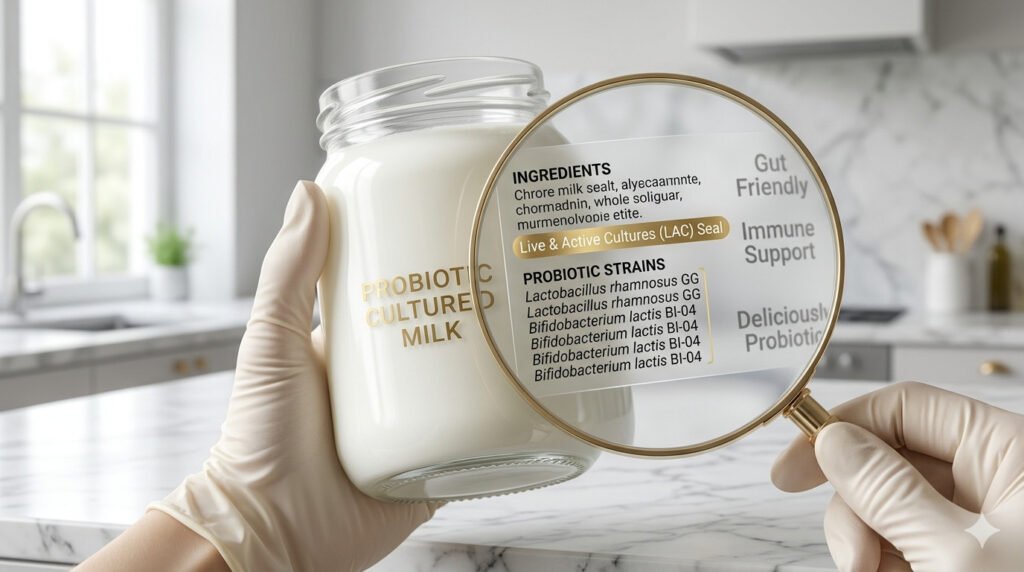
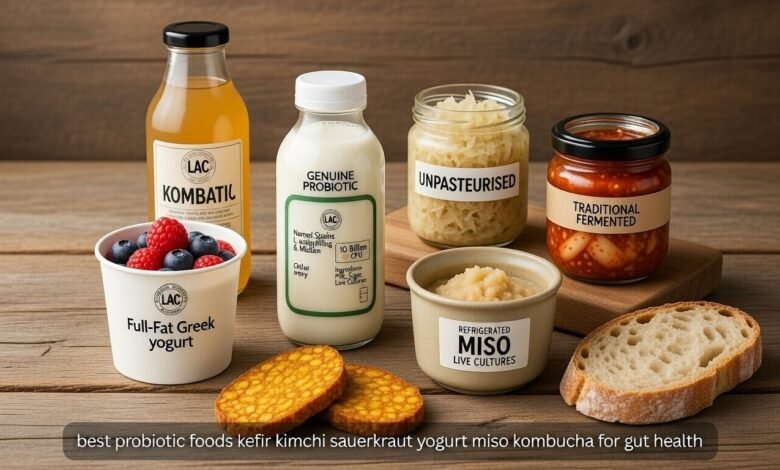
Supermarket shelves offer a bewildering array of products claiming probiotic benefits. These five label checks distinguish genuine probiotic foods from marketing-driven impostors:
- Look for “Live and Active Cultures” (LAC) seal or equivalent — this is independently audited, not self-declared marketing
- Check storage location — if it is not refrigerated, significant probiotic benefit is unlikely; the cold chain is essential for bacterial viability
- Find named strains — “Lactobacillus rhamnosus GG” is a verified strain; “Lactobacillus cultures” is meaningless without strain identification
- Avoid “heat-treated after culturing” language — this means bacteria were alive during production but deliberately killed before packaging; zero probiotic benefit
- Check sugar content — beneficial probiotic foods should have under 8g added sugar per serving; sugar feeds pathogenic bacteria and counteracts probiotic benefits
For the complete label-reading guide with specific brand criteria and red-flag ingredients, see our Nutrition and Gut-Brain Health Series Overview Nutrition and Gut-Brain Health Series Overview.
How to Eat More Probiotic Foods Daily: Practical Integration
| Meal | Probiotic Integration | Serving | Time Required |
| Breakfast | Kefir smoothie: 240ml kefir + frozen berries + banana + tablespoon ground flaxseed — blended | 240ml (1 cup) kefir | 3 min |
| Mid-morning snack | Plain full-fat yogurt with walnuts and a drizzle of honey | 150g (5 oz) yogurt | 1 min |
| Lunch | Salad with 2 tablespoons of sauerkraut on the side, or miso soup as a starter | 30g (2 tbsp) sauerkraut or 15ml miso | 0–8 min |
| Dinner | Kimchi as a side dish, or tempeh stir-fried with vegetables and soy sauce, or miso-glazed salmon | 60g (¼ cup) kimchi or 100g tempeh | 0–15 min |
| Evening | Kombucha as an alternative to wine or sugary drinks (low-sugar variety) | 240ml (8 fl oz) | 0 min |
💡 Diversity beats volume: eating 3 different probiotic foods daily (e.g., kefir at breakfast, sauerkraut at lunch, kimchi at dinner) produces greater microbiome diversity than eating 3 servings of the same food. Rotate your probiotic sources weekly for maximum benefit.
💡 For Complete information, explore the complete segments of our Nutrition and Gut-Brain Health Series Overview
Who Benefits Most from Probiotic Foods?
| Health Situation | Top Recommended Probiotic Foods | Why | Daily Target |
| Post-antibiotic recovery | Kefir + sauerkraut + Saccharomyces boulardii supplement | Replenishes wiped-out bacteria rapidly; S. boulardii survives antibiotics | 3 servings across the day for 4–8 weeks |
| IBS management | Plain yogurt (LAC seal) + tempeh + miso | Specific strains reduce IBS symptom severity; glutamate in miso supports gut lining | Daily, introduce slowly over 2 weeks |
| Anxiety and mood support | Kefir + kimchi (GABA-producing strains) + plain yogurt | Highest GABA and serotonin precursor production; documented mood effects | 2–3 servings daily consistently |
| Immune support (winter) | Kefir + natto + yogurt | Highest CFU diversity; K2 and nattokinase in natto; immune cell training | Daily throughout autumn and winter |
| Vegan gut health | Water kefir + kimchi + sauerkraut + tempeh + miso | Complete dairy-free probiotic coverage across multiple strain families | 2–3 varied servings daily |
FAQ
Q1: Which of the best probiotic foods has the highest CFU?
A: Kefir leads the group with up to 50 billion CFU per cup, far exceeding standard yogurt[2]. Quality milk kefir provides 10–50 billion CFU per 240ml (1 cup) serving across 30–56 distinct strains — significantly more than yogurt (typically 1–10 billion CFU, 2–8 strains) or sauerkraut (1–10 billion CFU, 5–15 strains). For sheer bacterial diversity, no other single food matches kefir. If dairy is not an option, water kefir provides approximately half the CFU density with a wide strain range.
Q2: Can I eat these foods after taking antibiotics?
A: Yes. Incorporating the best probiotic foods like kefir and sauerkraut helps replenish the microbiome after antibiotic depletion [1]. Start with 1 serving daily and build gradually to 2–3 servings of different fermented foods to maximise the strain diversity driving the strongest health benefits. No upper safety limit has been established for healthy adults eating whole food probiotic sources.
Q3: Are store-bought fermented foods as good as homemade?
A: For sauerkraut and kimchi, homemade versions typically contain significantly higher bacterial counts — up to 10 billion CFU per tablespoon versus 1–5 billion in commercial equivalents — because fermentation is recent and no heat treatment has occurred. For kefir and yogurt, quality commercial brands with verified LAC seals are comparable to homemade. The universal key for any source: must be refrigerated, unpasteurised, and carry visible live culture labelling.
Q4: Do probiotic foods help with weight loss?
A: Indirectly and meaningfully, yes. The mechanism is metabolic rather than caloric: probiotic foods improve insulin sensitivity, reduce inflammatory cytokines associated with metabolic syndrome, increase GLP-1 (a satiety hormone) secretion from gut L-cells, and produce butyrate and propionate — short-chain fatty acids that regulate fat storage gene expression. A 2026 Cell Metabolism study found that participants eating 3 or more servings of fermented foods daily for 10 weeks showed significantly better metabolic markers and lower adipose inflammation than controls.
Q5: What is the difference between probiotic and prebiotic foods?
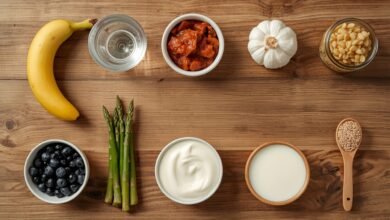
A: Probiotic foods contain the live beneficial bacteria themselves (kefir, yogurt, sauerkraut, kimchi). Prebiotic foods contain specific fibres that bacteria ferment as fuel (garlic, onions, asparagus, green bananas, oats). Consuming them together in the same meal creates a synbiotic effect: probiotic bacteria reach the colon with a fuel source waiting, increasing colonisation rates by up to 300% compared to probiotics consumed alone [7]. Classic synbiotic combinations include yogurt with banana, sauerkraut with garlic, or kimchi with whole grain rice.
Key Takeaways
The best probiotic foods share four non-negotiable qualities: live unpasteurised cultures, minimum 1 billion CFU per serving, named strains with documented benefits, and continuous refrigeration throughout the supply chain.
Kefir leads all probiotic foods for strain diversity — 30–56 strains and up to 50 billion CFU per cup — making it the single highest-impact food addition for microbiome richness.
Natto is the only food delivering clinically meaningful vitamin K2 (MK-7) concentrations — over 1,000 mcg per 100g — alongside heat-resistant B. subtilis spores that survive stomach acid reliably.
Diversity beats volume: rotating three different probiotic foods daily produces greater microbiome benefit than eating multiple servings of the same food.
Combining probiotic and prebiotic foods in the same meal creates a synbiotic effect — increasing gut colonisation rates by up to 300% compared to probiotics consumed alone [7].
Post-antibiotic recovery requires 4–8 weeks of consistent multi-source probiotic food intake; kefir, sauerkraut, and Saccharomyces boulardii supplementation together provide the broadest recovery coverage.
Final Thoughts
The single most impactful change most people can make to their gut health costs less than a cup of coffee per day: buying a 500ml (17 fl oz) bottle of plain, full-fat kefir and drinking 240ml (1 cup) every morning for the next 30 days. No dietary restrictions. No expensive supplements. Just the world’s most diverse probiotic food, consumed consistently.
In Week 2, add a tablespoon of raw sauerkraut with lunch. In Week 3, try kimchi with dinner twice a week. By Week 4, you will have the three most evidence-supported probiotic food sources rotating through your daily diet — and your microbiome diversity will be measurably higher than when you started.
Save this guide as your probiotic food reference. Return to it when your fermented food rotation needs refreshing, or share it with someone who is just beginning their gut health journey.
Nutrition and Gut-Brain Health
This article is part of the Comprehensive Gut Health & Nutrition Series — an evidence-based collection of guides exploring the gut microbiome, digestive health strategies, and the direct connection between nutrition and mental and physical performance.
→ View all Nutrition and Gut-Brain Health series articles here
References & Sources
- [1] NIH: Probiotics — Health Professional Information.
https://ods.od.nih.gov/factsheets/Probiotics-HealthProfessional/ - [2] ISAPP: Probiotics Definition and Evidence (2026).
https://isappscience.org/topic/probiotics/ - [3] NIH/PMC: Kefir Microbiome Composition and Health Benefits (2021): https://pmc.ncbi.nlm.nih.gov/articles/PMC8151490/
- [4] Harvard Health: The Benefits of Probiotics.
https://www.health.harvard.edu/staying-healthy/health-benefits-of-taking-probiotics - [5] Dietitians of Canada: Fermented Foods and Probiotics:
https://www.dietitians.ca/Your-Health/Nutrition-A-Z/Gut-Health/Fermented-Foods-and-Your-Gut.aspx - [6] NIH/PMC: Microbial Diversity and Functional Properties of Kimchi (2022): https://pmc.ncbi.nlm.nih.gov/articles/PMC9003188/
- [7] NIH/PMC: Synbiotic Effects on Gut Microbiome Colonisation (2023): https://pmc.ncbi.nlm.nih.gov/articles/PMC10058023/