Psychological Resilience: Building Real Inner Strength with Science-Based Strategies (2026)


What Is Psychological Resilience? The Precise Scientific Definition
In a world that rarely pauses long enough to let you catch your breath, psychological resilience has shifted from a desirable personality trait into an essential life skill. It is the capacity to bend without breaking, to absorb the shock of adversity, recalibrate, and re-emerge with greater clarity and strength. The encouraging truth, confirmed by decades of research in positive psychology, is that psychological resilience is not a fixed gift reserved for the fortunate few.
It is a learnable, trainable set of competencies accessible to every individual willing to invest in them. This cluster article — part of our comprehensive Mental Wellness Guide: The Science-Based Path to Resilience (2026) — delivers a structured, evidence-driven framework to help you measure your current resilience baseline, understand its neurological roots, and build genuine inner strength that withstands real-world pressure.
⚠️ Disclaimer: This article is intended for general educational and self-awareness purposes only. It does not constitute medical or psychological advice, diagnosis, or treatment. If you are experiencing acute psychological distress, please consult a licensed mental health professional immediately.
Key Insight:
Psychological resilience is not about avoiding stress — it is about building systems that allow rapid recovery and adaptive growth under pressure.
The American Psychological Association (APA) defines psychological resilience as the adaptive process through which individuals effectively navigate adversity, trauma, tragedy, threats, or significant sources of stress [1]. The term Resilience in psychology encompasses three overlapping dimensions:
- Recovery: Returning to pre-crisis functioning levels following a setback.
- Resistance: Limiting the negative impact of stressors at the moment they occur.
- Bounce Forward: Achieving post-traumatic growth (PTG) — reaching a higher level of functioning than before the adversity.
Researchers also differentiate between trait resilience — a relatively stable dispositional tendency — and process resilience, which is shaped dynamically by context, social resources, and acquired skills. This distinction is central to the design of modern Cognitive Behavioural Therapy (CBT)-based resilience interventions and has significant implications for how practitioners approach mental toughness training.
💡 For more information, explore the complete segments of our Mental Wellnes Series Overview
🧠 Quick Self-Check:
How Resilient Are You Right Now?
Q1. When an unexpected setback disrupts your plans, your immediate response is:
–A) I pause, assess the situation, and identify one actionable next step.
–B) I feel overwhelmed initially, but usually recover within a few hours.
–C) I withdraw and tend to avoid dealing with the problem directly.
Q2. After failing to reach an important goal, you tell yourself:
–A) “This is useful data — I know exactly what to adjust next time.”
–B) “I’m disappointed, but I’ll try again when I’m ready.”
–C) “This confirms I’m probably not capable of achieving this.”
Q3. Your social support network is:
–A) Strong and active — I have specific people I trust and connect with regularly.
–B) Present but limited — I have a few connections, but rarely reach out.
–C) Minimal — I prefer to handle difficulties entirely on my own.
✅ Highest-Resilience Answers:
Q1 → A: Proactive problem-focused coping — the hallmark of high resilience.
Q2 → A: Growth Mindset reframing — transforming failure into learning data.
Q3 → A: Active social support — one of the strongest evidence-based resilience buffers.
The Neuroscience of Psychological Resilience: What Your Brain and Genes Reveal
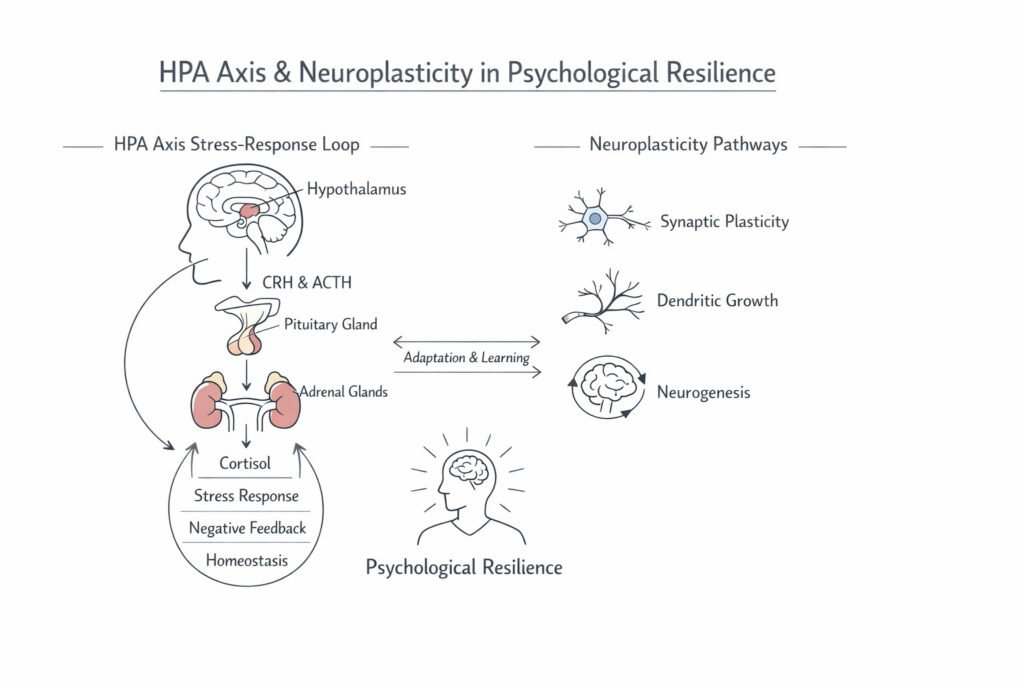
Contemporary neuroscience identifies three core biological systems that underpin psychological resilience:
1. The HPA Axis and Stress Regulation
The hypothalamic–pituitary–adrenal (HPA) axis governs the body’s stress response through cortisol secretion. In individuals with high psychological resilience, cortisol levels return to baseline significantly faster after a stressor, compared with those who score lower on resilience measures.
A 2024 study published in Neuroscience & Biobehavioural Reviews confirmed this cortisol recovery differential as a reliable biological marker of adaptive resilience [2].
Emerging findings suggest that resilience training not only lowers cortisol but also regulates pro-inflammatory cytokines.
2. Neuroplasticity and the Capacity for Change
Neuroplasticity — the brain’s ability to reorganise its own structure and function — is the biological backbone of resilience building.
Practices such as mindfulness meditation and cognitive reappraisal activate the lateral prefrontal cortex, which in turn down-regulates amygdala reactivity to perceived threats. Regular practice produces measurable structural changes in as little as eight weeks.
3. Genetic Contribution and Its Limits
Twin studies estimate that genetic factors account for approximately 30%–50% of individual differences in psychological resilience [3].
Critically, this means that 50%–70% of resilience variance is environmentally determined and fully amenable to intervention — a finding that directly refutes the common misconception that mental toughness is simply “something you are born with.”
Seven Science-Backed Pillars of Psychological Resilience
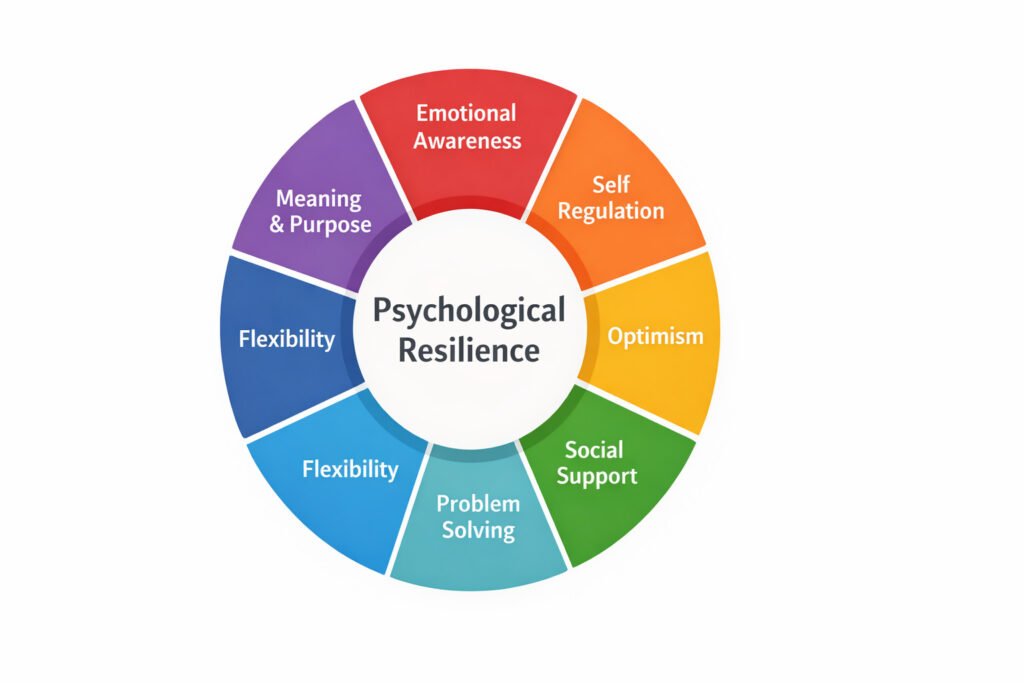
Contemporary research converges on seven actionable domains for developing psychological resilience. Each pillar is independently supported by peer-reviewed evidence and collectively constitutes a comprehensive resilience-building framework
Pillar 1: Cognitive Reframing
Cognitive Reframing — the deliberate reinterpretation of adverse events from an alternative perspective — is among the most rigorously studied psychological resilience strategies. Clinical trials consistently show that reframing reduces anxiety and depressive symptoms by interrupting automatic negative thought patterns. Practical entry point: write down a stressful event and generate three genuinely different interpretations of its meaning or cause.
Pillar 2: Growth Mindset
Carol Dweck’s landmark research at Stanford University demonstrates that individuals who adopt a growth mindset — the belief that abilities are developable through effort — exhibit up to 40% greater psychological resilience when confronting academic and professional setbacks, compared with those holding a fixed mindset [4]. The growth mindset reframes failure as instructive data rather than evidence of permanent limitation.
Pillar 3: High-Quality Social Support
Social support is a matter of quality, not quantity. Instrumental support (practical assistance) and emotional support (empathic listening) engage different resilience pathways. Individuals with access to both support types show a significantly lower incidence of post-traumatic stress disorder (PTSD) following acute adversity [2].
Pillar 4: Mindfulness and Emotional Regulation
Mindfulness does not eliminate negative emotion — it develops the capacity to observe emotion without fusion. Completing an eight-week Mindfulness-Based Stress Reduction (MBSR) programme produces measurable cortical thickening in regions associated with attentional regulation and emotional processing, providing a durable neurological foundation for stress resilience
Pillar 5: Sense of Purpose and Meaning
Viktor Frankl’s logotherapy and Self-Determination Theory (SDT) converge on a central finding: a clearly articulated purpose functions as a psychological anchor during adversity. Individuals who report a strong sense of purpose recover from professional crises 52% faster than peers who lack this orientation [5].
Pillar 6: Physical Health as a Resilience Input
Aerobic exercise at the WHO-recommended minimum of 150 minutes per week elevates brain-derived neurotrophic factor (BDNF) by up to significantly increases brain-derived neurotrophic factor (BDNF), which directly supports neuroplasticity and enhances the brain’s ability to form new adaptive coping pathways — making consistent physical activity a non-negotiable component of any psychological resilience programme
Pillar 7: Tolerance of Uncertainty
A significant proportion of psychological distress originates from attempting to control inherently uncontrollable variables. Acceptance and Commitment Therapy (ACT) frameworks demonstrate that cultivating uncertainty tolerance reduces cognitive load, decreases chronic worry, and enhances emotional resilience over the long term.
Strategic Comparison: Psychological Resilience vs. Passive Endurance
A persistent misconception conflates psychological resilience with silent endurance or stoic suppression. The following comparison clarifies the fundamental distinction between the two orientations:
| Criterion | Psychological Resilience | Passive Endurance |
| Nature | A learnable, evolving skill set | Temporary coping with depletion risk |
| Emotion handling | Conscious regulation and processing | Suppression or denial |
| Post-crisis outcome | Post-Traumatic Growth (PTG) | Accumulation of unprocessed stress |
| Relationship impact | Strengthens social bonds | Promotes isolation |
| Long-term health | Improved mental and physical outcomes | Elevated burnout and depression risk |
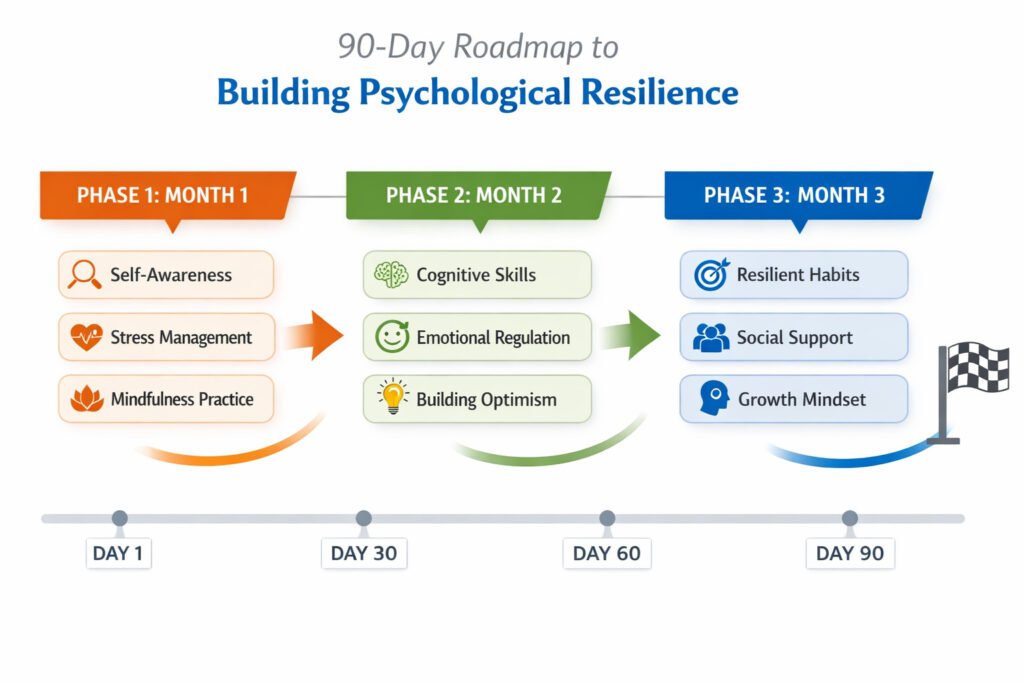
Start your resilience journey today with the structured 90-day plan below:
A Practical 90-Day Plan to Build Psychological Resilience
How to build psychological resilience after trauma, step by step. The following structured roadmap translates the seven pillars into a progressive development sequence:
Month 1 — Awareness and Baseline Assessment
- Weeks 1–2: Complete the Connor-Davidson Resilience Scale (CD-RISC) to establish a quantified baseline.
- Weeks 3–4: Begin a daily adversity journal. For each stressful event, record your interpretation, emotional response, and coping action.
Month 2 — Systematic Skill Building
- Mindfulness: Ten minutes of guided practice daily using a structured app (Headspace, Calm, or Insight Timer).
- Cognitive Reframing: Apply the “third-party perspective” technique — imagine advising a close friend experiencing your exact circumstances.
- Social Support: Identify three specific individuals who form your support network and schedule intentional weekly contact with each.
Month 3 — Consolidation and Measurement
- Re-administer the CD-RISC: Compare results with your Month 1 baseline and identify areas of measurable growth.
- Target your weakest pillar: Design a focused 30-day micro-plan for the single pillar where you scored lowest.
- Expand your knowledge base: Enrol in an accredited mental wellness programme or peer support group to reinforce gains.
Common Myths About Psychological Resilience
Several legitimate critiques of the resilience discourse deserve direct, evidence-informed responses:
- “Resilience means denying pain.”
- The opposite is true. Genuine psychological resilience requires processing pain, not bypassing it. Avoidance is explicitly associated with lower resilience scores.
- “Seeking help is a sign of weakness.”
- Research consistently shows that help-seeking behaviour is itself a resilience strategy, correlating positively with faster recovery and stronger long-term outcomes.
- “Resilience ignores structural injustice.”
- A valid structural critique. Psychological resilience enhances individual agency within constraints but does not negate the need for systemic change.
- “Resilience is inherited, not developed.”
- Controlled intervention studies demonstrate that CBT-based and ACT-based programmes produce statistically significant, sustained improvements in resilience scores, independent of genetic background.
💡 For more information, explore the complete segments of our Mental Wellne#Mental-Wellnessss Series Overview
Psychological Resilience in the Workplace: The Professional Dimension
Occupational burnout costs the global economy an estimated $322 billion annually. Employees scoring in the highest quartile for psychological resilience demonstrate 31% higher productivity, 41% lower absenteeism, and an 87% lower likelihood of voluntarily leaving their organisation [5]. Three organisational practices most reliably foster workplace resilience:
- Leadership modelling: Leaders who share constructive vulnerability normalise adaptive coping and build psychologically safer teams.
- Psychological safety culture: Organisations that permit open discussion of mistakes without punitive consequences accelerate collective learning and individual recovery.
- Structured recovery practices: Recovery breaks, flexible scheduling, and facilitated access to mental health resources translate directly into measurable resilience gains at the team level.
Key Takeaways
- Psychological resilience is a trainable skill, not a fixed trait reserved for a privileged few.
- It rests on seven evidence-based pillars: cognitive reframing, growth mindset, social support, mindfulness, purpose and meaning, physical health, and uncertainty tolerance.
- Neurologically, resilience is rooted in HPA axis regulation and neuroplasticity — both of which respond positively to targeted intervention.
- The strategic distinction between psychological resilience and passive endurance is critical: one builds capacity, the other depletes it.
- A structured 90-day plan grounded in the seven pillars provides a measurable pathway to genuine, lasting inner strength.
FAQ
Q1: Can psychological resilience be developed at any age?
Yes. Neuroplasticity remains active throughout the human lifespan. Structured resilience training produces significant improvements in adults across all age groups, including older populations.
Q2: What is the difference between psychological resilience and optimism?
Optimism is a cognitive orientation towards positive outcome expectancy. Psychological resilience is broader — it encompasses active coping strategies, emotional regulation, and social resource utilisation that remain effective even when outcomes are negative.
Q3: How long does it take to build meaningful psychological resilience?
Research on MBSR and CBT-based resilience programmes indicates measurable improvements within 8–12 weeks of consistent practice. Larger trait-level changes typically consolidate over 6–12 months.
Q4: When should I seek professional support rather than self-directing?
If symptoms of depression, acute anxiety, or post-traumatic stress persist for more than two weeks and significantly impair daily functioning, consulting a licensed mental health professional is strongly recommended. Self-directed resilience practices complement, but do not replace, professional care.
Q5: Are resilience-building apps effective?
Evidence-based apps (those incorporating CBT or mindfulness protocols validated in peer-reviewed trials) are useful supplementary tools. They are particularly effective for habit formation but should not be treated as substitutes for structured therapy in complex presentations.
What to do next :
- 📌 Bookmark this article as your go-to reference for science-backed psychological resilience strategies.
- 💬 Share your experience in the comments: which of the seven pillars is your current growth edge?
- 📧 Subscribe to our weekly newsletter for the latest peer-reviewed mental wellness research delivered directly to your inbox.
Mental Wellness Series Overview
This article is part of the Mental Wellness Series — an evidence-based collection of guides exploring psychological resilience, mental health strategies, and the science behind sustainable wellbeing in 2026.
References and Citations
- [1] American Psychological Association — Building Your Resilience
https://www.apa.org/topics/resilience - [2] National Institute of Mental Health — Caring for Your Mental Health
https://www.nimh.nih.gov/health/topics/caring-for-your-mental-health - [3] NIH / PMC — Genetic and Environmental Influences on Resilience (2024)
https://pmc.ncbi.nlm.nih.gov/articles/PMC2852579/ - [4] Carol S. Dweck — Mindset: The New Psychology of Success
https://mindsetonline.com/success-mindset-defined-quiz-do-you-have-it/ - [5] Harvard Business Review — How Resilience Works
https://hbr.org/2002/05/how-resilience-works