The Invisible Caregivers: A Practical 2026 Guide to Supporting Alzheimer’s Families


The Hidden Crisis: Caregiver Burnout by the Numbers
Support for Alzheimer’s families is no longer just a luxury—it is a physiological necessity in 2026. While Alzheimer’s devastates the person diagnosed, it significantly impacts the psychological and physical well-being of those who care for them. Alzheimer’s families face a crisis hiding in plain sight, and the numbers reveal just how deep it runs:
⚠️ Medical Disclaimer: This article provides educational information about Alzheimer’s disease based on current research (2025–2026) and is not a substitute for professional medical advice, diagnosis, or treatment. Always consult a qualified neurologist or healthcare professional regarding symptoms, diagnosis, or care decisions. Alzheimer’s disease management requires individualized medical evaluation.
- 11.3 million Americans provide unpaid care for people with Alzheimer’s or other dementias (Alzheimer’s Association, 2025)
- Many Alzheimer’s family caregivers provide 47+ hours of care per week, often without compensation or formal support. [1]
- A significant proportion of Alzheimer’s family caregivers report symptoms of depression — more than double the general population rate. [1]
- Some longitudinal studies have found that caregivers experiencing high levels of chronic emotional strain may face elevated mortality risk compared to non-caregivers. [2]
These aren’t just numbers. They represent spouses who haven’t slept through the night in years, adult children who’ve depleted retirement savings, and siblings torn apart by care disagreements. The person with Alzheimer’s isn’t the only patient in the room — and no Alzheimer’s Family should have to carry this weight alone.
Understanding the Emotional Rollercoaster: Grief Before Loss

Unlike sudden loss, Alzheimer’s forces families to grieve while their loved one is still physically present—a phenomenon psychologists call “ambiguous loss.” This creates a unique emotional paradox that most caregivers are completely unprepared for:
| Stage of Disease | What the Person Experiences | What the Caregiver Grieves |
| Early Stage | Frustration at memory lapses; awareness of decline | Loss of shared intellectual connection and mutual partnership |
| Middle Stage | Confusion, fear, personality shifts, reduced recognition | Loss of the person they knew—their humor, wisdom, and reciprocity |
| Late Stage | Minimal awareness; physical decline; limited communication | Loss of physical presence while mourning has already long since begun |
The Guilt Trap: Normal Feelings Caregivers Suppress
- Wishing it were over: “Am I a monster for wanting relief?”
- Feeling anger toward their loved one: “How can I be mad at someone who’s sick?”
- Resenting siblings who don’t share the load: “Why am I carrying this alone?”
Critical validation: These feelings are normal and nearly universal among caregivers. They don’t make you a bad person—they make you human. Suppressing them accelerates burnout; acknowledging them is the first step toward sustainable caregiving.
💡 For more information, explore the complete segments of our Mental Wellness Series Overview
Communication That Works: Talking to Someone With Alzheimer’s
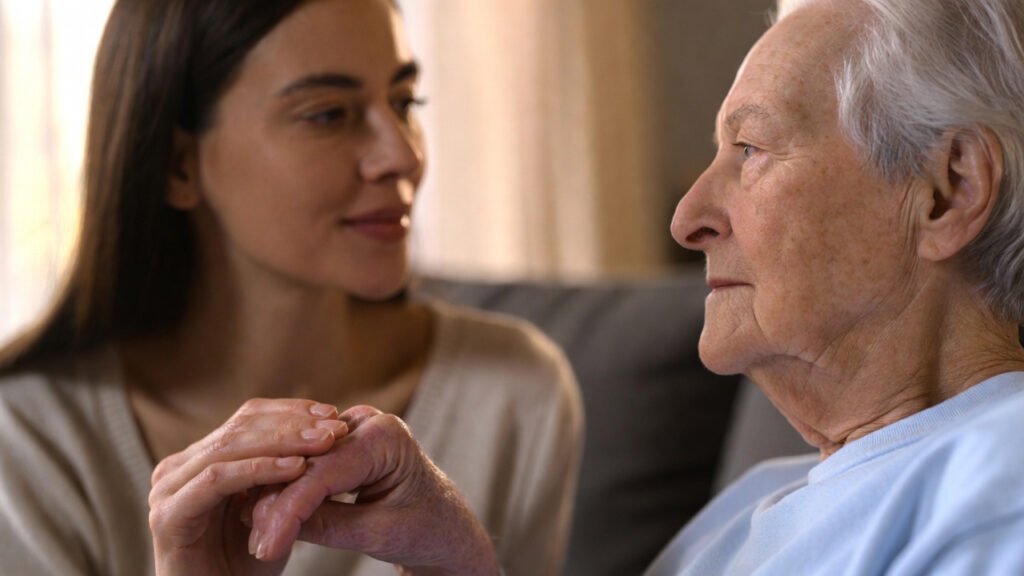
As Alzheimer’s progresses, traditional communication approaches cause frustration for everyone. These evidence-based techniques preserve connection and reduce agitation:
Connect Through Emotion, Not Facts
Instead of: “Dad, Mom died five years ago. You know this.”
Try: “You really miss Mom, don’t you? Tell me about her.”
Why it works: The factual memory is gone, but the emotional bond remains intact. Meeting them in their reality reduces agitation and preserves dignity.
Use Validation Therapy (Developed by Naomi Feil)
This approach accepts the person’s perceived reality without correction. When a person says, “I need to pick up my kids from school,” instead of correcting (“You’re 80, your kids are adults”), try: “You’re such a devoted parent. Let’s sit together while you wait.”
Evidence for validation therapy remains mixed, though some studies suggest it may reduce agitation in certain individuals (Neal & Barton Wright, 2003; Livingston et al., 2020). [3][6]
Simplify Language Without Talking Down
- Use short sentences of 5–7 words maximum
- One idea per sentence: “Let’s eat now,” not “It’s time for lunch, so let’s go to the kitchen.”
- Offer choices between two options only: “Red shirt or blue shirt?”, not open-ended “What do you want to wear?”
- Never argue, correct, or quiz—these trigger shame and defensive behaviors without any benefit
Creating a Safe, Dignified Home Environment (Room-by-Room Guide)

Safety modifications preserve independence while preventing injury. Prioritize these evidence-based changes by room (Alzheimer’s Association, 2024): [8]
Bathroom (Highest Risk Area)
| Modification | Why It Matters | Approx. Cost (USD) |
| Grab bars (not towel racks) | Significantly reduces fall risk-related fractures in this age group | $20–$50 |
| Non-slip mats inside and outside tub | Reduces slip risk on wet surfaces significantly | $15 |
| Raised toilet seat | Eases sit-to-stand transitions for weakened legs | $30 |
| Motion-sensor nightlight | Prevents disorientation during nighttime bathroom trips | $12 |
Kitchen
- Automatic stove shut-off device (turns off after 5 minutes): Prevents fire risk from forgotten cooking ($40)
- Locked cabinet for sharp objects and cleaning chemicals: Removes danger while preserving dignity
- Drawer labels with pictures and words: “Forks” and “Spoons” with images aid independence longer
Bedroom
- Nightlight path from bed to bathroom: Reduces nighttime confusion and wandering risk
- Remove all throw rugs: Major tripping hazard at this stage of disease
- Bed alarm (if wandering risk is high): Alerts caregiver when person gets up unsupervised
Golden rule: Modify the environment, not the person. Dementia is a neurodegenerative condition that affects behavior and cognition. Adapt spaces to their current abilities, not to past expectations.
The Alzheimer’s Family Team Approach: Dividing Responsibilities Without Resentment

One sibling shouldn’t carry the entire burden. A sustainable care team distributes tasks based on strengths, availability, and skills—not guilt:
| Role | Best Suited For | Example Tasks |
| Primary caregiver | Daily care, medication management, and doctor visits | Medication administration, attending medical appointments, and overnight supervision |
| Financial coordinator | Detail-oriented; financially literate | Bill paying, insurance claims, budget tracking, benefits research |
| Researcher | Skilled at online navigation | Finding resources, comparing facilities, and understanding new treatments |
| Emotional supporter | Empathetic listener; patient | Regular calls and visits with the person; respite relief for the primary caregiver |
| Alzheimer’s Family Liaison | Diplomatic communicator | Facilitating Alzheimer’s Family meetings, mediating disagreements fairly |
Critical tool: Monthly 30-minute family video calls with a structured agenda: health update (5 min), logistics coordination (10 min), primary caregiver emotional check-in (10 min), next steps assignment (5 min).
Script for overwhelmed primary caregiver: “I love Mom, and I’m committed to her care. But I cannot do this alone. Here’s specifically what I need from each of you this month.
Read more in: – Mental Wellness Guide: The Science-Based Approach to Resilience (2026)
When Siblings Disagree: Navigating Family Conflict About Care Decisions
Conflict is inevitable—but destructive conflict is not. Use these evidence-based strategies to protect both the care recipient and the Alzheimer’s Family relationships:
Separate Facts from Emotions
Fact: “Mom fell twice last month.” Emotion: “I’m terrified she’ll break her hip, and I’ll feel responsible.” Address emotions first (“I hear your fear”), then return to facts (“Let’s discuss specific fall prevention options”).
Use Neutral Third Parties
- Geriatric care manager ($150–250/hour): Provides an objective professional assessment that bypasses family dynamics
- Family therapist specializing in elder care: Creates a safe structure for difficult conversations
- Doctor’s written recommendation: Carries authority that siblings cannot easily dismiss or argue with
Accept ‘Good Enough’ Solutions
Perfectionism destroys families navigating Alzheimer’s care. A 70% solution implemented today beats a 95% solution debated for months while Mom’s safety deteriorates. Progress requires compromise from everyone.
Self-Care Isn’t Selfish: Preventing Burnout as a Primary Caregiver

You cannot pour from an empty cup. Sustainable caregiving requires non-negotiable self-care minimums:
Daily Non-Negotiables
- 10 minutes alone: No screens, no tasks—just breathing and mental decompression
- One nourishing meal: Not skipped or eaten standing over the sink while multitasking
- One expression of emotion: Journaling, talking to a friend, or crying in the car—release the pressure valve daily
Weekly Non-Negotiables
- 4 hours of respite: Hire a sitter, ask a friend to stay, or use an adult day program
- One genuine social connection: Coffee with a friend who doesn’t talk about Alzheimer’s
- One body-positive movement: Walk, stretch, or dance—reclaim your body from chronic stress
Red Flags That Signal Burnout
- Crying daily over small things that wouldn’t normally affect you
- Persistent insomnia despite physical and emotional exhaustion
- Thoughts of “I can’t do this anymore” lasting more than two consecutive weeks
- Neglecting your own medical appointments and health concerns
If you recognize these signs, contact your doctor immediately. Caregiver depression is highly treatable — and research consistently shows that caregivers who seek support report significantly better outcomes for both themselves and the person in their care (Pinquart & Sörensen, 2003). [7]
💡 For more information, explore the complete segments of our Mental Wellness Series Overview
Financial and Legal Planning: Protecting Your Loved One and Your Family

Act early—before cognitive decline prevents the person from having legal capacity to make decisions:
| Document | Purpose | When Needed |
| Durable Power of Attorney | Before a person loses decision-making capacity | Before moderate cognitive decline reaches Stage 4–5 |
| Healthcare Proxy | Designates someone to make medical decisions | Before person loses decision-making capacity |
| Living Will | Specifies end-of-life care wishes in advance | Anytime—prevents devastating family conflict later |
| Revocable Trust | Avoids probate; manages assets smoothly | Before a person loses decision-making capacity |
Hidden Costs to Budget For Long-term care costs vary significantly by state, level of care required, and facility type. In-home assistance, adult day programs, and memory care communities can represent substantial financial commitments. Reviewing current regional cost data and consulting a financial planner is recommended.
Resource: Medicaid covers long-term care for low-income seniors—but requires asset spend-down. Consult an elder law attorney early, before crisis forces rushed decisions. For a comprehensive overview of legal planning options, see NIA (2024). [9]
When to Consider Professional Care: Making the Hardest Decision With Compassion

Moving a loved one to professional care isn’t failure — research identifies clear clinical indicators that signal when in-home care is no longer sufficient to ensure safety and well-being (Gaugler et al., 2009). [10]
- Safety red flags: Wandering outside unsupervised, repeatedly forgetting to turn off the stove, inability to take medications safely
- Caregiver health crisis: Primary caregiver hospitalized or experiencing severe, untreated depression
- Unmanageable behavioral symptoms: Aggression or severe sundowning that disrupts the entire household
How to Approach the Conversation
- Frame it as “more help,” not “giving up” or “sending away.”
- Tour facilities together early—before crisis forces a rushed decision
- Start with adult day programs to ease the transition gradually
- Reassure consistently: “I will still be your son/daughter. I’ll visit often. This keeps you safe.”
Guilt management: Write a letter to your future self explaining why this decision was necessary and loving. Read it whenever guilt surfaces—which it will.
Resources That Actually Help: Support Groups, Respite Care, and Crisis Lines
| Resource Type | Specific Options | Why It Helps |
| Evidence-based support groups | Alzheimer’s Association Early-Stage Social Engagement; REACH II caregiver program | REACH II has demonstrated significant improvements in caregiver depression and burden in randomized trials. |
| Respite care services | ARCH National Respite Network; local Area Agency on Aging | Provides necessary breaks without guilt or logistical burden |
| Crisis support line | Alzheimer’s Association 24/7 Helpline: 1.800.272.3900 | Immediate guidance during behavioral crises at any hour |
| Online peer communities | ALZConnected (alz.org/alzconnected); Alzheimer’s Caregiver Support Online | Anonymous peer support when isolation strikes at 2 am |
Pro tip: Bookmark all of these resources before a crisis hits. In the middle of emotional overwhelm, finding resources becomes nearly impossible. Save them now.
Final Thoughts
Caring for someone with Alzheimer’s is not only a medical journey—it is a deeply human one. Behind every diagnosis stands a family adapting to uncertainty, emotional strain, and the gradual changes that reshape daily life. The invisible caregivers—spouses, children, siblings, and friends—carry responsibilities that often go unrecognized, yet their role is essential in preserving dignity, safety, and emotional connection for the person living with the disease.
Supporting Alzheimer’s Families, therefore, requires more than practical care strategies. It involves shared responsibility within the family, thoughtful planning for the future, and a strong commitment to the well-being of caregivers themselves. When caregivers receive understanding, rest, and practical support, they are far better equipped to provide compassionate and sustainable care.
Although Alzheimer’s may change memories and routines, it does not erase the meaning of the relationships that define a family. With patience, empathy, and cooperation, families can navigate this difficult path while maintaining the respect, love, and human connection that remain at the heart of caregiving.
(FAQ)
Q1: How do I handle repetitive questions without losing my patience?
Answer each time calmly as if it’s being asked for the first time. Try setting a timer for 5 minutes of focused attention, then gently redirect: “Let’s look at these photos together.” Remember: repetition isn’t manipulation—it’s brain damage. The person genuinely cannot recall asking.
Q2: What if my parent refuses help or refuses care?
In early stages, involve their doctor: “Dr. Smith specifically recommended this for your safety.” In later stages, distraction works better than logic: “Let’s go for a drive” instead of arguing about bathing. Resistance is often rooted in fear of losing independence.
Q3: How do I explain Alzheimer’s to young grandchildren?
Use simple, honest language: “Grandma’s brain is sick. She might forget your name sometimes, but she still loves you. We show love by being patient.” Model calm behavior consistently—children learn from watching your reactions more than from your words.
Q4: When is it time for hospice care?
When the person is mostly bedbound, eating very little, and experiencing frequent infections. Hospice provides comfort care and comprehensive Alzheimer’s family support—it’s often the most peaceful and dignified chapter of the journey, not giving up.
Q5: How do I deal with my own grief while still actively caregiving?
Schedule dedicated “grief time”: 15 minutes daily to cry, journal, or simply remember who they were before the disease. Suppressing grief prolongs and intensifies it. Acknowledging it regularly creates space for present-moment connection with your loved one.
Q6: Is it normal to feel relief when my parent passes away?
This is not only normal but extremely common among caregivers. Relief does not negate love—it reflects the immense physical and emotional burden you carried for years. Allow yourself to feel both grief and relief simultaneously, without judgment.
Mental Wellness Series Overview
This article is part of the Mental Wellness Series — an evidence-based collection of guides exploring psychological resilience, mental health strategies, and the science behind sustainable wellbeing in 2026.
Resources
- [1] Alzheimer’s Association. (2025). 2025 Alzheimer’s Disease Facts and Figures. Alzheimer’s & Dementia, 21(4), e70235. doi:10.1002/alz.70235 — Caregiver data: nearly 12 million unpaid caregivers; 19.2 billion hours of care valued at $413B https://pmc.ncbi.nlm.nih.gov/articles/PMC12040760/
- [2] Schulz, R., & Beach, S. R. (1999). Caregiving as a risk factor for mortality: The Caregiver Health Effects Study. JAMA, 282(23), 2215-2219. doi:10.1001/jama.282.23.2215 https://pubmed.ncbi.nlm.nih.gov/10605972/
- [3] Neal, M., & Barton Wright, P. (2003). Validation therapy for dementia. Cochrane Database of Systematic Reviews, 2003(3), CD001394. doi:10.1002/14651858.CD001394 https://pubmed.ncbi.nlm.nih.gov/33395437
- [4] Belle, S. H., Burgio, L., Burns, R., et al. (2006). Enhancing the quality of life of dementia caregivers from different ethnic or racial groups: A randomized, controlled trial. Annals of Internal Medicine, 145(10), 727-738. doi:10.7326/0003-4819-145-10-200611210-00005 https://pmc.ncbi.nlm.nih.gov/articles/PMC2819276/
- [5] National Institute on Aging. (2024). Caregiving: What You Need to Know.
https://www.nia.nih.gov/health/caregiving/getting-started-caregiving - [6] Livingston, G., et al. (2020). Dementia prevention, intervention, and care: 2020 report of the Lancet Commission. The Lancet, 396(10248), 413-446. doi:10.1016/S0140-6736(20)30367-6 https://pubmed.ncbi.nlm.nih.gov/32738937/
- [7] Pinquart, M., & Sörensen, S. (2003). Differences between caregivers and noncaregivers in psychological health and physical health: A meta-analysis. Psychology and Aging, 18(2), 250-267. doi:10.1037/0882-7974.18.2.250
https://pubmed.ncbi.nlm.nih.gov/12825775/ - [8] Alzheimer’s Association. (2024). Home Safety and Alzheimer’s Disease: Practical Modifications by Stage. Alzheimer’s Association Care Practice Recommendations.
https://www.alz.org/help-support/caregiving/safety/home-safety - [9] National Institute on Aging. (2024). Legal and Financial Planning for People with Alzheimer’s Disease.
https://www.nia.nih.gov/health/legal-and-financial-planning-people-alzheimers-disease - [10] Gaugler, J. E., et al. (2009). Predictors of nursing home admission for persons with dementia. Medical Care, 47(2), 191-198. doi:10.1097/MLR.0b013e31818457ce https://pubmed.ncbi.nlm.nih.gov/19169119/