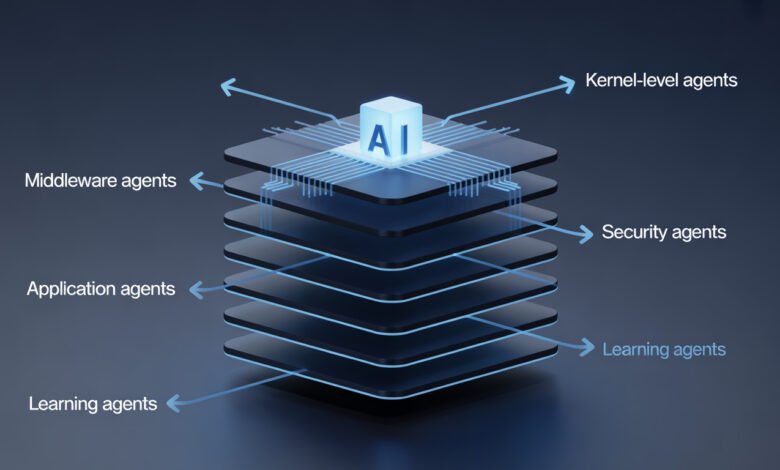
The operating system has not fundamentally changed its relationship with the user in decades. You open an application. The application does one thing. You close it and open another. This model served computing well through the desktop and smartphone eras — but it was built on an assumption that is now being systematically dismantled: that software is passive, waiting to be instructed. The agentic operating system challenges that assumption at the deepest architectural level, embedding autonomous intelligence into the computing platform itself rather than layering it on top as an application.
⚠️ Tech Disclaimer: This guide explores 2026 AI trends for educational purposes. AI capabilities and software performance vary by platform; this is not professional, technical, or financial advice. Always verify with certified experts before deploying or evaluating agentic systems in critical environments.
Understanding what is an agentic operating system — and how it differs structurally from every OS that preceded it — is one of the most important questions in technology architecture in 2026. This educational analysis covers how AI operating systems manage agents across layered architectures, what the AI native computing architecture looks like in practice, and where future operating systems powered by AI are heading. Stanford’s AI Index 2024 documents substantial AI performance improvements in planning, resource management, and adaptive reasoning benchmarks [1] — the capabilities that make agentic operating systems technically viable for the first time.
For the broader context — how this architectural shift connects to the replacement of traditional apps by personal AI agents — explore our full pillar guide: AI Personal Agents Are Replacing Your Apps Faster Than You Think.
What Is an Agentic Operating System?
To answer what an agentic operating system is precisely: it is a computing environment in which autonomous AI agents are embedded at the operating system level — not as applications running on top of the OS, but as integral components of the platform itself. These agents manage hardware resources, schedule processes, coordinate inter-application communication, enforce security policies, and adapt system behaviour based on usage patterns — all without requiring explicit human instruction for each operation.
This represents a categorical departure from the design philosophy of all prior operating systems. Windows, macOS, Linux, and their mobile equivalents are fundamentally application delivery platforms: they provide a stable environment for software to run, mediated by system calls and hardware drivers. An agentic operating system is something different — it is an AI-driven computing platform in which the OS itself actively participates in determining how resources are allocated, which tasks are prioritised, and how the system as a whole responds to user intent.
Five Core Capabilities That Define an Agentic OS
- Autonomous resource management: Agents allocate CPU, memory, and storage dynamically based on real-time system state and predicted workload — not static priority rules.
- Intent-driven task scheduling: Rather than executing fixed queues, the OS interprets user goals and schedules processes to achieve them — adapting in real time to changing conditions.
- Context awareness: The platform perceives user behaviour patterns, application usage history, and environmental context to pre-position resources before they are explicitly requested.
- Continuous security enforcement: Security agents monitor system state permanently, detecting anomalies, enforcing access policies, and responding to threats without waiting for scheduled scans or manual patches.
- Self-optimising learning: The OS accumulates performance history and uses it to continuously improve scheduling, resource allocation, and predictive caching — becoming more efficient over time.
Knowledge Assessment — Agentic Operating Systems:
Q1 : What best defines an agentic operating system compared to a traditional OS?
A ) A traditional OS with AI applications installed on top
B ) An OS where autonomous AI agents manage core system operations, resources, and application coordination
C ) A cloud-based virtual machine hosting environment
D ) A hardware abstraction layer designed for IoT sensors
Q2: Which architectural layer in an agentic operating system controls memory allocation, process scheduling, and I/O optimisation?
A ) Application-level agents
B ) Security monitoring agents
C ) Kernel-level agents
D ) Middleware communication agents
Q3: How do AI operating systems manage agents across distributed workloads?
A ) Through static rule scripts reloaded at each boot cycle
B ) Via message-passing protocols, shared memory spaces, and dynamic load balancing
C ) By requiring manual administrator input for each task assignment
D ) Using only single-threaded sequential processing
✅ Correct Answers:
- Q1 → B: An OS where autonomous AI agents manage core system operations — this is the defining characteristic that separates an agentic operating system from all prior OS architectures.
- Q2 → C: Kernel-level agents — operating at the deepest system layer, they control the fundamental resource management functions: memory, CPU scheduling, and I/O optimisation.
- Q3 → B: Message-passing protocols, shared memory spaces, and dynamic load balancing — these mechanisms enable AI operating systems to coordinate agents across distributed workloads without centralised bottlenecks.
💡 For more information, explore the complete segments of our AI & Personal Technology Series
Why Traditional Operating Systems Are Changing
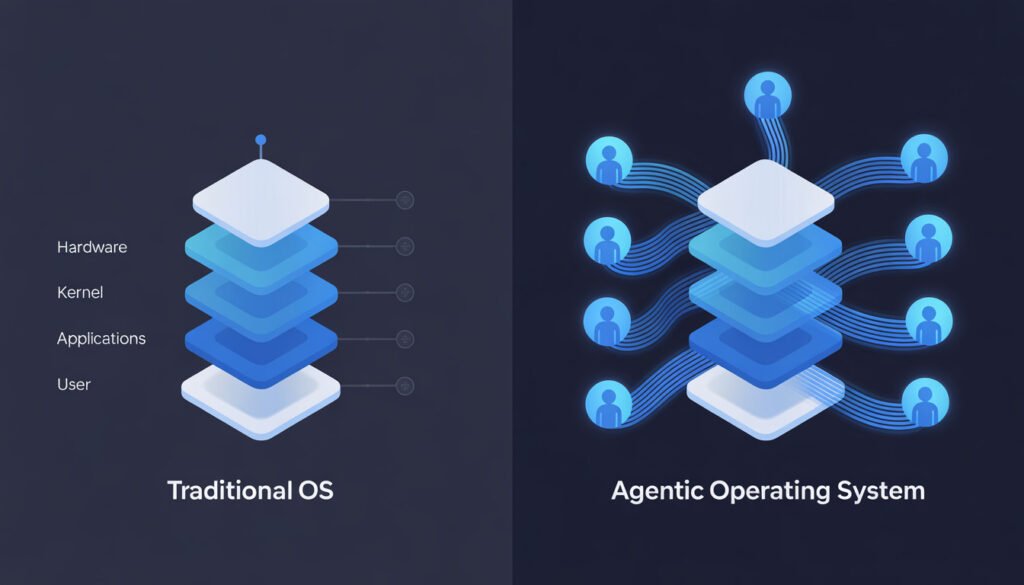
Traditional operating systems were engineered around a set of assumptions that made sense in 1980 and remained largely valid through 2020. Users have discrete tasks. Applications handle those tasks in isolation. The OS provides a stable, neutral substrate. Hardware resources are allocated by fixed rules. Security is enforced at scheduled intervals.
Each of those assumptions is now being challenged simultaneously. Users increasingly express goals rather than task sequences. Applications no longer operate in isolation — they depend on real-time API integrations, cloud services, and cross-platform data flows. The threat landscape has become continuous rather than periodic. And the computational complexity of modern AI workloads — including the very AI native operating system components being discussed here — cannot be optimally managed by static allocation rules designed for single-threaded desktop software.
The Performance Ceiling of Static Scheduling
Modern devices run dozens of concurrent processes, each with different latency requirements, memory footprints, and dependency chains. A smartphone juggling real-time camera processing, background model inference, active network connections, and a conversational AI interface simultaneously cannot be optimally managed by a priority queue written for a 2005 chipset. AI-driven computing platforms replace the fixed scheduler with an agent that continuously evaluates process states, predicted resource needs, and user context to make allocation decisions in real time — reducing latency and improving throughput for complex concurrent workloads [1].
The Inadequacy of Periodic Security Models
Signature-based security — where threats are identified by matching against known attack patterns — operates on a fundamentally reactive timeline. An agent-based operating system embeds security agents that monitor system state continuously, detect behavioural anomalies that pattern-matching misses, and respond in milliseconds rather than after the next scheduled scan. This shift from periodic to continuous security enforcement is one of the clearest near-term value propositions of agentic OS architecture, particularly for enterprise and critical infrastructure deployments. The EU AI Act’s governance framework for high-risk AI systems[6] directly addresses the accountability requirements for autonomous security agents in consequential environments.
How AI Agents Become the Interface Layer
The most visible implication of an agentic operating system is not under the hood — it is at the interface level. In a traditional OS, the interface is the application. You want to book a flight: you open a travel app. You want to analyse data: you open a spreadsheet. The application is the unit of interaction, and the OS is invisible infrastructure beneath it.
In an AI native operating system, the interface layer shifts from applications to agents. The user expresses an intent — “Book the cheapest direct flight to Berlin next Thursday” — and the agentic OS interprets that intent, coordinates the necessary services (calendar, payment, booking APIs, travel preferences), executes the workflow, and delivers the result. The application layer still exists beneath this, but the user interacts with the agent interface, not the applications individually. This is the agent-based software platform model that Microsoft’s Copilot integration previews at the enterprise level [4], and that research labs, including DeepLearning.AI, identify as the emerging trajectory for OS-level AI integration [5].
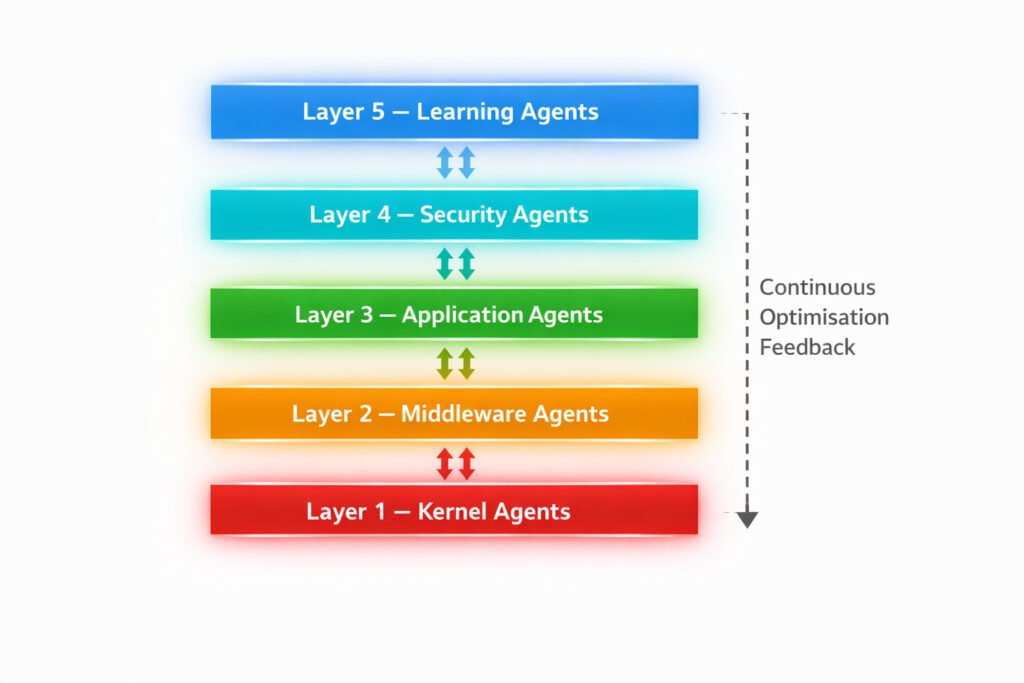
The AI Native Computing Architecture: Five Layers
| Layer | Agent Type | Primary Responsibility |
| 1- Core | Kernel-level agents | Memory allocation, CPU scheduling, I/O management, process lifecycle control |
| 2- Mid | Middleware agents | API routing, data flow coordination, inter-service communication, and distributed resource management |
| 3- App | Application agents | Adaptive UI, predictive feature enablement, context-aware personalisation, workflow automation |
| 4- Sec | Security agents | Real-time threat detection, access policy enforcement, anomaly response, and compliance monitoring |
| 5- Learn | Learning agents | Historical pattern analysis, system optimisation recommendations, adaptive scheduling refinement |
Understanding AI native computing architecture requires seeing these five layers not as separate systems but as a coordinated intelligence stack — each layer informing and being informed by the others. The learning agents at Layer 5 feed insights down to the kernel-level agents at Layer 1, enabling scheduling decisions in 2027 to be informed by resource utilisation patterns from 2026. This accumulating intelligence is what makes an agentic operating system genuinely different from any prior OS — and what creates its compounding efficiency advantage over time.
Examples of Emerging AI-Native Platforms
The agentic operating system is not a purely theoretical concept in 2026. Several commercial and research deployments illustrate the agent-based software platforms that are beginning to define the next generation of computing infrastructure.
Microsoft Windows with Copilot Integration
Microsoft’s embedding of Copilot agents into Windows 11 and the Microsoft 365 ecosystem represents the most commercially scaled example of AI native operating system principles in production. Rather than operating as a standalone application, Copilot agents access system-level context — open windows, file contents, calendar state, email inbox — to coordinate actions across the operating environment. Microsoft documents this integration as a direct step toward agentic computing platforms at the OS layer [4].
Apple Intelligence and On-Device AI Agents
Apple’s Apple Intelligence framework — integrated into iOS 18 and macOS Sequoia — embeds on-device AI agents that can access and act across multiple applications based on user intent, without routing data through cloud services. This AI-driven computing platform approach prioritises privacy through on-device processing while demonstrating how AI native OS capabilities can operate under strict resource constraints. The architecture exemplifies what DeepLearning.AI describes as the emerging on-device agentic model[5].
Enterprise Cloud OS Platforms
In enterprise data centre environments, platforms such as Google Cloud’s Vertex AI agents and AWS Bedrock Agents are extending agentic operating system principles to distributed cloud infrastructure — enabling autonomous resource scaling, cross-service workflow orchestration, and intelligent workload routing without requiring manual DevOps intervention. Gartner identifies autonomous cloud resource management as one of the top strategic technology trends for 2025–2028 [2].
Autonomous Vehicle Operating Systems
The operating systems powering autonomous vehicles are among the most demanding real-world implementations of agentic OS architecture: kernel-level agents managing sensor fusion, middleware agents coordinating navigation and safety systems, application agents handling passenger interface, and security agents monitoring system integrity — all operating in real time under safety-critical latency constraints. These systems demonstrate AI native computing architecture at its most operationally consequential.
Benefits of Agent-Driven Computing
The performance and usability advantages of agentic operating systems over traditional platforms are measurable across several dimensions — not theoretical projections, but outcomes observable in current deployments.
- Adaptive performance optimisation: Kernel-level agents that learn from historical usage patterns deliver measurably lower latency for high-frequency workloads. Stanford’s AI Index documents substantial AI performance improvements in resource scheduling benchmarks between 2022 and 2024 [1]
- Intent-driven user experience: Replacing the application-switching model with an agent interface layer reduces cognitive overhead for complex, multi-step tasks — the structural benefit that AI native OS platforms deliver over their predecessors.
- Continuous security without performance penalty: AI security agents that monitor behavioural anomalies rather than scanning for signatures impose measurably lower computational overhead than traditional signature-based antivirus approaches, while covering a broader threat surface.
- Self-healing fault tolerance: An agentic operating system that detects process failures, reallocates resources, and restores normal operation autonomously reduces unplanned downtime — a direct operational cost benefit for enterprise deployments.
- Compounding efficiency over time: Unlike static OS logic, learning agents accumulate system intelligence with every interaction — meaning an AI native operating system becomes measurably more efficient the longer it is deployed, rather than degrading as traditional OS installations tend to do over time.
Risks and Challenges of Agentic Operating Systems
A credible assessment of agentic operating systems requires direct engagement with the risks and engineering challenges that accompany their advantages.
- Complexity of multi-layer agent coordination: Designing, testing, and maintaining a system in which kernel-level, middleware, application, security, and learning agents interact dynamically — without creating coordination conflicts or cascading failures — is substantially more complex than traditional OS engineering. Emergent behaviours arising from agent interactions require a monitoring infrastructure that does not yet have established industry standards.
- Resource overhead from agent processes: Running persistent AI agents at the kernel and middleware layers consumes computing resources that traditional OS processes do not. On resource-constrained devices — IoT sensors, embedded systems, older hardware — this overhead may negate the efficiency gains the agents provide.
- Legacy application compatibility: Applications built for traditional OS models may not expose the API surface or context data that agentic OS agents need to operate effectively. Migration paths and compatibility layers add architectural complexity and potential performance degradation.
- Security attack-surface expansion: Embedding AI agents at the kernel level creates new attack vectors — particularly prompt injection and adversarial input attacks targeting LLM components. A compromised kernel-level agent has access to the most sensitive system resources. The EU AI Act’s high-risk classification framework[6] applies directly to autonomous agents with kernel-level access.
- Regulatory and accountability gaps: When an agentic operating system makes an autonomous decision that produces a harmful outcome — a security misclassification, a resource allocation error under safety-critical conditions — accountability attribution is legally complex. Full decision audit trails and human override mechanisms are governance requirements for regulated-industry deployments.
Strategic Comparison: Traditional OS vs Agentic Operating System
| Dimension | Traditional Operating System | Agentic Operating System |
| Resource management | Static, manually configured rules | Autonomous, real-time adaptive allocation |
| Task scheduling | Fixed priority queues or round-robin | Context-aware, goal-driven dynamic scheduling |
| Interface model | Application-centric — user opens apps | Agent-centric — intent expressed in natural language |
| Security | Periodic patches, user-managed policies | Continuous AI-driven threat detection and response |
| Adaptability | Minimal — requires manual reconfiguration | Self-optimising based on usage patterns |
| Error handling | Crash reports, manual restart required | Autonomous self-healing and fault recovery |
| Cross-app coordination | None — applications run in isolation | Native agent-to-agent orchestration across services |
| Learning capability | None — static logic | Continuous learning from system history |
💡 For more information, explore the complete segments of our AI & Personal Technology Series
The Future of AI-Native Software Ecosystems
Three capability frontiers will define the evolution of agentic operating systems and future operating systems powered by AI through 2030 — each representing a meaningful extension of what AI-driven computing platforms can achieve.
Edge AI integration will bring agentic OS capabilities off the cloud and onto devices directly — enabling real-time agent coordination without network dependency. Gartner identifies edge-native agentic computing as one of the top strategic infrastructure trends for 2025–2028 [2]. The practical implication: an AI native operating system that manages a smart home, an industrial robot, or a medical device will operate with the same adaptive intelligence as a cloud-scale enterprise platform, without the latency or privacy exposure of cloud processing.
Cross-platform agent collaboration will extend agentic OS capabilities beyond single-device boundaries. Agents running on a smartphone, a laptop, and cloud infrastructure will coordinate as a unified distributed AI agent architecture — sharing context, distributing workloads, and maintaining coherent user intent across every device in the ecosystem. MIT Sloan Management Review identifies cross-platform AI coordination as the next frontier for human-AI collaborative systems [7].
Self-updating and self-governing systems — agentic operating systems that not only optimise their own performance but autonomously update their agent logic based on observed outcomes — represent the full realisation of the agent-based operating system concept. As governance frameworks under the EU AI Act mature [6], the regulatory infrastructure for safely deploying self-updating AI systems in high-stakes environments will develop alongside the technology.
The broader transition toward AI native software ecosystems is inseparable from the shift described in our pillar guide, where personal AI agents are increasingly replacing the application layer that traditional operating systems were designed to deliver. Learn more in our detailed pillar guide: AI Personal Agents Are Replacing Your Apps Faster Than You Think.
Key Takeaways
- What is an agentic operating system? A computing platform that embeds autonomous AI agents at the OS level — managing resources, scheduling, security, and coordination — rather than treating AI as an application layer running on top.
- AI native computing architecture operates across five coordinated layers: kernel, middleware, application, security, and learning agents — each informing the others through a continuous feedback loop.
- How AI operating systems manage agents across distributed workloads: through message-passing protocols, shared memory spaces, dynamic load balancing, and market-based task allocation.
- Commercial examples — Microsoft Copilot OS integration, Apple Intelligence, enterprise cloud agent platforms, and autonomous vehicle OS — demonstrate agent-based software platforms already in production deployment.
- Future operating systems powered by AI through 2027 and beyond will integrate edge intelligence, cross-platform agent collaboration, and self-governing update capabilities. — reaching enterprise maturity between 2027 and 2030.
- Security exposure, resource overhead, legacy compatibility, and regulatory accountability are the primary deployment challenges that must be addressed before agentic operating systems reach mass-market adoption.
FAQ
Q1- What is an agentic operating system?
An agentic operating system is a computing platform in which autonomous AI agents are embedded at the OS layer — not as applications, but as integral system components — managing hardware resources, task scheduling, security enforcement, and user intent coordination without requiring explicit human instruction for each operation.
Q2- How do AI operating systems manage agents across workloads?
Through a combination of message-passing protocols for real-time coordination, shared memory spaces for collective knowledge access, and dynamic load balancing that continuously redistributes tasks based on agent availability and system state, enabling parallel, adaptive execution that static OS schedulers cannot achieve.
Q3- What does an AI-native computing architecture look like?
AI native computing architecture organises agents across five coordinated layers — kernel, middleware, application, security, and learning — with bidirectional feedback between layers enabling continuous self-optimisation. The learning layer accumulates historical performance data and feeds insights down to the kernel layer, creating a compounding efficiency advantage that no traditional OS architecture replicates.
Q4- What are the best examples of agent-based software platforms in 2026?
Microsoft’s Copilot OS integration, Apple Intelligence on iOS/macOS, Google Cloud’s Vertex AI agents, AWS Bedrock Agents, and autonomous vehicle OS platforms. Each demonstrates different aspects of agentic computing — from consumer-facing intent-driven interfaces to enterprise-scale cloud resource orchestration.
Q5- What is the future of operating systems powered by AI?
Three frontiers: edge AI integration enabling on-device agentic capabilities without cloud dependency; cross-platform agent collaboration creating unified intelligence across device ecosystems; and self-updating OS agents that autonomously refine their own logic based on observed outcomes — all governed by maturing regulatory frameworks targeting 2027–2030 deployment maturity.
AI & Personal Technology Series
This article is part of the AI & Personal Technology Series — a practical collection of guides exploring how autonomous AI systems are reshaping productivity, privacy, and the future of human-technology interaction.
References
- [1] Stanford HAI — Artificial Intelligence Index Report 2024
https://aiindex.stanford.edu/report/ - [2] Gartner — Top Strategic Technology Trends 2025: Agentic AI
https://www.gartner.com/en/documents/5850847 - [3] McKinsey Global Institute — The Economic Potential of Generative AI (2024)
https://www.mckinsey.com/capabilities/tech-and-ai/our-insights/the-economic-potential-of-generative-ai-the-next-productivity-frontier - [4] Microsoft. Copilot AI Agents — Overview and Capabilities. Microsoft, 2024. https://www.microsoft.com/en-us/microsoft-copilot/copilot-101/copilot-ai-agents
- [5] DeepLearning.AI — How Agents Can Improve LLM Performance
https://www.deeplearning.ai/the-batch/agentic-design-patterns-part-2-reflection/ - [6] European Commission — EU AI Act — Regulatory Framework for Artificial Intelligence
https://digital-strategy.ec.europa.eu/en/policies/regulatory-framework-ai - MIT Sloan Management Review. The New Era of Human-AI Collaboration. 2024. https://sloanreview.mit.edu/article/the-new-era-of-human-ai-collaboration/