AI Agent Security Risks: What Happens When Autonomous Systems Make Decisions (2026)

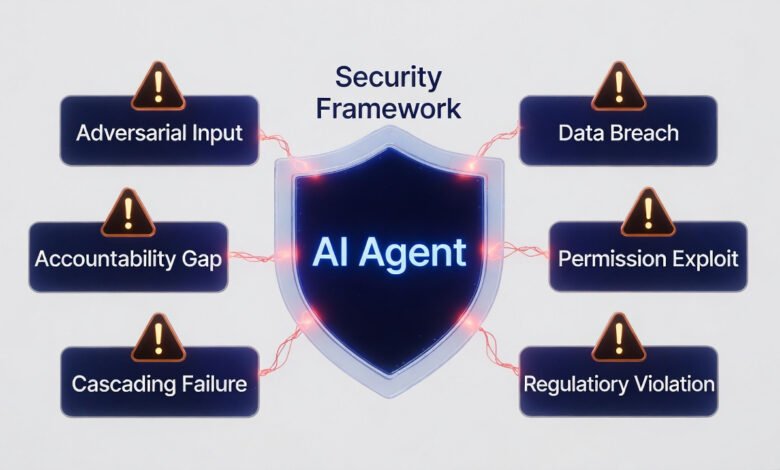
Why Autonomous AI Decision-Making Creates Unique Security Challenges
The same properties that make autonomous AI agents valuable — their ability to interpret goals, take independent action, and execute across multiple systems without constant human supervision — are precisely the properties that create their most serious security challenges. An AI agent that can book flights, process transactions, access databases, and send communications on your behalf is also, if compromised, an extraordinarily capable instrument of harm. Understanding AI agent security is therefore not a peripheral concern — it is a foundational requirement for any responsible deployment of agentic AI in 2026.
⚠️ Tech Disclaimer: This guide explores 2026 AI trends for educational purposes. AI capabilities and software performance vary by platform; this is not professional, technical, or financial advice. Always verify with certified experts for a critical system
This educational analysis examines the security risks of autonomous AI agents systematically — covering why the agentic model introduces threats that traditional software security was not designed to address, the specific vulnerability categories that matter most, how to secure AI agent systems through layered defence frameworks, and the governance and regulatory landscape that organisations must navigate. Stanford’s AI Index 2024 documents the rapid growth in agentic AI deployments [1], making the AI security challenges this article addresses increasingly urgent for technology and risk leaders alike.
For the broader context — the shift toward personal AI agents replacing traditional applications — explore our full pillar guide: AI Personal Agents Are Replacing Your Apps Faster Than You Think.
Why Security Matters in Agentic AI
Traditional software security operates on a relatively contained threat model. An application does one thing, in one context, with defined inputs and outputs. A vulnerability in a spreadsheet application may expose data within that application — but the blast radius is bounded by what the application can access.
AI agent security operates under a fundamentally different threat model. A capable autonomous agent may have access to email systems, financial platforms, databases, communication tools, and operational APIs simultaneously — acting across all of them in response to a single natural-language instruction. The blast radius of a compromised, manipulated, or malfunctioning agent is proportional to its permissions. And because agents act autonomously — without human review at each step — errors and attacks can propagate across multiple systems before any human becomes aware that something has gone wrong.
The Permission-Capability Mismatch Problem
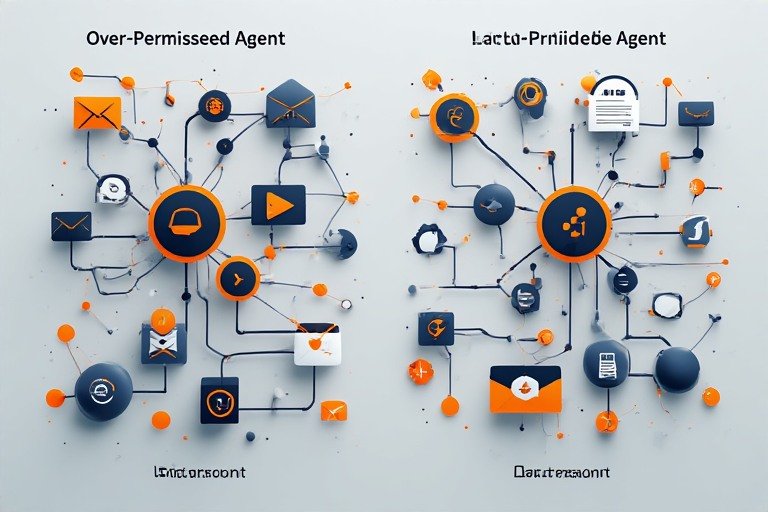
The most persistent structural AI security challenge in agentic deployments is what security practitioners call the permission-capability mismatch: the agent’s capability — what it can reason about and plan — tends to expand rapidly with model improvements, while its permission scope — what systems it is actually authorised to access — is often granted once during setup and rarely revisited. This creates a systematic tendency toward over-permissioned agents whose potential impact on breach is far larger than their actual task requirements justify.
The NIST AI Risk Management Framework [6] explicitly identifies permission scoping as a primary risk control for autonomous AI systems, and the EU AI Act [2] requires demonstrable governance over what high-risk AI systems can access and what actions they are authorised to take. The combination of these frameworks provides the clearest current reference for organisations designing AI agent safety architectures.
💡 For more information, explore the complete segments of AI & Personal Technology series articles here
🧠 Knowledge Assessment — AI Agent Security
Q1: Which attack type manipulates the inputs fed to an AI agent to alter its decisions?
A) Denial-of-service flooding
B) Prompt injection and adversarial input attacks
C) Physical hardware tampering
D) DNS cache poisoning
Q2: What is the primary purpose of implementing least-privilege access controls in AI agent deployments?
A) To improve agent processing speed
B) To ensure agents can access all systems without restriction
C) To limit the blast radius of a compromised or malfunctioning agent
D) To reduce the cost of cloud computing resources
Q3: Under the EU AI Act, how are autonomous AI agents deployed in high-stakes domains typically classified?
A) Minimal risk — no oversight required
B) Limited risk — transparency obligations only
C) High risk — requiring conformity assessments and human oversight mechanisms
D) Prohibited — banned entirely across all use cases
✅ Correct Answers:
- Q1 → B: Prompt injection and adversarial input attacks — these manipulate the data or instructions fed to an AI agent to alter its reasoning and decisions, often without triggering traditional security controls.
- Q2 → C: Least-privilege access limits the blast radius — a compromised agent with narrow permissions can cause far less damage than one with broad system access, making permission scoping a primary security control.
- Q3 → C: High risk — the EU AI Act requires conformity assessments, human oversight mechanisms, and full audit trail documentation for autonomous AI agents deployed in consequential domains, including healthcare, finance, and critical infrastructure.
Types of Risks in Autonomous Systems
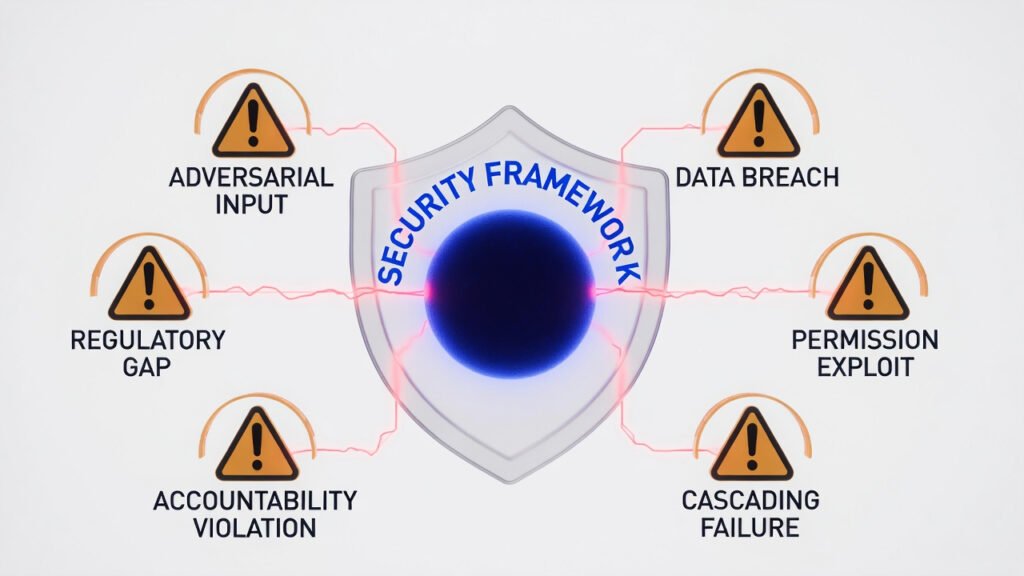
The AI agent vulnerabilities landscape is not monolithic. Different risk types require different mitigation approaches, and conflating them leads to security frameworks that address some threats while leaving others undefended. The following taxonomy covers the primary categories of autonomous AI risks that organisations must account for in 2026.
Adversarial Input and Prompt Injection
The most technically distinctive AI agent security threat category involves manipulating the inputs that reach the agent’s reasoning core. Prompt injection attacks embed malicious instructions within data that the agent processes — a document, an email, a webpage — causing the agent to execute actions its operators did not intend. Because LLM-based agents interpret natural language rather than executing compiled code, traditional input sanitisation approaches do not fully address this threat vector. Gartner identifies prompt injection as a top emerging security risk for agentic AI deployments [3].
Privilege Escalation and Access Exploitation
An agent that has been granted broad access permissions — or that can request elevated permissions through normal workflow paths — presents a severe escalation risk if compromised. Unlike a human employee whose privilege escalation attempts are logged and reviewed, an agent operating autonomously can exploit access paths silently, at machine speed, before any human review mechanism activates. Implementing AI agent safety controls for privilege escalation requires treating each agent interaction with sensitive systems as a potential escalation event, with explicit authorisation required for each permission boundary crossed.
Data Exfiltration and Privacy Exposure
Agents with access to multiple data sources can be exploited to aggregate and exfiltrate sensitive information in ways that no single-system breach would enable. A compromised autonomous AI agent with access to HR records, financial data, and communication systems simultaneously presents a data breach surface that dwarfs conventional application vulnerabilities. GDPR compliance requirements apply directly to any personal data processed by AI agents [2], and organisations must ensure that agent data access is both minimised and audited.
Cascading Failure Propagation
Because autonomous AI agents execute multi-step workflows that span multiple connected systems, a single error in early pipeline stages can propagate through subsequent steps before any checkpoint catches it. In financial trading, this risk is well-documented — automated systems have caused significant market disruptions by propagating erroneous signals faster than human oversight could intervene [4]. The same propagation dynamic applies to any agentic deployment where the agent’s output in step two depends on its output in step one.
Data Privacy Concerns in Agentic AI
The trust issues with AI agents that privacy-conscious users and regulators raise most frequently centre on data handling — specifically, the question of what data an agent accesses, retains, processes, and potentially shares as a byproduct of doing its work.
An agent that manages email, calendars, financial accounts, and personal communications necessarily processes deeply sensitive personal information. The key privacy questions are: Is all of that data necessary for the tasks performed? How long is it retained in the agent’s memory layer? Who else can access the agent’s accumulated context? And what happens to that data if the agent platform is breached or changes ownership?
Persistent Memory as a Privacy Risk
Persistent memory layers — which give AI agents the ability to remember user preferences and prior context across sessions — are simultaneously one of the most valuable capabilities of agentic systems and one of their most significant privacy risks. Memory that includes sensitive communications, financial decisions, health-related queries, or personal relationship details constitutes a high-value target for adversaries and a significant liability under data protection regulations. Organisations deploying agents with persistent memory must implement clear data retention limits, user-controlled memory deletion, and rigorous access controls on memory stores.
Cross-System Data Aggregation
A single agent with access to five different services creates the technical capability to aggregate data across those services in ways that no individual service would permit — potentially reconstructing sensitive profiles from apparently innocuous partial data sets. This aggregation risk is one the NIST AI RMF [6] specifically flags as requiring explicit risk assessment in agentic system design. The principle of data minimisation — ensuring agents access only what their current task genuinely requires — is the most practical mitigation.
AI Decision-Making Failures and Their Consequences
Beyond external attack vectors, AI agent security risks also arise from internal decision-making failures — cases where the agent behaves incorrectly not because it has been compromised but because its reasoning, training data, or operational context contains errors that produce harmful outputs.
Reasoning Errors in Novel Contexts
Current LLM-based agents perform well within structured, familiar contexts but remain less reliable when confronted with genuinely novel situations, ambiguous instructions, or edge cases outside their training distribution. An agent that misinterprets an ambiguous instruction and executes a consequential action — sends an unintended communication, processes an incorrect transaction, escalates a case to the wrong team — may cause significant operational harm without any external adversary being involved. AI agent vulnerabilities explained in this category require mitigation through instruction clarity, conservative default behaviours, and human review gates for high-consequence actions.
Algorithmic Drift in Self-Learning Systems
Agents that continuously learn from their operational history can develop behavioural drift — gradual changes in decision-making patterns that emerge from accumulated feedback and are not individually visible in any single interaction. Drift can cause an agent’s behaviour to diverge from its intended parameters over time, in ways that periodic audits may miss. Continuous monitoring for distributional shift in agent outputs is a requirement for any autonomous AI risk management framework applied to adaptive systems [6].
Security Frameworks for AI Agents
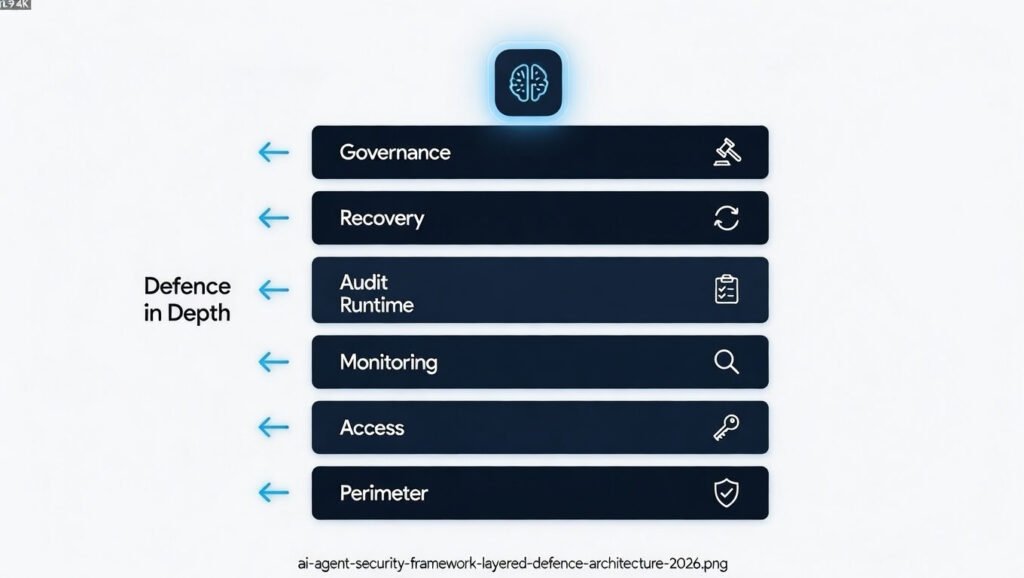
Understanding how to secure AI agent systems requires moving beyond point-in-time controls toward a layered, defence-in-depth architecture that addresses threats at every stage of the agent’s operational lifecycle. The framework below synthesises guidance from the NIST AI RMF [6] and EU AI Act [2] into seven actionable security layers.
| Security Layer | Control Mechanism | Purpose |
| Perimeter | Input validation & sanitisation | Prevent adversarial inputs from reaching the agent’s reasoning core |
| Access | Least-privilege permissions | Limit the blast radius of compromised or malfunctioning agents |
| Runtime | Behaviour constraint rules | Define operational boundaries; halt execution on violation |
| Monitoring | Real-time anomaly detection | Continuous surveillance for behavioural drift and threats |
| Audit | Immutable decision logs | Full traceability for regulatory compliance and incident review |
| Recovery | Rollback and fail-safe | Restore known-good state on detection of critical failure |
| Governance | Human review checkpoints | Ensure human accountability for consequential decisions |
Each layer addresses a distinct failure mode. The perimeter layer stops adversarial inputs before they reach agent reasoning. The access layer limits blast radius. The runtime layer enforces behavioural boundaries. The monitoring layer detects anomalies in real time. The audit layer ensures traceability for regulatory and incident purposes. The recovery layer enables rapid restoration. The governance layer maintains human accountability for consequential decisions. No single layer is sufficient — AI agent safety requires all seven operating together.
💡 For more information, explore the complete segments of our AI & Personal Technology Series
Governance and Regulation of Autonomous AI
The governance of autonomous AI is no longer solely a voluntary ethics commitment — it is increasingly a legal obligation. Three regulatory frameworks are most directly relevant to AI agent security in 2026.
The EU AI Act
The EU AI Act [2] establishes a risk-tiered framework that classifies autonomous AI systems deployed in high-stakes domains — healthcare, financial services, critical infrastructure, law enforcement — as high-risk, requiring conformity assessments, human oversight mechanisms, full documentation, and post-market monitoring. Organisations deploying AI agents in these domains must demonstrate that their systems meet these requirements before deployment. The Act’s extraterritorial reach means it applies to any AI system affecting EU users, regardless of where the deploying organisation is based.
The NIST AI Risk Management Framework
The NIST AI RMF [#ref-66] provides the most operationally detailed guidance for how to secure AI agent systems at the organisational level. Its four core functions — Govern, Map, Measure, Manage — translate directly into the security and governance controls required for responsible agentic AI deployment. Unlike the EU AI Act, the NIST framework is voluntary in the United States but has been adopted as a baseline by federal agencies and a growing number of regulated-industry organisations.
GDPR and Data Protection Obligations
AI agents that process personal data are subject to GDPR’s full requirements — including lawful basis for processing, data minimisation, right to erasure, and breach notification obligations. The trust issues with AI agents that regulators highlight most frequently involve the difficulty of demonstrating GDPR compliance for systems that aggregate data across multiple services and retain context in memory layers. Privacy-by-design principles — embedding data minimisation and access controls at the architecture stage rather than retrofitting them — are the most practical compliance path [2].
Strategic Comparison: Unsecured vs Secured AI Agent Deployments
| Security Dimension | Unsecured AI Agent Deployment | Secured AI Agent Deployment |
| Decision control | Unmonitored — no oversight | Monitored with human review checkpoints |
| Access permissions | Broad — accesses all connected systems | Least-privilege — scoped to task requirements |
| Vulnerability surface | High — no input validation | Reduced via input validation and sandboxing |
| Failure propagation | Cascading — errors spread unchecked | Contained — rollback mechanisms activated |
| Audit trail | None — actions unattributable | Full — every decision logged and traceable |
| Regulatory compliance | Low — no framework alignment | High — mapped to GDPR, EU AI Act, sector rules |
| Threat detection | Reactive — post-incident | Continuous — real-time anomaly monitoring |
| Self-learning control | Unchecked adaptive algorithms | Monitored — drift detection and constraints |
Future Safety Strategies for Autonomous AI
The AI security challenges of 2026 will not be the same as those of 2028 — both because agent capabilities will expand and because the security and governance ecosystem will mature alongside them. Three emerging safety strategies are shaping the trajectory of autonomous AI risk management through the end of the decade.
Explainable AI (XAI) for security transparency — techniques that make agent decision-making interpretable to human reviewers — are becoming a core requirement for regulated-industry deployments. An agent whose reasoning can be inspected, questioned, and overridden is fundamentally safer than one that produces outputs from an opaque process. Stanford’s AI Index documents growing research output in XAI in direct response to AI agent safety requirements [1].
Adaptive cybersecurity agents — AI systems specifically designed to monitor other AI agents for anomalous behaviour — represent the application of agentic principles to the security problem itself. Rather than relying on static rule sets or periodic human audits, adaptive AI security systems can detect behavioural drift, prompt injection attempts, and privilege escalation in real time, at the speed and scale that autonomous systems require. Microsoft’s Copilot security integration previews this approach at commercial scale [7].
Standardised compliance protocols for agentic AI are being developed by regulatory bodies globally — with the EU AI Act [2] and NIST AI RMF [6] providing the most developed current frameworks. By 2027–2028, organisations in regulated industries will face explicit governance of autonomous AI requirements with audit and certification obligations — making early adoption of structured security frameworks not just a risk management best practice but a competitive and regulatory necessity.
The broader transition toward AI agents replacing traditional applications — and the security implications that follow — is examined in detail in our pillar guide. Learn more in our detailed pillar guide: AI Personal Agents Are Replacing Your Apps Faster Than You Think.
Key Takeaways
- AI agent security requires a fundamentally different threat model from traditional software security — the blast radius of a compromised agent scales with its permissions, not just its functionality.
- The primary security risks of autonomous AI agents span six categories: adversarial input, privilege escalation, data exfiltration, cascading failure, reasoning errors, and algorithmic drift.
- How to secure AI agent systems: through a seven-layer defence-in-depth framework — perimeter, access, runtime, monitoring, audit, recovery, and governance — operating simultaneously.
- Trust issues with AI agents in the data privacy centre on persistent memory aggregation, cross-system data access, and the difficulty of demonstrating GDPR compliance for context-retaining systems.
- Governance of autonomous AI is increasingly a legal obligation under the EU AI Act, NIST AI RMF, and GDPR — with high-risk classifications requiring conformity assessments and human oversight mechanisms.
- Future safety strategies — explainable AI, adaptive security agents, and standardised compliance protocols — will define the autonomous AI risk management landscape through 2030.
FAQ
Q-1 What are the main security risks of autonomous AI agents?
The primary AI agent security risks are: adversarial input and prompt injection attacks, privilege escalation through over-permissioned access, data exfiltration via cross-system aggregation, cascading failure propagation across connected systems, reasoning errors in novel contexts, and algorithmic drift in self-learning agents.
Q-2 How do you secure AI agent systems?
Through a layered defence-in-depth approach: input validation at the perimeter, least-privilege access scoping, runtime behaviour constraints, real-time anomaly monitoring, immutable audit logging, rollback and fail-safe mechanisms, and human review checkpoints for consequential decisions. No single control is sufficient — AI agent safety requires all layers operating together.
Q-3 What are AI agent vulnerabilities explained in simple terms?
An AI agent can be manipulated by feeding it malicious instructions hidden in data it processes (prompt injection). It can expose data by having access to more systems than necessary for its task (over-permissioning). It can propagate errors rapidly across connected systems because it acts without human review at each step. And it can drift from its intended behaviour over time as it learns from operational feedback.
Q-4 What governance frameworks apply to autonomous AI?
The EU AI Act (mandatory for high-risk EU deployments), the NIST AI Risk Management Framework (widely adopted in the US and internationally), and GDPR (for all AI systems processing EU personal data) are the three most directly applicable. All three converge on the same core requirements: transparency, human oversight, auditability, and demonstrable risk controls.
Q-5 Can AI agents be trusted with sensitive data?
With appropriate security controls — data minimisation, least-privilege access, encrypted memory layers, access auditing, and clear retention limits — autonomous AI agents can handle sensitive data responsibly. The trust issues with AI agents are real but addressable through architecture, not avoidable by design. MIT Sloan Management Review identifies structured human oversight as the defining factor in trustworthy AI deployment [5].
AI & Personal Technology Series
This article is part of the AI & Personal Technology Series — a practical collection of guides exploring how autonomous AI systems are reshaping productivity, privacy, and the future of human-technology interaction.
References
- [1] Stanford HAI — Artificial Intelligence Index Report 2024
- [2] European Commission — EU AI Act — Regulatory Framework for Artificial Intelligence
- [3] Gartner — Top Strategic Technology Trends 2025: Agentic AI
- [4] McKinsey Global Institute — The Economic Potential of Generative AI (2024)
- [5] Collaborative Intelligence: Humans and AI Are Joining Forces
- [6] NIST — AI Risk Management Framework (AI RMF 1.0)
- [7] Microsoft Research — Research at Microsoft — Copilot and Agentic Systems