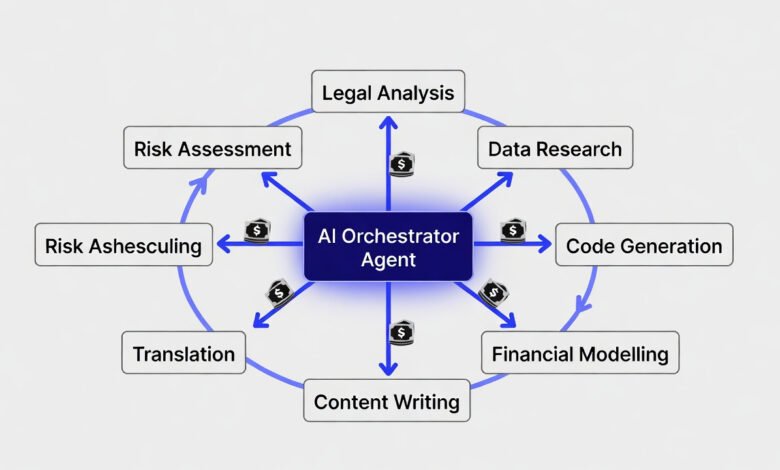
AI Agent Marketplaces: The Emerging Economy of Autonomous Services
In the app economy, a human opens an application to complete a task. In the agent economy, an AI agent opens an AI agent marketplace to hire another AI agent to complete a subtask — and that second agent may hire a third. No human makes each transaction decision. No human selects each service. The orchestrating agent evaluates available providers, negotiates terms, executes the transaction, and integrates the result into a larger workflow — autonomously, at machine speed.
⚠️ Tech Disclaimer: This guide explores 2026 AI trends for educational purposes. AI capabilities and software performance vary by platform; this is not professional, technical, or financial advice. Always verify with certified experts for a critical system
Understanding how AI agent marketplaces work — and what the broader agent economy explained means for technology, business, and economic structure — is one of the defining questions in applied AI in 2026. This educational analysis covers the architecture and mechanics of AI service automation platforms, examines the business models that are emerging around autonomous AI services, addresses the trust and governance challenges these markets must solve, and projects where the future marketplaces for AI agents are headed. Stanford’s AI Index 2024 documents the rapid growth in agentic AI deployments that is creating the demand for AI agent marketplace infrastructure [1].
For the broader context — how the rise of AI agents is challenging the entire application ecosystem — explore our full pillar guide: AI Personal Agents Are Replacing Your Apps Faster Than You Think.
What an AI Agent Marketplace Is
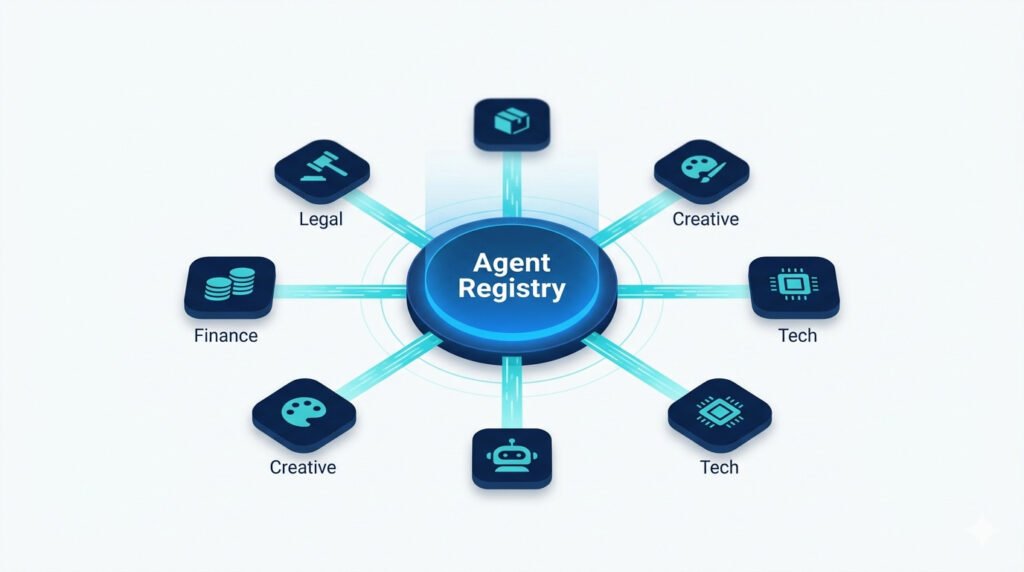
An AI agent marketplace is a platform through which AI agents can be discovered, accessed, and engaged to perform specialised tasks — either by human users or by other AI agents acting as orchestrators. It is, in functional terms, the infrastructure layer that enables the agent economy to operate: providing the discovery, trust, pricing, and transaction mechanisms that allow autonomous service consumption to occur at scale.
The concept draws structural analogies from existing digital marketplaces — app stores, freelance platforms, API marketplaces — but differs from all of them in a critical dimension: its primary transacting parties are not humans selecting services, but agents hiring agents. A human user may set a top-level goal; the orchestrating agent makes all the downstream service procurement decisions autonomously, without requiring human input for each step.
Four Core Functions of an AI Agent Marketplace
- Discovery: Enabling agents and users to find specialised agents that match specific capability requirements. Discovery in AI agent marketplaces relies on structured capability registries — standardised descriptions of what an agent can do, under what constraints, at what performance level — rather than human-readable marketing descriptions.
- Trust verification: Providing mechanisms for verifying that a listed agent is what it claims to be — that its capabilities match its declarations, that it has operated reliably in prior engagements, and that it can be held accountable if it fails. This is the most technically and institutionally challenging function of any AI service marketplace
- Transaction execution: Handling the payment, rights, and data-sharing arrangements between agent consumer and agent provider — at the speed and volume that machine-to-machine transactions require, which far exceeds what human-mediated payment systems were designed for.
- Performance tracking: Accumulating outcome data from completed engagements to build reputation signals, identify underperforming agents, and continuously refine the marketplace’s matching quality.
🧠 Knowledge Assessment — AI Agent Marketplaces
Q1 : What is the core function of an AI agent marketplace?
A)- A database for storing AI model weights
B)- A platform where AI agents can be discovered, hired, and paid for specialised tasks
C)- A cloud computing service for training neural networks
D)- A government registry for certifying AI applications
Q2 : What distinguishes the agent economy from traditional app economies?
A)- It relies exclusively on human workers completing tasks
B)- Agents autonomously hire, coordinate, and pay other agents without human instruction for each step
C)- It operates only within a single company’s internal network
D)- It requires manual API integration for every transaction
Q3 : Which trust mechanism is most critical for AI agent marketplace transactions?
A)- Agent user interfaces designed for human visual inspection
B)- Cryptographic verification, standardised capability attestation, and immutable audit trails
C)- Manual review of every transaction by a human administrator
D)- Geographic restriction to agents operating in the same country
✅ Correct Answers:
- Q1 → B: A platform where AI agents can be discovered, hired, and paid for specialised tasks — enabling orchestrating agents to compose complex workflows from specialised sub-agents without building each capability themselves.
- Q2 → B: Agents autonomously hire, coordinate, and pay other agents — the defining characteristic of the agent economy is machine-to-machine service transactions that occur without human instruction at each step.
- Q3 → B: Cryptographic verification, standardised capability attestation, and immutable audit trails — these three mechanisms together address the identity, capability, and accountability trust requirements that agent-to-agent transactions demand.
Why the Agent Economy Is Emerging
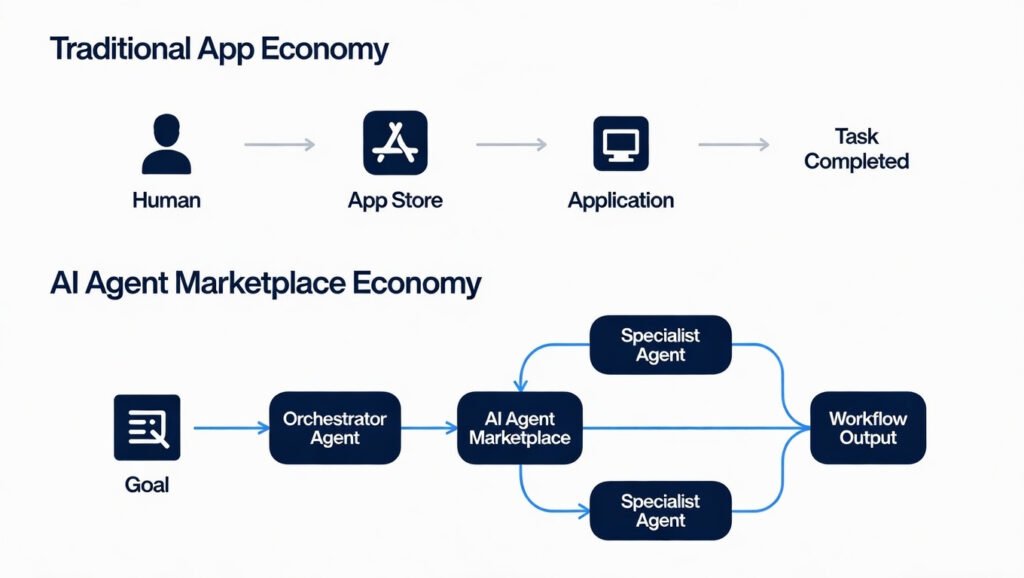
The agent economy is not emerging because of a single technological breakthrough — it is the product of several capability thresholds being crossed simultaneously, creating the conditions for machine-to-machine service markets that were not previously feasible.
The Specialisation Imperative
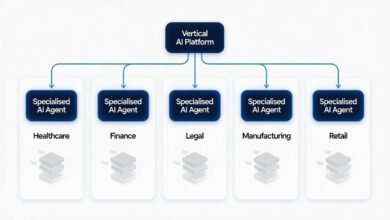
As agentic AI systems are deployed across more consequential domains — legal analysis, financial modelling, medical data interpretation, engineering design — the performance gap between generalist agents and domain-specialist agents becomes commercially significant. An orchestrating agent that needs both legal analysis and financial modelling performed simultaneously faces a choice: build or fine-tune specialised models in-house, or access specialist agents through an AI agent marketplace. The marketplace model dramatically reduces the time and capital required to access specialist capability — a structural driver of the agent economy, explained in economic terms [3].
The Composability Value Proposition
The value of AI service automation platforms grows super-linearly with the number of agents available. Each additional specialist agent added to a marketplace increases the number of possible workflow compositions that orchestrating agents can assemble. This composability dynamic — familiar from API economy dynamics but amplified by autonomous orchestration — is the economic foundation of the agent economy. McKinsey’s analysis of generative AI economic potential identifies composable AI service architectures as one of the highest-value configuration models for enterprise deployment [3].
Infrastructure Readiness
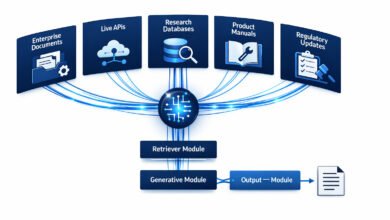
The AI agent marketplace concept requires several infrastructure components that have only recently reached production maturity: reliable LLM agents capable of multi-step autonomous execution [4]; standardised agent communication protocols enabling interoperability across providers; identity and capability verification systems; and high-speed micropayment infrastructure capable of processing machine-speed transactions. Gartner identifies the convergence of these infrastructure components as a top strategic technology trend for 2025–2028 [2].
💡 For more information, explore the complete segments of our AI & Personal Technology Series
How Agents Buy and Sell Services: The AI Agents Hiring Other AI Agents Model
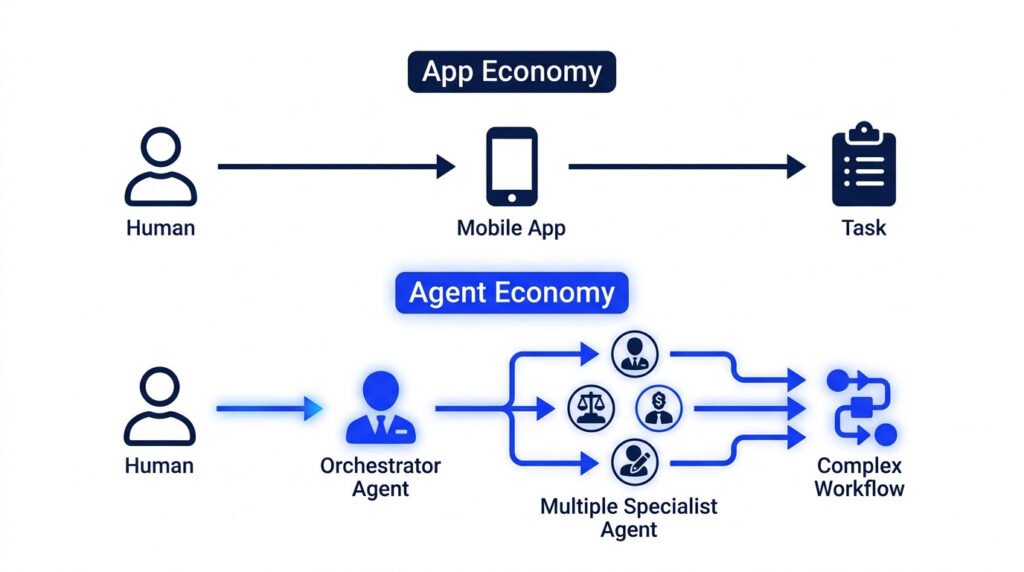
The most conceptually distinctive aspect of the agent economy is the phenomenon of AI agents hiring other AI agents — autonomous machine-to-machine service transactions that occur without human involvement at each step. Understanding this mechanism requires examining the transaction lifecycle from goal specification to outcome delivery.
The Transaction Lifecycle
- Goal decomposition: The orchestrating agent receives a high-level objective from a human user or parent system and decomposes it into subtasks that map to available specialist capabilities in the marketplace.
- Capability matching: The orchestrator queries the marketplace’s capability registry to identify agents whose declared capabilities match each subtask requirement — filtering by domain, performance history, price range, and availability.
- Negotiation and selection: The orchestrator evaluates matched agents — comparing reputation scores, pricing, SLA terms, and compatibility with the current workflow context — and selects the optimal provider for each subtask.
- Task dispatch and monitoring: The orchestrator dispatches the subtask to the selected specialist agent, monitors execution, and handles exceptions if the specialist fails or returns unsatisfactory outputs.
- Payment settlement: Upon verified task completion, payment is automatically settled — either through a platform-managed escrow system, a direct API billing arrangement, or a tokenised smart contract. This is how AI agent marketplaces work at the transaction layer.
- Outcome integration: The orchestrator integrates the specialist’s output into the larger workflow, potentially triggering further marketplace transactions downstream.
Multi-Level Agent Hierarchies
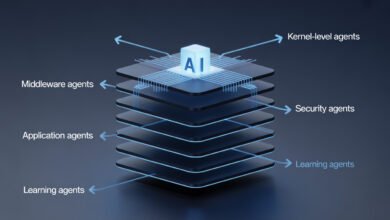
Advanced AI agent marketplace architectures support multi-level agent hierarchies — where a specialist agent hired by an orchestrator may itself sub-hire further specialist agents from the same or different marketplaces to complete components of its assigned task. This recursive composition pattern is AI agents hiring other AI agents at its most powerful — enabling arbitrarily deep workflow hierarchies assembled entirely at runtime, without pre-planned integration by human developers. DeepLearning.AI identifies this hierarchical agentic pattern as a primary mechanism for extending LLM capability beyond single-agent limitations [4].
Platforms Enabling AI Agent Markets
Several commercial and open-source platforms are developing the infrastructure components that AI service automation platforms require in 2026. Each takes a distinct approach to the discovery, trust, and transaction challenges that AI agent marketplaces must solve.
Microsoft Azure AI Marketplace
Microsoft’s Azure AI marketplace represents the most commercially mature AI service marketplace infrastructure currently available. Through Azure AI Studio and the broader Microsoft Copilot ecosystem [5], organisations can access pre-built agent capabilities, connect them to enterprise data sources, and compose multi-agent workflows. The platform’s enterprise trust infrastructure — identity management, audit logging, compliance controls — provides the accountability layer that enterprise autonomous AI services require under the EU AI Act [6].
Anthropic and OpenAI API Ecosystems
The API ecosystems around major foundation model providers function as early AI agent marketplaces — providing access to specialised model capabilities (vision, code generation, structured reasoning, tool use) that orchestrating agents can hire programmatically. As these ecosystems add standardised agent capability declarations, reputation systems, and outcome-based billing, they are evolving toward the full agent economy model. Stanford’s AI Index documents the rapid growth in API-mediated AI service consumption that is driving this evolution [1].
Emerging Decentralised Agent Protocols
Beyond centralised platform models, several research and commercial projects are developing decentralised AI agent marketplace protocols — where agent capability registries, reputation scores, and payment settlement operate on distributed infrastructure without a single platform operator controlling access. These approaches address vendor lock-in and single-point-of-failure risks but introduce governance and accountability challenges that centralised platforms partially resolve through their operational oversight.
Business Models of Autonomous Services
The agent economy explained from a business model perspective requires understanding how value is priced, captured, and distributed in systems where the primary transacting parties are machines operating at speed and scale that traditional billing systems were not designed for.
| Business Model | How It Works | Best Suited For |
| Per-task billing | Agent charges a fixed fee per completed task unit | Well-defined, repeatable tasks with clear outputs |
| Outcome-based | Payment is triggered only on successful outcome delivery | High-stakes tasks where performance verification is feasible |
| Usage-based metering | Agent charges per API call, token, or compute unit | Variable-volume workloads with unpredictable task frequency |
| Subscription tier | Flat monthly fee for defined capacity or task volume | Enterprise deployments with predictable workload patterns |
| Revenue share | Marketplace takes a percentage of each transaction | Marketplace operators enabling third-party agent listings |
| Staking and reputation | Agents stake tokens as quality guarantees | Trust-sensitive marketplaces requiring accountability signals |
The most significant business model innovation in AI agent marketplaces is outcome-based pricing — where payment is contingent on verified successful task completion rather than on service access or compute consumption. This model aligns agent provider incentives with orchestrator objectives in a way that subscription and per-call models do not. McKinsey identifies outcome-based AI service pricing as the model most likely to achieve broad enterprise adoption, as it reduces deployment risk for buyers [3]. The challenge is developing reliable, tamper-resistant outcome verification mechanisms — a technically non-trivial problem that future marketplaces for AI agents must solve.
Risks and Trust Issues in AI Agent Marketplaces
The trust challenges of AI agent marketplaces are structurally more complex than those of human-facing digital marketplaces — because the parties establishing and relying on trust signals are themselves autonomous systems operating without human judgment at each decision point.
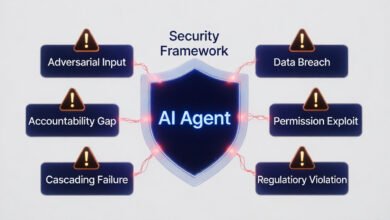
- Identity and capability spoofing: An agent claiming specialised capabilities it does not actually possess — or impersonating a reputable agent under a similar identifier — is the fundamental fraud risk in AI service marketplaces. Without cryptographic identity verification and independent capability attestation, orchestrating agents cannot reliably distinguish legitimate specialist agents from fraudulent ones. This mirrors the supply chain attack risks in software ecosystems but operates at the speed and scale of autonomous transactions.
- Accountability gaps in chained transactions: When an orchestrating agent hires a specialist, who sub-hires a sub-specialist, and a downstream failure occurs, attributing accountability across the chain is legally and technically complex. Full immutable audit trails of every transaction in every tier are a governance requirement — but implementing them without creating prohibitive latency or storage overhead is an active engineering challenge. The EU AI Act’s accountability requirements [6] apply to each tier of a multi-agent marketplace transaction.
- Prompt injection through agent services: A malicious or compromised agent in a marketplace can return outputs designed to manipulate the orchestrating agent’s subsequent decisions — embedding adversarial instructions in what appears to be normal task output. This supply chain attack vector is specific to autonomous agent systems and has no direct equivalent in traditional API security models.
- Market concentration and lock-in risks: If one platform controls a dominant share of agent listings, it gains significant leverage over pricing, access, and the capability composition options available to orchestrating agents. The history of app store economics — where platform operators extracted significant rents from developers — suggests that AI agent marketplace governance will be a significant policy concern as these markets mature [6].
- Regulatory compliance across jurisdictions: An AI agent marketplace transaction may involve an orchestrating agent, a specialist agent, and a sub-specialist agent operating under different regulatory jurisdictions — creating compliance complexity that no single agent operator can fully resolve unilaterally. Standardised compliance attestation frameworks, aligned with the EU AI Act and emerging national AI governance standards, are a prerequisite for the agent economy operating reliably across borders.
Strategic Comparison: App Economy vs AI Agent Marketplace Economy
| Dimension | Traditional App Economy | AI Agent Marketplace Economy |
| Service unit | Application (fixed function) | Autonomous agent (goal-driven capability) |
| Transaction parties | Human selects, human pays | Agent discovers, agent hires, agent pays |
| Composition model | APIs are integrated manually by developers | Agents compose services dynamically at runtime |
| Pricing model | Fixed subscription or per-seat licensing | Dynamic per-task, per-outcome, or usage-based |
| Service discovery | Manual app store browsing or search | Automated capability matching by the orchestrator |
| Workflow scope | One app, one task domain | Multi-agent, cross-domain workflow orchestration |
| Update mechanism | Version releases by the developer | Agents improve continuously via feedback loops |
| Failure handling | Error messages returned to humans | Orchestrator retries with alternative agents |
💡 For more information, explore the complete segments of our AI & Personal Technology Series
The Future of the AI Agent Economy: 2026–2030
The future marketplaces for AI agents will be defined by three capabilities and governance frontiers that are currently in early development — each representing a qualitative step forward in what autonomous AI services can provide and how reliably they can be trusted.
Standardised agent communication protocols — analogous to HTTP for the web or SMTP for email — are a foundational infrastructure requirement for interoperable AI agent marketplaces that enable orchestrators to transact with specialists across platform boundaries. Several protocol proposals are in active development in 2026, with convergence on a dominant standard likely to occur between 2027 and 2029. Once a standard emerges, it will enable the same composability dynamics that HTTP enabled for the web — allowing agent economy participants to compose services across any compliant provider without platform-specific integration.
Reputation and performance infrastructure — persistent, portable, tamper-resistant records of agent performance across engagements — will determine which agents gain marketplace traction and which do not. Unlike human freelance platforms, where reputation is social and subjective, AI agent marketplace reputation systems can be built on objective outcome metrics: task completion rates, output quality scores, SLA adherence, and error rates across thousands of transactions. MIT Sloan Management Review identifies structured performance accountability as the defining factor in trustworthy autonomous AI deployment [7].
Governance and regulatory frameworks specific to the agent economy are being developed alongside the technology, with the EU AI Act providing the most developed reference framework [6]. By 2028–2030, regulated industries will face explicit requirements for AI agent marketplace transactions involving personal data, financial decisions, or health-related tasks — including auditable transaction records, accountability assignments, and human override mechanisms for consequential decisions. Organisations that build these governance requirements into their marketplace architectures early will be better positioned as regulatory obligations tighten.
The AI agent marketplace is, ultimately, the economic infrastructure layer that makes the broader shift from apps to agents commercially viable at scale. Learn more in our detailed pillar guide: AI Personal Agents Are Replacing Your Apps Faster Than You Think.
Key Takeaways
- An AI agent marketplace is a platform enabling autonomous discovery, hiring, and payment of specialist agents by orchestrating agents, with four core functions: discovery, trust verification, transaction execution, and performance tracking.
- How AI agent marketplaces work: through a six-stage transaction lifecycle — goal decomposition, capability matching, negotiation, task dispatch, payment settlement, and outcome integration — executed autonomously at machine speed.
- AI agents hiring other AI agents in multi-level hierarchies enables arbitrarily complex workflow composition assembled entirely at runtime, without pre-planned developer integration.
- Agent economy explained: the structural shift from human-selected applications to machine-composed agent services — driven by specialisation economics, composability value, and maturing agentic AI infrastructure.
- AI service automation platforms face four critical trust challenges: identity spoofing, accountability gaps in chained transactions, prompt injection through agent services, and regulatory compliance across jurisdictions.
- Future marketplaces for AI agents will be defined by standardised communication protocols, objective reputation infrastructure, and maturing governance frameworks — reaching enterprise maturity between 2027 and 2030.
FAQ
Q1- What is an AI agent marketplace?
An AI agent marketplace is a platform through which AI agents — or human users — can discover, hire, and pay specialised AI agents for defined tasks. It provides the discovery, trust, and transaction infrastructure that enables the agent economy to operate at scale — functioning as the service procurement layer for autonomous multi-agent workflow systems.
Q2- How do AI agent marketplaces work?
Orchestrating agents decompose their objectives into subtasks, query the marketplace’s capability registry to match each subtask to an appropriate specialist, select the best available agent based on capability, reputation, and price, dispatch the task, monitor execution, and settle payment on verified completion. This is how AI agent marketplaces work at the transaction layer — a fully autonomous procurement and workflow execution cycle.
Q3- What does agent economy explained mean in practice?
Agent economy explained refers to the emerging economic system in which AI agents are both producers and consumers of services — hiring other agents to complete subtasks, being hired by orchestrators to contribute specialised capabilities, and generating economic value through autonomous task execution rather than human labour. It is the machine-scale equivalent of the freelance or gig economy, operating at the speed and volume of software execution.
Q4- What are the biggest risks in AI agent marketplaces?
The five primary risks are: identity and capability spoofing by fraudulent agent listings; accountability gaps in multi-tier agent transaction chains; prompt injection attacks through malicious agent outputs; market concentration by dominant platform operators; and cross-jurisdictional regulatory compliance complexity. All five require both technical controls and governance frameworks to address adequately [6].
Q5- What is the future of AI agent marketplaces?
Three frontiers: standardised interoperability protocols enabling cross-platform agent composition; objective performance reputation infrastructure enabling reliable specialist selection; and maturation of governance and regulatory frameworks requiring auditability and accountability for consequential transactions. Gartner projects enterprise-maturity agentic marketplace infrastructure reaching production readiness between 2027 and 2030 [2].
AI & Personal Technology Series
This article is part of the AI & Personal Technology Series — a practical collection of guides exploring how autonomous AI systems are reshaping productivity, privacy, and the future of human-technology interaction.
References
- [1] Stanford HAI — Artificial Intelligence Index Report 2024
- [2] Gartner — Top Strategic Technology Trends 2025: Agentic AI
- [3] McKinsey Global Institute — The Economic Potential of Generative AI (2024)
- [4] DeepLearning.AI — How Agents Can Improve LLM Performance
- [5] Microsoft Research — Research at Microsoft 2024 — Copilot and Agentic Systems
- [6] European Commission — EU AI Act — Regulatory Framework for Artificial Intelligence
- [7] MIT Sloan Management Review — The Collaborative Intelligence That Humans and AI Can Achieve