Crypto-Agility Architecture: How to Build Quantum-Ready Systems That Survive Algorithm Changes

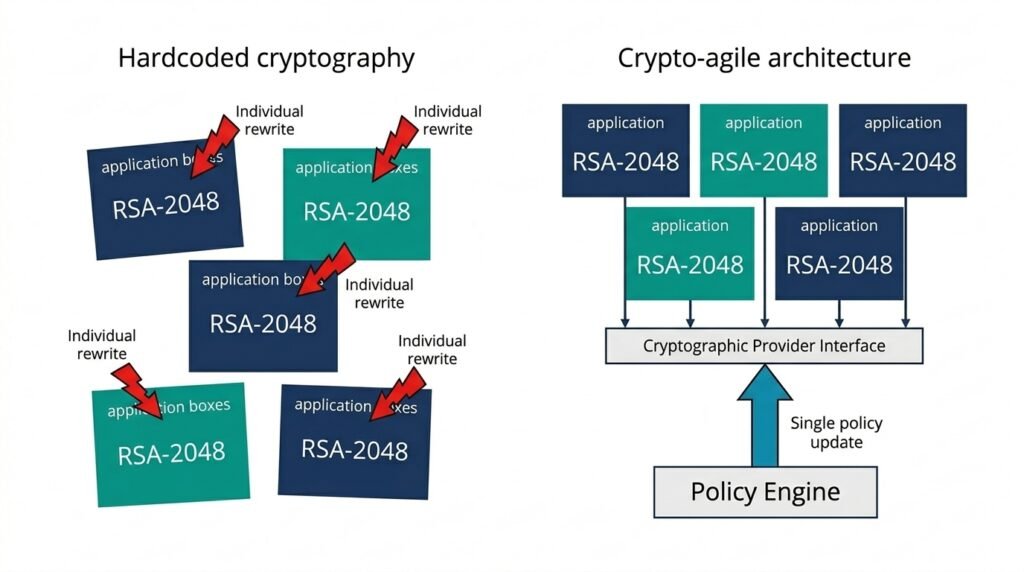
A system with hardcoded cryptography is a system designed to fail at migration. When algorithms such as RSA-2048 are embedded directly into application code—rather than abstracted behind a configurable cryptographic interface—every required change becomes a full engineering cycle: code modification, testing, and redeployment across all affected systems.
At enterprise scale, this design choice converts what should be a controlled configuration update into a multi-year operational burden. As organizations face the post-quantum transition, this rigidity is no longer sustainable. Crypto-agility architecture addresses this problem by decoupling algorithm selection from application logic, enabling cryptographic changes to be executed through policy and configuration rather than code rewrites. The result is a shift from reactive, high-risk migrations to predictable, governance-driven transitions.
This approach is formalized in the National Institute of Standards and Technology Cybersecurity White Paper 39 (CSWP 39), published in December 2025, which defines crypto agility as the capability to replace and adapt cryptographic algorithms across systems while maintaining security and operational continuity.
This guide operationalizes that definition by outlining the architectural patterns, anti-patterns, maturity levels, and layered design principles required to build truly crypto-agile systems—capable not only of surviving the post-quantum transition, but of adapting to every future cryptographic change without disruption.
Why Crypto-Agility Architecture Is the Strategic Priority for 2026
NIST CSWP 39 opens with a historically grounded observation: organizations have managed cryptographic transitions in a reactive, ad hoc way for fifty years — changing algorithms only when absolutely forced, at great expense and risk[1]. SHA-1 is the archetypal example. Weaknesses were identified as early as 2005. NIST urged agencies to stop using SHA-1 by 2010. Yet SHA-1 remained in production TLS deployments for years after that deadline because systems depended on it and lacked the architectural flexibility to substitute it without breaking backward compatibility. The migration, when it finally occurred, was reactive, expensive, and organizationally disruptive.
The post-quantum migration is the SHA-1 problem at an order of magnitude greater scale. Every public-key algorithm — not a single algorithm — must be replaced simultaneously[1]. RSA, ECDSA, ECDH, and Diffie-Hellman are the cryptographic foundation of TLS, PKI, VPNs, code signing, SSH, and virtually every other security protocol in enterprise infrastructure.
If those algorithms are hardcoded throughout an organization’s systems, the migration cost is multiplicative across every application, service, and device. NIST IR 8547 establishes that all quantum-vulnerable public-key algorithms will be disallowed for federal use by 2035[2]. For large enterprises, the gap between current architecture and quantum-safe architecture — without crypto-agility — represents years of concurrent engineering work on every system simultaneously. With crypto-agility, algorithm substitution becomes a governance event: update the approved algorithm list, propagate the policy, and monitor compliance.
CSWP 39 central finding: Crypto transitions should not be treated as one-off, emergency projects but as a continuous, anticipated process. The goal is to move from a world where algorithms are hardcoded and keys are scattered to one where agility is built into governance from the ground up. [1]
The NIST CSWP 39 Crypto-Agility Maturity Model — Where Does Your Organization Stand?
NIST CSWP 39 introduces a five-level maturity model for crypto agility — ranging from systems that are architecturally incapable of algorithm substitution to organizations where algorithm changes are executed automatically across the full enterprise via policy-driven governance[1]. The model draws from the NIST Crypto-Agility and Transition research track and provides a practical framework for assessing current architectural state and planning the path to higher maturity.
For systems where cryptography is implemented in ASICs or FPGAs, algorithm updates require hardware recapitalization rather than software patches — a fundamental constraint that NIST CSWP 39 explicitly acknowledges [1]. Level 0 systems are not rare edge cases; they are common in industrial control systems, medical devices, and legacy network infrastructure. Identifying Level 0 assets during Phase 1 cryptographic inventory is essential because they require hardware replacement budgeting rather than software migration planning — a distinction that directly affects program timelines and capital expenditure forecasts.
Table 1: The five-level NIST crypto-agility maturity model — system characteristics and enterprise capability at each level, derived from NIST CSWP 39.
| 0 | Initial / Not Possible | Cryptographic algorithms hardcoded in silicon (ASICs, FPGAs) or burned into firmware; no path to algorithm update without hardware replacement | Cannot migrate without capital hardware replacement; algorithm changes require a full procurement cycle |
| 1 | Possible | Cryptographic functions accessible via software update; libraries are not modular but updates are technically feasible; no formal governance or testing process | Algorithm updates possible but unstructured; reactive, emergency-driven; high risk of errors or service disruption during transition |
| 2 | Prepared | Modular cryptographic interfaces defined; some separation of algorithm logic from application logic; limited automated testing; partial CBOM in place | Can plan and execute algorithm transitions with significant engineering effort; transitions take months to years |
| 3 | Practiced | Algorithm negotiation in protocols; crypto APIs abstract algorithm selection from application code; CBOM current and automated; transition procedures documented and tested | Migration between cryptographic methods is demonstrably feasible; transitions are executable without service disruption in a controlled scope |
| 4 | Sophisticated | Policy-driven algorithm management via machine-readable configuration; automated monitoring and compliance enforcement; crypto-agility applied across the full supply chain; fast rollback capability | Organization-wide algorithm substitution is achievable via configuration update; transition time measured in days rather than months; continuous governance operational |
Hardcoded vs. Crypto-Agile — The Seven Architectural Anti-Patterns to Eliminate
The difference between a crypto-agile system and a brittle one is a set of seven specific architectural decisions that either couple or decouple algorithm selection from application logic. NIST CSWP 39 identifies policy-mechanism separation as the central architectural principle: cryptographic choices should be driven by external policy settings rather than hardcoded in software[1].
In practice, this means cryptography must be configurable via machine-readable profiles or management consoles — not compiled into application binaries. An organization that discovers a deprecated algorithm should be able to remove it from an approved policy list and have that enforcement propagate automatically across all affected systems, rather than opening hundreds of code repositories and scheduling coordinated deployments.
Table 2: Seven architectural anti-patterns that prevent crypto-agility, compared to the agile design pattern that replaces each one.
| Design Decision | Hardcoded Cryptography (Anti-Pattern) | Crypto-Agile Architecture (Required Pattern) |
| Algorithm selection | RSA-2048 or ECDSA P-256 written directly into application source code; requires full code rewrite and re-testing to change | Algorithm name loaded from configuration file or environment variable; substitution requires configuration update only — no code change |
| Key size and parameters | Key length fixed at compile time; changing key size requires binary recompilation and deployment | Key parameters defined in external policy profile; updatable at runtime via management API without service restart |
| Cryptographic library dependency | Application imports a specific version of OpenSSL or BouncyCastle and calls algorithm functions directly | Application calls a cryptographic abstraction layer (Cryptographic Provider Interface) that routes to the underlying library; the library can be swapped without application changes |
| Algorithm negotiation | TLS configuration specifies a fixed cipher suite list; no dynamic negotiation capability | TLS configuration driven by policy; cipher suite list updated centrally and propagated to all endpoints; downgrade attack prevention enforced by policy engine |
| Key lifecycle management | Key rotation requires manual intervention; expiry is tracked in spreadsheets or ticketing systems | Key rotation automated via certificate lifecycle management platform; CBOM updated automatically on rotation; expiry alerts and automated renewal integrated with CI/CD |
| Algorithm deprecation response | Discovering a deprecated algorithm requires source code search, code fix, testing, and multi-environment deployment — minimum weeks | Deprecated algorithm removed from approved policy list; enforcement propagates automatically; affected systems identified via continuous CBOM scanning — response measured in hours |
| Vendor and supply chain cryptography | Third-party dependencies carry their own cryptographic implementations; no visibility into vendor algorithm usage | Vendor CBOM required as procurement condition; cryptographic SBOMs ingested into enterprise CBOM; vendor roadmaps tracked against deprecation timeline |
💡 For more information, explore the complete segments of our Post-Quantum Security series articles here
Crypto-Agility Architecture by Layer — What Is a Cryptographic Provider Interface (CPI) and How Does It Work? — From Protocol to Policy Engine
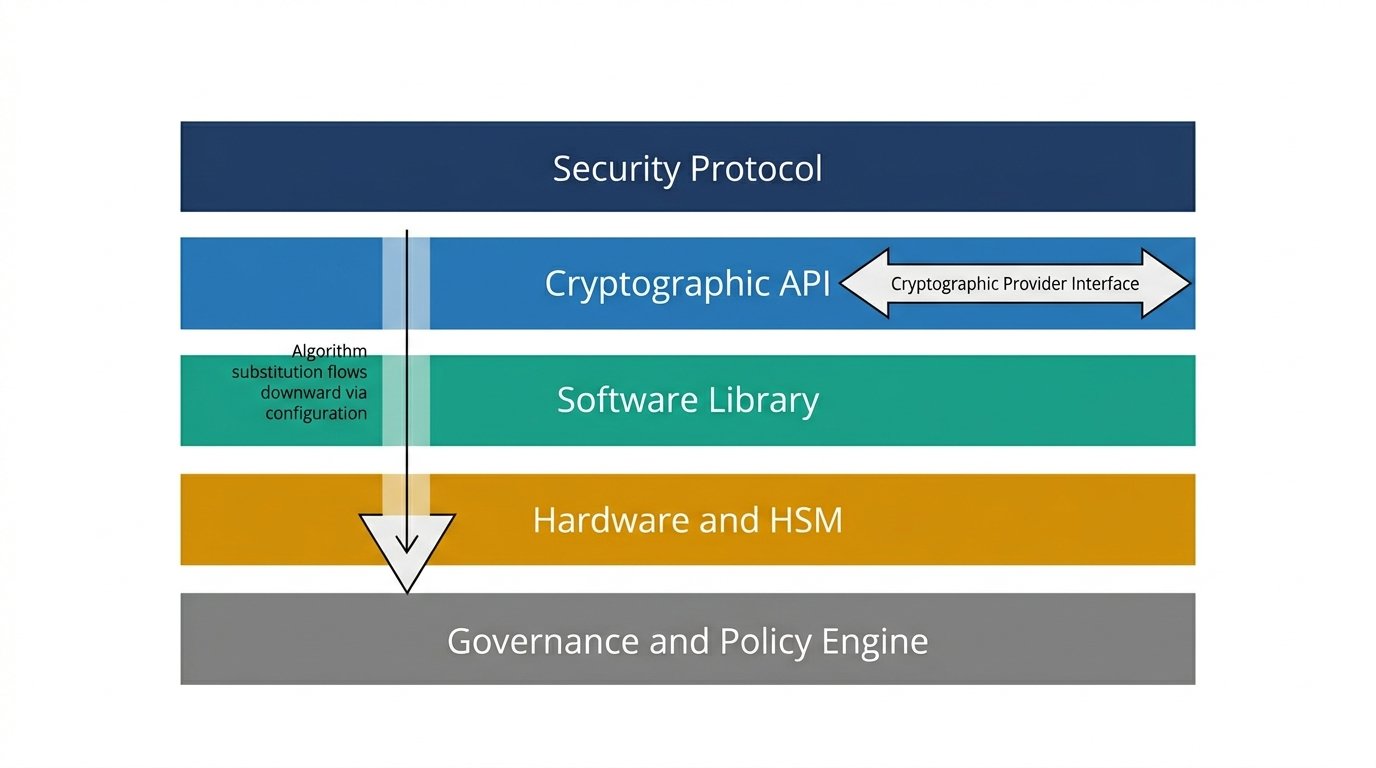
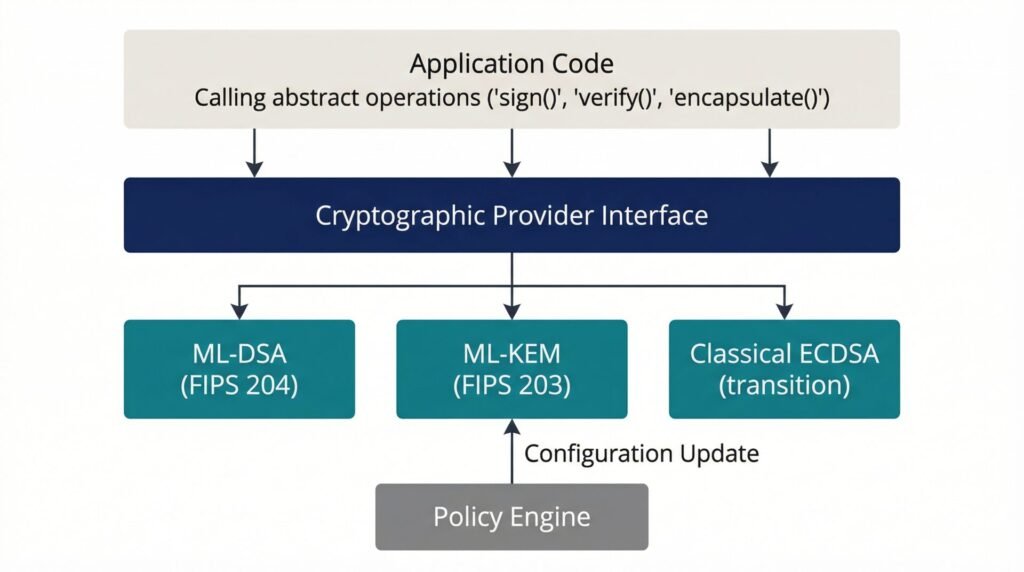
NIST CSWP 39 structures crypto-agility requirements across all layers of a system architecture — from security protocols at the top to hardware at the foundation[1]. The key architectural component that makes agility function across these layers is the Cryptographic Provider Interface (CPI) — an abstraction layer through which application code calls logical cryptographic primitives (sign, verify, encapsulate, decapsulate) without referencing specific algorithms.
The CPI routes those calls to the underlying library (OpenSSL, BouncyCastle, wolfSSL) and can be reconfigured to route them to a different algorithm or library without touching application code. Table 3 maps the agility requirements and practical implementations across all five architecture layers.
Table 3: Crypto-agility requirements, NIST CSWP 39 guidance, and practical implementations for each of the five architecture layers.
| Architecture Layer | Crypto-Agility Requirement | NIST CSWP 39 Guidance | Practical Implementation |
| Security Protocol (TLS, IPsec, SSH) | Algorithm negotiation built into protocol; no fixed cipher suites; downgrade prevention enforced | Protocols must carry explicit algorithm identifiers; the cipher suite list must be externally configurable | TLS 1.3 cipher suite negotiation; IKEv2 algorithm identifiers in IPsec; OpenSSH crypto configuration externalized |
| Cryptographic API (Application Layer) | Application calls abstract crypto primitives; no direct library function calls; algorithm substitutable via configuration | Crypto API must not assume fixed algorithms or key sizes; API design should be documented and easy to use | Java JCA/JCE provider model; Python cryptography library abstraction; Windows CNG provider interface |
| Software Library (OpenSSL, BouncyCastle) | Library supports multiple concurrent algorithms; PQC algorithms (ML-KEM, ML-DSA) available alongside classical; algorithm selection via external configuration | Libraries should support modular algorithm insertion; version updates should not break application API contracts | OpenSSL 3.5 (native ML-KEM, ML-DSA, SLH-DSA); BouncyCastle Java 1.79 (full NIST PQC support); wolfSSL PQC-enabled build |
| Hardware / HSM (Key Storage) | HSM supports multiple algorithm families; key material is portable across algorithm generations; firmware is updatable in the field | Hardware is the most constrained layer; algorithm updates may require hardware replacement; design for updateability during development | PQC-ready HSMs from Thales and Entrust; hardware-bound crypto requires recapitalization planning; embedded systems may need hardware replacement cycles |
| Governance and Policy Engine | Centralized cryptographic policy definition; machine-readable policy profiles; automated compliance monitoring; CBOM continuously updated | Policy-mechanism separation: cryptographic choices driven by external policy settings, not hardcoded in software; automated policy enforcement via management tools | IBM Quantum Safe Explorer for continuous scanning; Keyfactor for certificate lifecycle; CycloneDX 1.6 CBOM standard for policy-driven inventory |
Library support in 2026: OpenSSL 3.5 (released 2025) includes native support for ML-KEM, ML-DSA, and SLH-DSA in the default provider — no external plugin required. BouncyCastle Java 1.79 provides full NIST PQC support. Organizations targeting crypto-agile library abstraction now have production-ready implementations to build against. [3]
Building Crypto-Agility Into New Systems — The 2026 Design Standard
NIST SP 800-131A Rev. 3 — which governs cryptographic algorithm transitions for U.S. federal systems — establishes that all new systems should be designed with algorithm substitution as a standard architectural requirement[4]. Any system built in 2026 with hardcoded classical algorithms creates immediate migration debt: it will require full re-engineering rather than configuration changes when NIST IR 8547’s deprecation deadlines arrive.
NIST CSWP 39 frames crypto agility not as an optional enhancement but as a foundational design practice — one that must be embedded at every level, from algorithm selection to enterprise architecture governance [1].
For organizations implementing hybrid PQC deployments — combining ML-KEM with X25519 for TLS key exchange — crypto-agility is what enables the hybrid configuration to evolve cleanly toward pure post-quantum once the ecosystem fully supports it[5]. A hybrid deployment built on a crypto-agile CPI can drop the classical component via a configuration update when the transition is complete.
A hybrid deployment built with hardcoded cipher suites requires another round of code changes, testing, and coordinated deployment. The architectural investment made in 2026 determines which of these futures the organization faces in 2028 and beyond. Palo Alto Networks’ guidance on cryptographic agility identifies governance and visibility first, followed by flexible interface design, controlled experimentation, and continuous algorithm lifecycle management as the sequence for building crypto-agile infrastructure[6].
Counter-Arguments: Four Honest Challenges to Crypto-Agility Architecture
1- Objection: Crypto-agility adds architectural complexity that introduces new security risks — abstractions can hide vulnerabilities and create implementation errors.
Discussion: National Institute of Standards and Technology CSWP 39 acknowledges that enabling crypto agility increases system complexity. A poorly designed CPI can introduce risks such as side channels, downgrade attacks, or interoperability issues..’ [1]
The solution is not to avoid abstraction, but to implement it correctly—through careful design, clear documentation, and rigorous testing. Hardcoding algorithms does not remove complexity; it defers it into a future migration crisis.
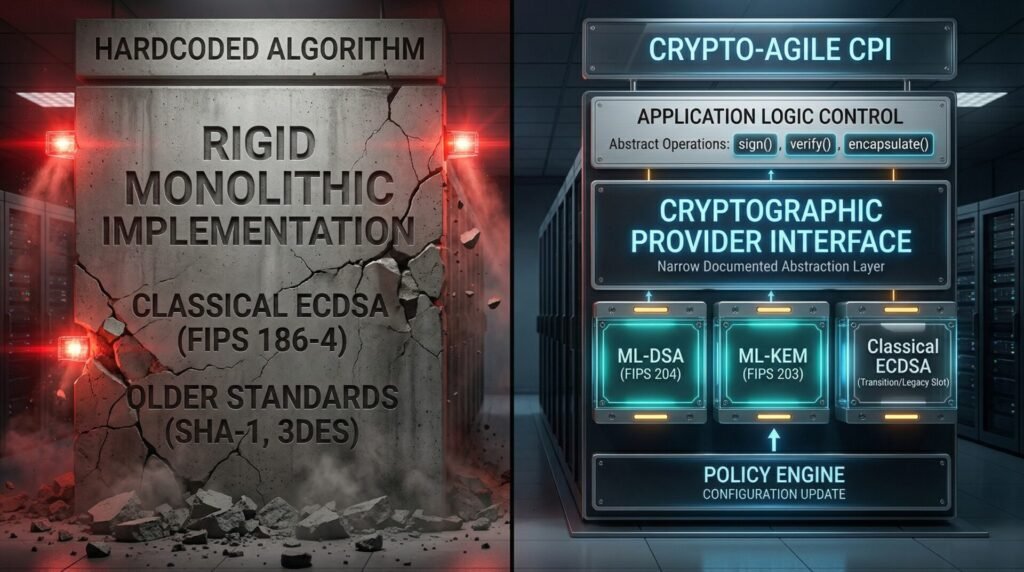
Solution: Design the CPI to be narrow and well-documented. Use established patterns from the Java JCA/JCE model or Windows CNG provider interface rather than building custom abstractions. Test algorithm substitution in non-production environments before relying on it for migration.
2- Objection: Our organization’s legacy systems cannot achieve crypto-agility — retrofitting abstraction layers into existing codebases is not feasible at scale.
Discussion: Level 0–1 legacy systems cannot achieve crypto-agility through software changes alone; hardware-bound cryptography requires replacement, as noted by the National Institute of Standards and Technology CSWP 39.
Crypto-agility should therefore be treated as a design standard for new systems and a governance model across the enterprise—not a retrofit strategy. Legacy systems should be prioritized for replacement based on maturity and HNDL risk, with interim protection via network-layer PQC (e.g., hybrid TLS at the gateway).

Solution: Classify legacy systems by maturity level and HNDL risk. Apply network-layer PQC controls as compensating measures for Level 0 and Level 1 assets. Require Level 3 or higher maturity as a mandatory design standard in all new system specifications and procurement requirements.
3- Objection: Crypto-agility is a preparation for an algorithm failure that may never happen — ML-KEM and ML-DSA have passed eight years of vetting.
Discussion: Crypto-agility addresses two distinct risk scenarios, not only algorithm failure. The first is a discovered weakness in a deployed algorithm. The second — and more immediately relevant — is planned deprecation: NIST has published a 2035 deadline for disallowing all quantum-vulnerable public-key algorithms, [2] and CNSA 2.0 imposes earlier deadlines for NSS environments.
Both scenarios require the ability to substitute algorithms without emergency code changes. SHA-1 remained in widespread use for five years after its deprecation recommendation precisely because systems lacked the agility to substitute it under non-emergency conditions. The PQC deprecation timeline is known in advance; the agility to meet it should be built in advance.

Solution: Treat crypto-agility as a governance and operational capability, not a contingency for algorithm failure. The primary use case in 2026 is meeting the 2030–2035 deprecation deadlines on a planned schedule rather than under compliance pressure.
4- Objection: Building crypto-agility into systems requires specialized cryptographic expertise that most development teams do not have.
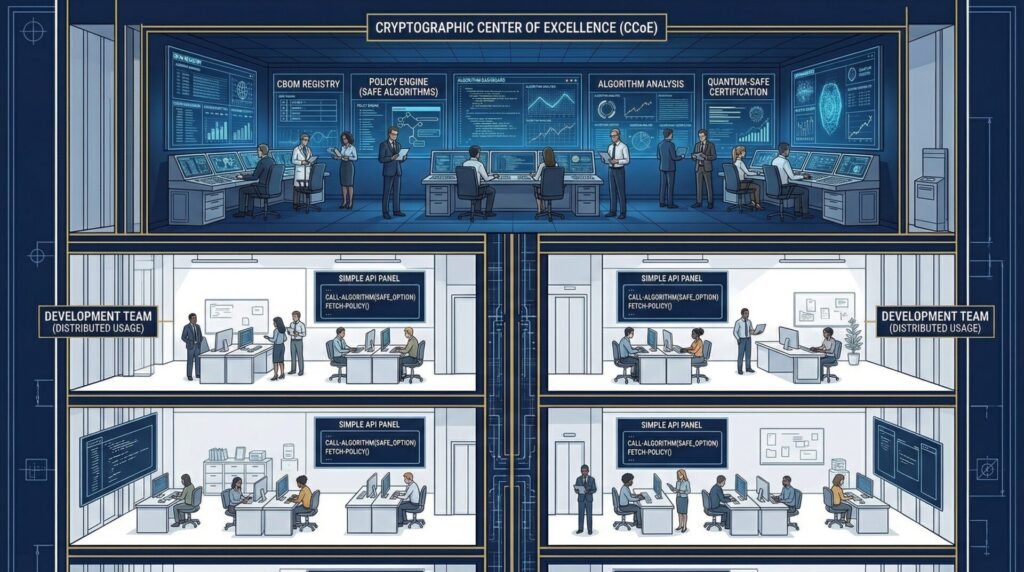
Discussion: The expertise gap is real and represents one of the most significant operational barriers to crypto-agility at enterprise scale. However, the CPI pattern does not require individual development teams to understand cryptographic algorithm internals — it requires them to call abstract operations through a well-defined interface, with algorithm selection delegated to a centrally governed policy engine.
The cryptographic expertise is concentrated in the interface design and policy governance layer, not distributed across every development team. NIST CSWP 39 recommends establishing a Cryptographic Center of Excellence (CCoE). For organizations researching how to set up a Cryptographic Center of Excellence, NIST CSWP 39 provides the governance model: the CCoE owns the policy layer, defines the CPI standard, manages the CBOM, and monitors deprecation deadlines — while development teams call abstract primitives without needing cryptographic specialization [1].
Solution: Establish a CCoE with responsibility for cryptographic policy, interface standards, and CBOM governance. Development teams adopt the CPI standard and call abstract primitives; the CCoE owns algorithm selection, deprecation management, and compliance monitoring.
Knowledge Assessment: Is Your Architecture Crypto-Agile?
⚠ Disclaimer: This quiz is for self-awareness only and does not constitute a professional assessment.
Knowledge Assessment Quiz: How Crypto-Agile Is Your Architecture?
Q1: A system hardcodes RSA-2048 directly into its application source code for digital signature generation. What is the primary crypto-agility failure this represents?
- A) The system is using RSA-2048 instead of the more secure RSA-4096
- B) Algorithm selection is coupled to application logic, requiring a full code rewrite and re-testing cycle to substitute any alternative signing algorithm
- C) The system is missing a hardware security module for key storage
- D) The system does not support TLS 1.3, which is required for post-quantum key exchange
Q2: According to the NIST CSWP 39 maturity model, which level describes a system where algorithm substitution is achievable via configuration update and transition time is measured in days rather than months?
- A) Level 1 — Possible
- B) Level 2 — Prepared
- C) Level 3 — Practiced
- D) Level 4 — Sophisticated
Q3: NIST CSWP 39 describes ‘policy-mechanism separation’ as a core crypto-agility architectural principle. What does this mean in practice?
- A) Cryptographic keys and their associated policies must be stored in physically separate hardware modules
- B) The security team that writes cryptographic policy must be organizationally separate from the development team that implements it
- C) Cryptographic algorithm choices are defined in external, machine-readable policy configurations rather than hardcoded in application source code, allowing algorithm changes without code modification
- D) TLS policy configuration must be separated from application-level encryption policy to prevent conflicting cipher suite specifications
Score Interpretation:
- All correct (B, D, C): Advanced crypto-agility architecture understanding. Apply the Table 3 layer requirements to audit each tier of your existing systems against the agile patterns.
- Mostly correct: Review the hardcoded vs. agile comparison in Table 2 — the distinction between algorithm selection in code versus algorithm selection in configuration is the central architectural principle.
- Incorrect: Return to the NIST CSWP 39 maturity model and the Cryptographic Provider Interface section before beginning architectural remediation planning.
FAQ
Q1: What is the practical difference between a crypto-agile system and one that is not?
A: In a crypto-agile system, changing the signing algorithm from ECDSA P-256 to ML-DSA-65 requires updating a configuration file or policy setting — the application code does not change. In a non-agile system, the same change requires modifying source code, recompiling, testing, and deploying updated binaries across every affected service.
At enterprise scale, the difference between a configuration update and a code change is the difference between a days-long governance process and a months-long engineering program across hundreds of applications simultaneously.
Q2: What is the Cryptographic Provider Interface, and how does it work?
A: The Cryptographic Provider Interface (CPI) is an abstraction layer that application code calls for cryptographic operations — sign, verify, encapsulate, decapsulate — without specifying which algorithm implements the operation.
The CPI routes those calls to the underlying library (OpenSSL,
BouncyCastle, or another) and can be reconfigured to route them to a different algorithm without changing application code. Established CPI models include Java’s JCA/JCE provider architecture, Microsoft’s Windows CNG provider interface, and OpenSSL’s engine and provider frameworks. NIST CSWP 39 recommends industry-wide standardization of a common cryptographic API to further reduce the per-system cost of algorithm substitution.
Q3: What is the NIST CSWP 39 maturity model, and how do I assess my organization’s level?
A: NIST CSWP 39 defines five maturity levels from Level 0 (systems with hardware-bound cryptography that cannot be updated without hardware replacement) to Level 4 (organization-wide algorithm substitution via policy update with automated compliance monitoring).
Assessment involves examining how algorithm selection is implemented across representative systems: if changing the algorithm requires a code change, the system is Level 1 or below. If it requires a configuration change, it is Level 2 or above. The degree to which that change propagates automatically and is monitored for compliance determines Level 3 versus Level 4.
Q4: Which cryptographic libraries support post-quantum algorithms today?
A: OpenSSL 3.5 (released 2025) includes native support for ML-KEM, ML-DSA, and SLH-DSA in its default provider without requiring the Open Quantum Safe extension. BouncyCastle Java 1.79 provides full NIST PQC support, including ML-KEM and ML-DSA, enabling hybrid X.509 certificate generation. wolfSSL supports ML-KEM and ML-DSA in its PQC-enabled build configuration.
Microsoft’s Windows CNG has added support for ML-KEM and ML-DSA in Windows Insider builds as of 2025. Organizations building crypto-agile systems should verify that their CPI implementations route to one of these libraries and provide a configurable path to ML-KEM and ML-DSA.
Q5: What is a Cryptographic Center of Excellence, and does my organization need one?
A: A Cryptographic Center of Excellence (CCoE) is a cross-functional governance body — typically spanning security architecture, cryptographic engineering, compliance, DevSecOps, and procurement — responsible for defining approved algorithm policies, maintaining the enterprise CBOM, governing the CPI standard, and managing cryptographic deprecation timelines.
NIST CSWP 39 recommends centralizing cryptographic expertise in such a body rather than distributing it across individual development teams. Not every organization requires a formal CCoE with dedicated headcount — but every organization needs a defined ownership model for cryptographic policy, deprecation management, and CBOM governance.
Q6: How does crypto-agility relate to the Phase 4 step in the PQC migration roadmap?
A: Phase 4 of the 6-phase PQC migration roadmap — described in the companion article PQC Migration Roadmap: The Complete 6-Phase Enterprise Implementation Guide for 2026 — is the Crypto-Agility Engineering phase, running from 6 to 24 months after program initiation.
This phase implements the architectural patterns described here: eliminating hardcoded algorithms, establishing the CPI, externalizing cryptographic policy, and automating CBOM updates. Systems built with crypto-agility during Phase 4 will not require the same level of engineering effort when the next algorithm transition occurs — whether that is the movement from hybrid to pure PQC, or a future response to a discovered lattice vulnerability.
Quick Start: Five Steps to Crypto-Agile Architecture
- Step 1: Build cryptographic inventory (CBOM)
- Step 2: Identify hardcoded algorithms
- Step 3: Introduce CPI abstraction layer
- Step 4: Externalize crypto policy
- Step 5: Test algorithm substitution
PQC Series Overview
This article is part of the Post-Quantum Security Series — a technical collection of guides exploring cryptographic vulnerabilities exposed by quantum computing, migration strategies for organizations, and the steps required to protect sensitive data before quantum decryption becomes operationally viable.
References
- [1] NIST. CSWP 39 — Considerations for Achieving Crypto Agility: Strategies and Practices. December 2025. https://nvlpubs.nist.gov/nistpubs/CSWP/NIST.CSWP.39.pdf
- [2] NIST. IR 8547 — Transition to Post-Quantum Cryptography Standards. 2024. https://nvlpubs.nist.gov/nistpubs/ir/2024/NIST.IR.8547.ipd.pdf
- [3] Cloudflare Research. NIST’s First Post-Quantum Standards — What This Means for the Internet. https://blog.cloudflare.com/nists-first-post-quantum-standards/
- [4] NIST. SP 800-131A Rev. 3 (ipd) — Transitioning the Use of Cryptographic Algorithms and Key Lengths. October 2024.
https://nvlpubs.nist.gov/nistpubs/SpecialPublications/NIST.SP.800-131Ar3.ipd.pdf - [5] IBM Research. NIST’s Post-Quantum Cryptography Standards Are Here. August 2024. https://research.ibm.com/blog/nist-pqc-standards
- [6] Palo Alto Networks. Cryptographic Agility: The Key to Quantum Readiness. https://www.paloaltonetworks.com/cyberpedia/what-is-cryptographic-agility
- [7] Encryption Consulting. Understanding Cryptographic Agility in Security Protocols through NIST CSWP 39. February 2026. https://www.encryptionconsulting.com/cryptographic-agility-in-security-protocols-nist-cswp-39/
- [8] PQShield. NIST Finalizes Cybersecurity Whitepaper 39 — Considerations for Crypto Agility. January 2026. https://pqshield.com/nist-finalizes-cybersecurity-whitepaper-39-considerations-for-crypto-agility/