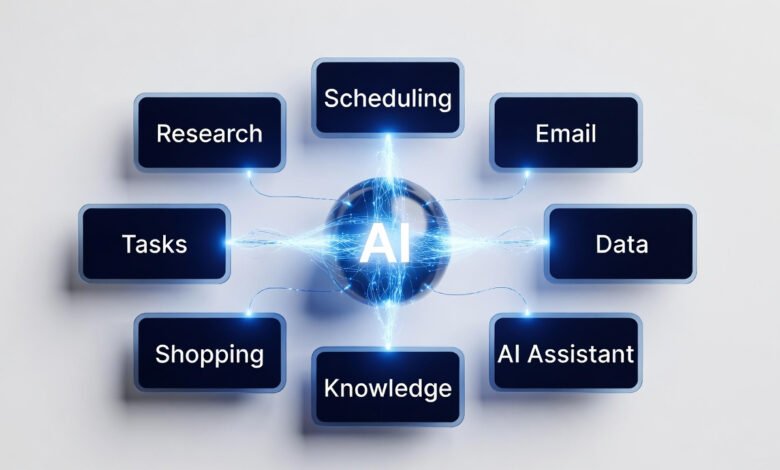
7 Powerful Ways Autonomous Assistants Are Transforming Work in 2026
AI personal agents for productivity are reshaping how professionals interact with technology at work. Rather than opening a dozen separate applications to complete a single project, workers can now delegate complex, multi-step workflows to autonomous AI workflow agents that plan, execute, and coordinate tasks across platforms — with minimal manual input. The global market for intelligent AI productivity tools is accelerating rapidly, with enterprise adoption rates climbing steeply since 2024 [2].
This shift is not an incremental upgrade to existing software. It represents a structural change in how digital work gets done. AI Personal Agents for Productivity combine Large Language Models (LLMs), AI task automation, and deep API integration to function less like tools and more like capable, goal-driven colleagues. This article examines what these systems are, why adoption is accelerating in 2026, and precisely how they are delivering measurable productivity gains across seven core work domains.
For the broader context of how AI agents are challenging the entire app ecosystem, explore our full pillar guide: AI Personal Agents Are Replacing Your Apps Faster Than You Think.
⚠️ Tech Disclaimer: This guide explores 2026 AI trends for educational purposes. AI capabilities and software performance vary by platform; this is not professional, technical, or financial advice. Always verify with certified experts for a critical system
What Are AI Personal Agents for Productivity?
AI personal agents for productivity are intelligent software systems designed to autonomously complete tasks, make decisions, and coordinate multiple tools on behalf of a user — without requiring manual interaction at every step. Unlike conventional applications that execute single functions, these agents operate through a goal-driven AI model: the user states an objective, and the agent plans and executes the steps needed to achieve it.
The technical foundation rests on Large Language Models (LLMs) — such as GPT-4o, Gemini 2.0, and Claude Sonnet 4 — which provide the natural language comprehension and multi-step AI reasoning these systems need. Beyond language understanding, agentic AI systems connect to external services via APIs, retrieve information from multiple sources simultaneously, and execute real-world actions: booking meetings, drafting communications, processing data, and managing tasks across an entire digital environment.
Core Characteristics
- Goal-based task execution: The agent interprets intent and sequences actions independently.
- Multi-step AI reasoning: Complex requests are decomposed into subtasks and executed in order.
- Cross-platform API integration: Agents communicate with email, calendars, CRMs, databases, and cloud services.
- Continuous behavioural learning: Agents adapt recommendations and workflows based on observed user patterns.
- Proactive assistance: Rather than waiting for commands, agents surface relevant actions and information autonomously.
| 🧠 Quick Knowledge Check — AI Productivity Agents Q1: Which capability best defines modern AI personal agents for productivity? -A) They generate text responses only -B) They automate multi-step tasks across different tools and platforms -C) They replace internet browsers entirely -D) They function only within a single application Q2: What makes AI workflow automation agents different from traditional productivity apps? -A) They are only available on mobile devices -B) They coordinate multiple tools autonomously based on user goals -C) They require manual input for every single action -D) They work without any internet connection Q3: Which technology forms the reasoning core of AI personal agents? -A) Bluetooth Low Energy sensors -B) Large Language Models (LLMs) -C) Augmented Reality overlays -D) Robotic Process Automation scripts only |
✅ Correct Answers:
- Q1 → B: They automate multi-step tasks across different tools and platforms.
- Q2 → B: They coordinate multiple tools autonomously based on user goals.
- Q3 → B: Large Language Models (LLMs) provide the reasoning and planning core.
Why AI Productivity Agents Are Trending in 2026
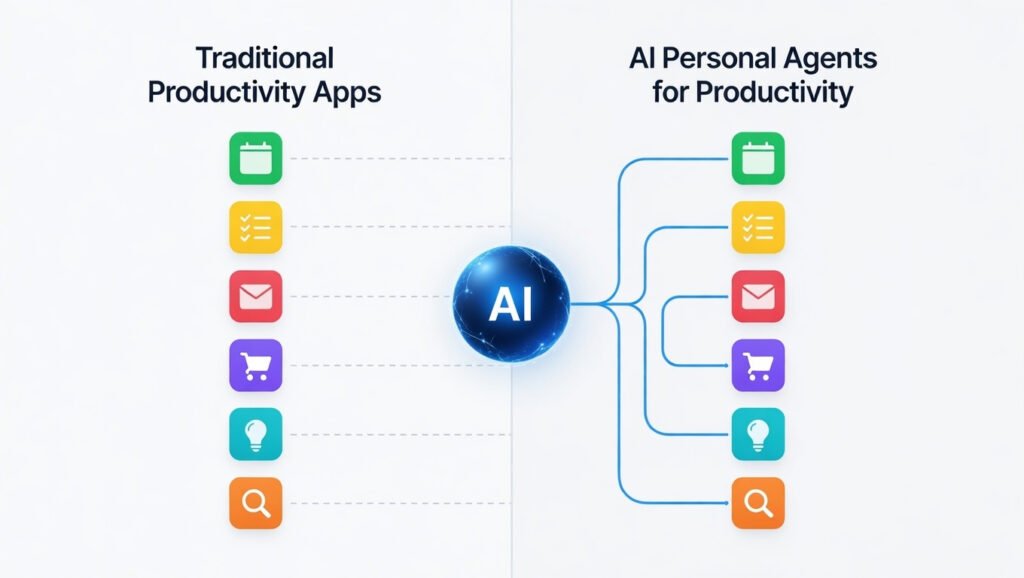
Interest in AI agent automation and autonomous AI assistants has surged since 2024 as both individuals and enterprises search for solutions to the inefficiencies of the traditional app-based work model. Several converging technological and market forces explain this acceleration.
1. Maturation of Large Language Models
The rapid capability improvements in LLMs between 2023 and 2026 have crossed a threshold of practical usefulness for agentic AI task management. Models can now maintain context across extended interactions, reason through ambiguous instructions, and decompose open-ended goals into executable sequences — capabilities that were not reliably available two years ago. Stanford’s AI Index Report 2024 documents a measurable acceleration in LLM performance benchmarks across reasoning, planning, and instruction-following tasks [1].
2. Enterprise Adoption Signals
McKinsey’s 2024 analysis of generative AI productivity tools identifies knowledge worker efficiency as the highest-value application domain for AI investment [2]. Microsoft’s integration of Copilot AI agents into the Microsoft 365 ecosystem represents the largest commercial deployment of AI workflow automation to date — directly embedding agent capabilities into the productivity tools used by hundreds of millions of workers globally [4].
3. The Demand for Workflow Consolidation
Research consistently identifies context-switching between applications as a primary driver of workplace inefficiency. AI personal agents for productivity address this directly by acting as a unified coordination layer across all work tools — reducing the friction that currently forces workers to manage tasks, data, and communication across dozens of separate applications.
Strategic Comparison: AI Personal Agents for Productivity vs Traditional Productivity Apps
| Feature | Traditional Productivity Apps | AI Personal Agents for Productivity |
| Interaction model | Manual commands | Goal-driven, autonomous execution |
| Workflow scope | Single task per app | Multi-step processes across platforms |
| User involvement | High — every step manual | Low — intent-based delegation |
| Learning ability | Static/limited | Continuous behavioural adaptation |
| Cross-app coordination | None — siloed | Native via APIs |
| Proactivity | None — reactive only | Anticipates needs from behaviour patterns |
| Productivity impact | Incremental | Potentially transformative |
7 Powerful Ways AI Personal Agents Improve Productivity at Work
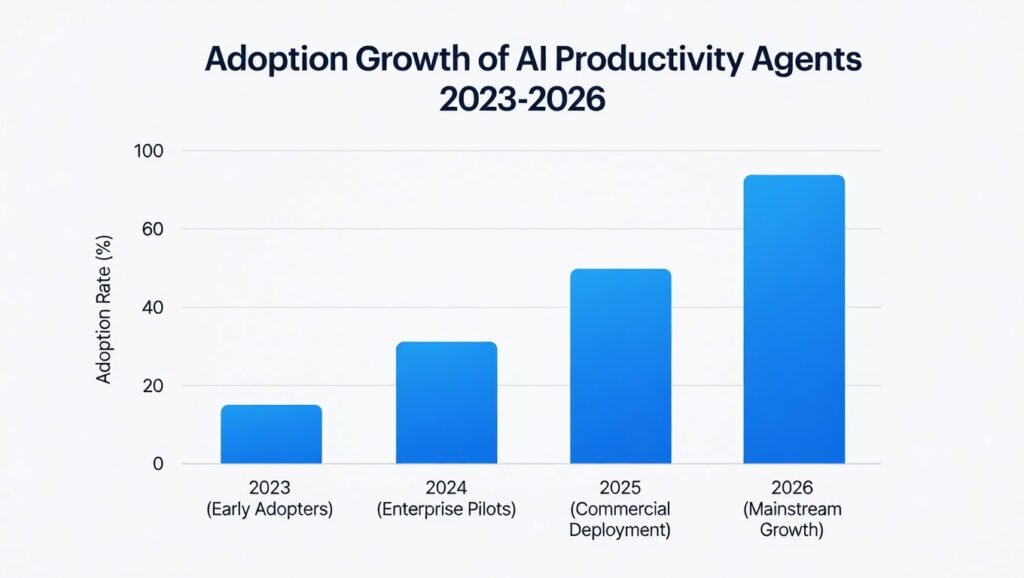
The case for AI personal agents for productivity is most compelling in the specifics. Below are seven domains where autonomous agents are already delivering measurable gains — with concrete examples drawn from current enterprise deployments and emerging AI workflow automation platforms.
💡 For more information, explore the complete segments of our AI & Personal Technology Series
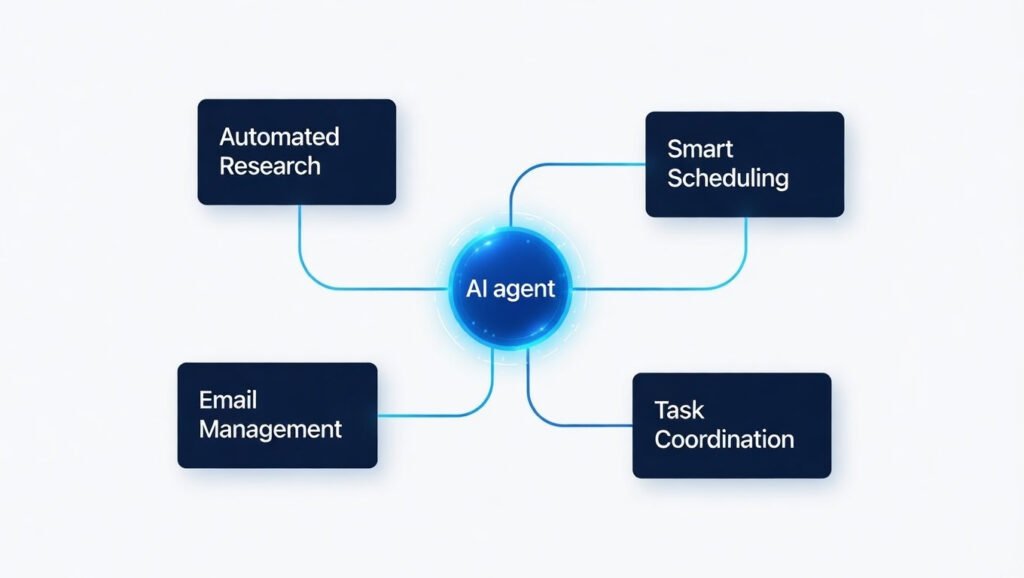
1. Automated Research and Knowledge Synthesis
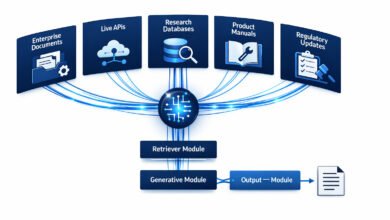
Traditional research requires manually visiting multiple sources, reading, summarising, and cross-referencing findings. An AI research automation agent can simultaneously query academic databases, industry reports, and verified news sources, synthesise findings, and deliver a structured summary — in minutes rather than hours. Enterprise deployments of tools such as Perplexity Enterprise and Microsoft Copilot demonstrate measurable reductions in research time for standard information-gathering tasks, with McKinsey identifying knowledge worker efficiency as the highest-value AI application domain in enterprise contexts [2].
2. Intelligent Meeting and Calendar Management
Smart AI scheduling agents analyse calendar data, meeting priorities, participant time zones, and historical scheduling patterns to propose and execute optimal meeting arrangements. Rather than a back-and-forth email chain to find a mutual slot, the agent handles the full cycle — from proposal to confirmation to calendar update — autonomously. This represents one of the highest-frequency friction points in knowledge work, making it one of the highest-impact early applications of AI agent automation.
3. Proactive Email and Communication Management
AI email management agents do far more than filter spam. They prioritise message queues based on urgency and sender relationships, draft context-aware responses, categorise correspondence into actionable folders, schedule follow-up reminders, and flag time-sensitive items — all without requiring manual triage. For professionals managing high-volume inboxes, this capability alone can recover a substantial portion of the working day.
4. Cross-Platform Task and Project Coordination
AI workflow automation agents monitor project status across tools — Asana, Jira, Notion, Slack — identify blockers, send contextual reminders, and surface tasks that require attention based on deadlines and dependencies. Rather than manually checking each platform, the agent maintains a unified view of all active work and surfaces the right information at the right moment.
5. Automated Data Analysis and Reporting
AI data analysis agents can process structured datasets, identify patterns, generate visual summaries, and produce written interpretations — transforming raw data into decision-ready reports without requiring manual analysis. For teams that currently depend on dedicated analysts for routine reporting tasks, this capability has significant implications for both speed and cost of business intelligence automation. Stanford’s AI Index notes that AI performance on data comprehension and analysis benchmarks improved substantially between 2022 and 2024 [1].
6. Autonomous Transaction and Procurement Management
AI procurement agents can monitor pricing across vendors, execute routine purchases against pre-defined approval rules, manage subscription renewals, and flag anomalous transactions — reducing the administrative overhead of procurement workflows. While fully autonomous financial transactions require careful governance frameworks, AI-assisted procurement automation for routine, rule-governed purchases is already demonstrating efficiency gains in enterprise contexts [7].
7. Personal Knowledge Base and Document Intelligence
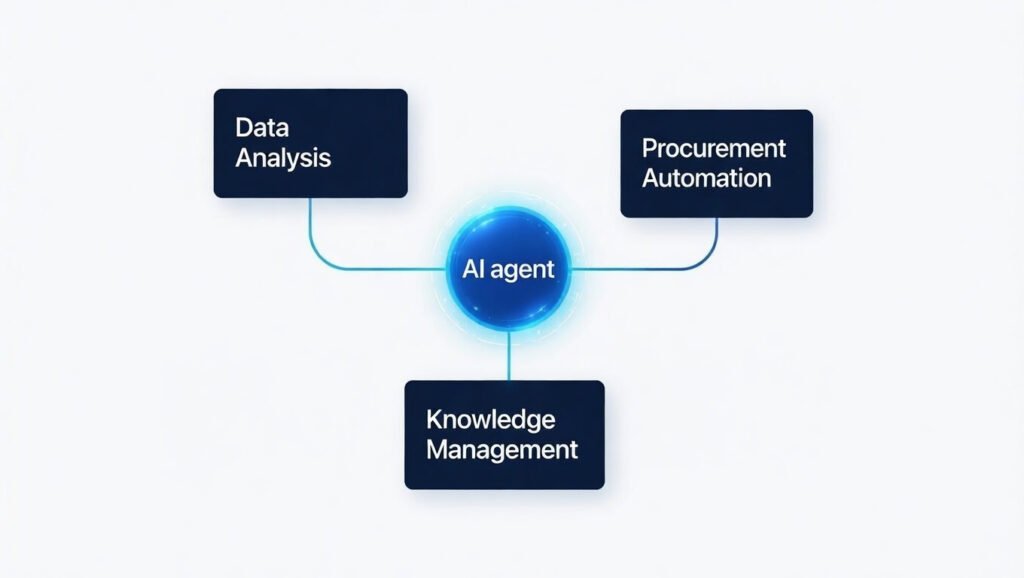
AI knowledge management agents organise documents, meeting notes, research materials, and correspondence into searchable, contextually linked knowledge systems. Rather than manually tagging and filing content, users can describe what they are looking for in natural language and receive accurate, contextually relevant results drawn from their entire document history. This capability is particularly valuable for knowledge workers managing large volumes of reference material across extended project timelines.
💡 For more information, explore the complete segments of our AI & Personal Technology Series
Counter-Arguments: Are AI Productivity Agents Overhyped?
A credible assessment of AI personal agents for productivity requires honest engagement with the risks of using AI agents in the workplace — limitations that accompany their promise and that organisations must address before deployment at scale. Several substantive counter-arguments deserve consideration.
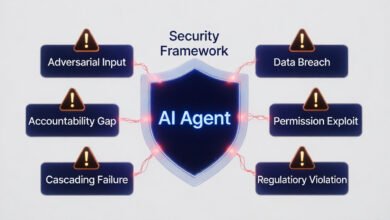
- Security and permission risks: Granting autonomous AI agents access to email accounts, financial platforms, calendar data, and internal systems creates a significant and difficult-to-audit attack surface. A compromised agent with broad permissions could expose sensitive organisational data at scale. The EU AI Act introduces governance requirements for high-risk AI deployments [6], but enterprise security frameworks for agentic systems remain immature in most organisations.
- Reliability and error propagation: AI agents may misinterpret ambiguous instructions, produce factually incorrect outputs, or take unintended actions — particularly in novel or edge-case situations. Because agents often execute multi-step sequences autonomously, a single misinterpretation early in a workflow can propagate and compound across subsequent steps before a human intervenes.
- Governance and accountability gaps: When an AI workflow agent makes a consequential error — such as sending the wrong communication or submitting an incorrect data report — accountability attribution becomes complex. Organisations must establish clear oversight mechanisms, audit trails, and human review checkpoints before deploying agents in consequential workflows [3].
- Over-reliance and skill atrophy: Delegating research, analysis, and decision-support tasks to AI productivity agents may gradually erode the cognitive skills required to perform these tasks independently. This risk is particularly relevant in roles where critical thinking and source evaluation are core professional competencies.
- The hype-to-capability gap: Current agentic AI systems perform well within structured, well-defined workflows. They remain less reliable in contexts requiring genuine judgment, novel problem-solving, or nuanced interpersonal sensitivity — domains that represent a significant portion of the value generated by skilled knowledge workers.
The Future of AI Personal Agents in the Workplace
The next generation of AI personal agents for productivity will extend well beyond the capabilities currently available in commercial products. Research into persistent AI memory, multi-agent collaboration frameworks, and deeper operating system integration suggests that the agentic AI landscape of 2028–2030 may look substantially different from today’s early deployments.
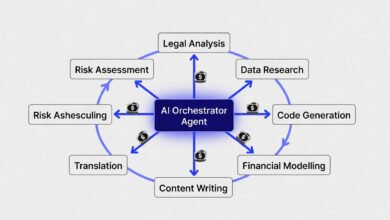
Persistent memory systems will allow agents to maintain context not just across a single session but across months or years of interaction — building increasingly accurate models of user preferences, working styles, and long-term goals. Multi-agent architectures, in which specialised agents collaborate on complex tasks under the coordination of an orchestrating agent, are already being explored in research contexts and represent the likely next phase of enterprise AI workflow automation [5].
The MIT Sloan Management Review notes that the most effective human-AI working arrangements are not those where AI replaces human judgment entirely, but those where AI agent capabilities augment and extend human decision-making — allowing workers to operate at a higher level of strategic abstraction while agents handle execution-level tasks [8].
For a comprehensive view of how this technological shift is challenging the broader app ecosystem, learn more in our detailed pillar guide: AI Personal Agents Are Replacing Your Apps Faster Than You Think.
Key Takeaways
- AI personal agents for productivity represent a shift from manual, app-by-app interaction to autonomous, goal-driven workflow coordination.
- Agentic AI systems combine LLMs, machine learning, and API integration to execute multi-step tasks across platforms with minimal user input.
- Enterprise adoption is accelerating in 2026, led by deployments in research automation, scheduling, email management, and data analysis.
- Security governance, reliability, and accountability frameworks must be established before deploying agents in consequential workflows.
- Persistent memory and multi-agent collaboration represent the next capability frontier for AI productivity agents.
- The most effective model is augmentation — AI agents handling execution while humans focus on strategy and judgment.
FAQ
Q1: What are AI personal agents for productivity?
AI personal agents for productivity are intelligent software systems that autonomously complete tasks and coordinate multiple digital tools on a user’s behalf, using goal-based reasoning rather than executing commands manually.
Q2: How do AI productivity agents differ from traditional apps?
Traditional applications execute single, manually triggered functions. AI productivity agents coordinate across multiple tools autonomously based on user intent — executing multi-step workflows that would otherwise require switching between several separate applications.
Q3: Are AI agents safe to use in professional settings?
Safety depends on the scope of permissions, security controls, and oversight mechanisms. Organisations should implement clear governance frameworks, audit trails, and human review checkpoints — particularly for agents with access to sensitive data or financial accounts. The EU AI Act provides a relevant regulatory reference point for high-risk AI deployments [6].
Q4: Which AI productivity agents are available in 2026?
Leading examples include Microsoft Copilot (embedded in Microsoft 365), OpenAI’s Operator, Google’s Project Astra, and a growing range of enterprise-focused AI workflow automation platforms. Capabilities and integration depth vary significantly between products.
Q5: Will AI agents replace knowledge workers?
Most credible research suggests AI productivity agents will augment knowledge work rather than replace it in aggregate — automating execution-level tasks while humans retain responsibility for strategic judgment, relationship management, and novel problem-solving. The transition, however, may displace specific roles within organisations.
AI & Personal Technology Series
This article is part of the AI & Personal Technology Series — a practical collection of guides exploring how autonomous AI systems are reshaping productivity, privacy, and the future of human-technology interaction.
References
- [1] Stanford HAI — Artificial Intelligence Index Report 2024
https://aiindex.stanford.edu/report/ - [2] McKinsey Global Institute — The Economic Potential of Generative AI
https://www.mckinsey.com/capabilities/tech-and-ai/our-insights/the-economic-potential-of-generative-ai-the-next-productivity-frontier - [3] Gartner — What Is Agentic AI? (Public Summary):
https://www.gartner.com/en/information-technology/topics/agentic-ai - [4] Microsoft Research — Copilot and AI Agents in Microsoft 365
https://www.microsoft.com/en-us/microsoft-copilot/copilot-101/copilot-ai-agents - [5] DeepLearning.AI — How Agents Can Improve LLM Performance
https://www.deeplearning.ai/the-batch/how-agents-can-improve-llm-performance/ - [6] European Commission — EU AI Act — Regulatory Framework for Artificial Intelligence
https://digital-strategy.ec.europa.eu/en/policies/regulatory-framework-ai - [7] Stanford University Future of Work with AI Agents
https://futureofwork.saltlab.stanford.edu/ - [8] MIT Sloan Management Review — Rethinking the Human Role in AI-Augmented Work (2024): https://sloanreview.mit.edu/article/rethinking-the-human-role-in-ai-augmented-work/