RAG-Powered AI Agents: The Complete Blueprint for High-Accuracy, Context-Aware AI Systems (2026)

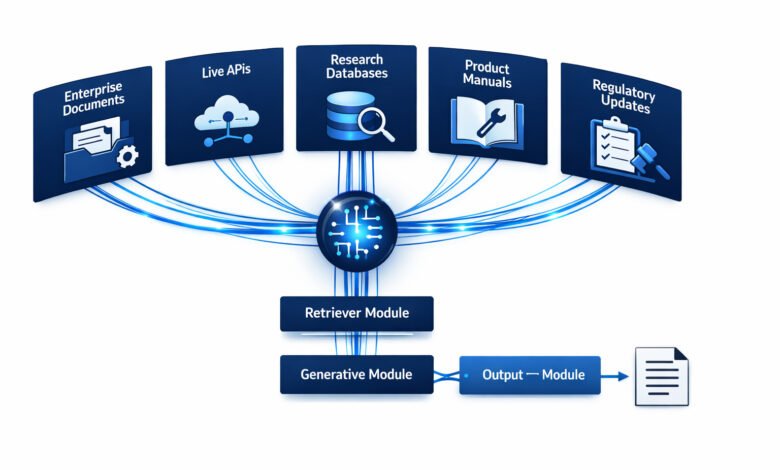
RAG AI Agents: How Retrieval Systems Make AI Smarter
Every large language model faces a fundamental limitation: its knowledge is confined to its original training data, which concludes at a specific point in time. Whether it is a recent regulatory update, a newly announced product recall, or the proprietary details of an organization’s internal policy documents, a static model may either provide outdated information or decline to answer. RAG AI agents—systems that integrate Retrieval-Augmented Generation with autonomous architectures—solve this challenge directly. By reaching beyond their fixed training data to retrieve current, domain-specific knowledge in real-time, they ensure every output is grounded in verifiable and up-to-date information.
⚠️ Tech Disclaimer: This guide explores 2026 AI trends for educational purposes. AI capabilities and software performance vary by platform; this is not professional, technical, or financial advice. Always verify with certified experts for a critical system
Understanding how RAG improves AI agents — and why AI agents with external knowledge outperform static generative models across almost every knowledge-intensive task — is one of the most practically relevant topics in applied AI in 2026. This educational analysis covers the architectural foundations of retrieval augmented AI explained from first principles, examines the AI memory architecture systems that make retrieval possible, and identifies where the future of knowledge-powered AI agents is headed. Meta AI Research’s foundational work on RAG [2] and Stanford’s AI Index 2024 [1] provide the primary research reference points for the capabilities discussed here.
For the broader context — how this shift toward knowledge-connected agents is accelerating the replacement of traditional applications — explore our full pillar guide: AI Personal Agents Are Replacing Your Apps Faster Than You Think.
What is Retrieval-Augmented Generation?
Retrieval-augmented generation (RAG) is an AI architecture that augments a generative language model with a retrieval mechanism — enabling the model to access external knowledge at inference time rather than relying solely on information encoded in its training weights. The concept was formalised in Meta AI’s 2020 research paper [2], which demonstrated that combining a retrieval step with generation substantially improved accuracy on knowledge-intensive tasks compared to either approach used alone.
In a RAG system, when a user submits a query or an agent receives a task, the system does not immediately generate a response from parametric memory. Instead, it first executes a retrieval step: it searches a knowledge base — which may contain documents, databases, API responses, or any indexed information store — to identify the most relevant content for the current query. That retrieved content is then provided as context to the generative model, which produces its output based on the combined input of the query and the retrieved evidence.
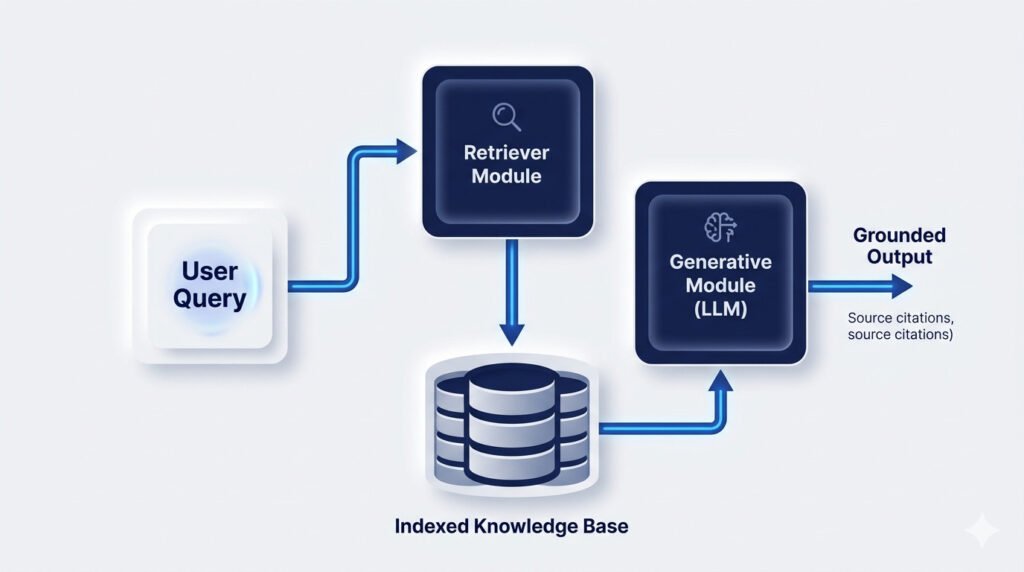
This two-step architecture is retrieval-augmented AI explained at its most fundamental level. The generative model provides language understanding, reasoning, and output quality. The retrieval mechanism provides currency, specificity, and verifiability. Neither component alone achieves what their combination delivers — which is why RAG AI agents have become the dominant architectural pattern for knowledge-intensive enterprise AI deployments in 2026 [4].
🧠 Knowledge Assessment — RAG AI Agents:
Q1: What is the primary mechanism that differentiates RAG AI agents from standard generative AI models?
A) They operate without any internet connection
B) They retrieve relevant external knowledge at inference time to ground their outputs
C) They rely exclusively on pre-trained static weights with no external input
D) They require manual data entry before each response
Q2: Which component of a RAG architecture is responsible for identifying and fetching relevant documents based on a query?
A) The generative module
B) The controller agent
C) The retriever module
D) The output interface
Q3: How does retrieval augmented generation reduce AI hallucination compared to pure generative models?
A) By limiting the model to single-word responses
B) By disabling the model’s language generation capabilities entirely
C) By grounding generation in retrieved verifiable source documents rather than relying solely on training weights
D) By requiring human approval before every output
✅ Correct Answers:
- Q1 → B: Retrieving external knowledge at inference time — unlike static models that rely solely on training data, RAG AI agents dynamically fetch current, relevant information to ground each response.
- Q2 → C: The retriever module — it performs the vector similarity search or keyword query against the knowledge base to identify the most relevant documents for the current task.
- Q3 → C: Grounding generation in retrieved source documents — when a model generates from verified sources rather than relying on parametric memory alone, fabricated or outdated claims are substantially reduced.
Why AI Agents Need External Knowledge
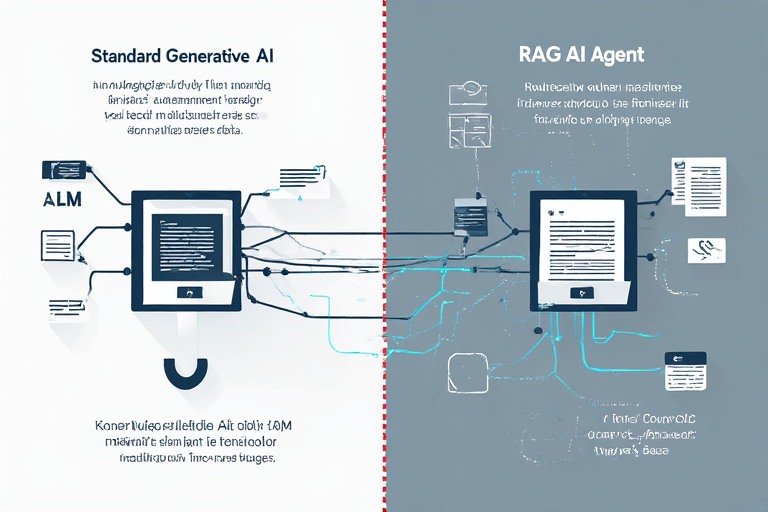
The case for AI agents with external knowledge rests on a structural argument: the knowledge requirements of real-world tasks change continuously, while the knowledge encoded in a trained model is frozen at a fixed point. This creates an accumulating gap between what agents can reliably know and what they actually need to know — a gap that widens with every day that passes after training.
💡 For more information, explore the complete segments of our AI & Personal Technology Series
The Training Cutoff Problem
A language model trained on data up to a specific date cannot know about events, publications, regulatory changes, product updates, or organisational decisions that occurred after that date. For an AI knowledge retrieval system serving a financial analyst, a legal compliance team, or a customer support workflow, this cutoff represents an active liability — not merely a theoretical limitation. The analyst asking about a company’s most recent quarterly results, the compliance officer checking a regulation updated last month, and the support agent addressing a product issue reported yesterday all require information the base model cannot provide.
The Domain Specificity Gap
Beyond the time dimension, there is a domain specificity problem. A general-purpose LLM trained on public web data has no knowledge of an organisation’s internal policies, proprietary databases, customer records, or unpublished research. These are precisely the knowledge assets that make enterprise AI deployments valuable — and they are inaccessible to any static model. AI agents with external knowledge resolve this by treating organisational knowledge bases as first-class retrieval sources, enabling agents to answer questions about internal matters with the same fluency they apply to general knowledge [3].
The Hallucination-at-Scale Problem
When a generative model produces an incorrect answer — fabricating a citation, confabulating a statistic, or misremembering a fact — the error is manageable in a low-stakes conversational context. In an autonomous AI agent workflow that executes decisions across financial, medical, or legal systems, a hallucinated fact can propagate through multiple downstream steps before human review catches it. RAG AI agents address this at the architectural level: by retrieving verifiable source documents and using them as generation context, they substantially reduce the probability of factual confabulation [2].
How RAG Improves AI Agents: Accuracy, Relevance, and Trust
Understanding how RAG improves AI agents requires examining its impact across three dimensions that matter most for production deployments: factual accuracy, contextual relevance, and output transparency.
Factual Accuracy Through Retrieval Grounding
The most directly measurable improvement that retrieval augmented generation delivers is a reduction in factual error rate. When a model generates from retrieved source documents — rather than from parametric memory alone — its outputs are anchored to information that can be independently verified. Meta AI’s original RAG research demonstrated substantial accuracy improvements on open-domain question answering benchmarks compared to pure generation [2]. Stanford’s AI Index 2024 confirms continued improvements in retrieval-grounded generation quality across multiple benchmark categories [1].
Contextual Relevance Through Dynamic Retrieval
A standard generative model applies the same parametric knowledge to every query — whether the question is about general history or the specific contents of a document published yesterday. RAG AI agents dynamically adjust their knowledge context to each specific query, retrieving the most relevant documents from a potentially vast knowledge base and providing them as targeted context for generation. The result is outputs that are contextually tailored to the specific task rather than drawn from a generic knowledge pool — a crucial advantage for enterprise applications where specificity is the value proposition [6].
Transparency Through Source Attribution
One of the most significant AI memory architecture advantages of RAG systems over pure generation is transparency. Because the generation step is grounded in specific retrieved documents, those documents can be cited alongside the output — enabling users to verify claims directly. This source attribution capability is increasingly important for regulated-industry deployments, where the EU AI Act [7] requires demonstrable auditability of AI outputs in high-risk domains.
Architecture of RAG Systems
The AI memory architecture systems that power RAG AI agents consist of four primary components working in a coordinated pipeline. Understanding each component — and how they interact — is the foundation of retrieval augmented AI explained at an architectural level.
Component Overview
- Knowledge base: The indexed repository of documents, databases, or API-accessible data that the retriever searches. Can include internal enterprise documents, public research publications, product documentation, regulatory databases, or any other structured or unstructured information source relevant to the agent’s domain.
- Retriever module: Converts the user’s query into a vector embedding and performs a similarity search against the indexed knowledge base to identify the top-k most relevant documents. Modern retrievers use dense vector search (via embedding models), sparse keyword search (BM25), or hybrid combinations of both for optimal recall.
- Generative module: The LLM that produces the final output — receiving the original query plus the retrieved documents as combined context. The model synthesises across the retrieved sources to produce a coherent, contextually grounded response.
- Controller agent: Orchestrates the flow between retrieval and generation, manages query reformulation when initial retrieval quality is insufficient, handles multi-step retrieval for complex tasks, and coordinates result presentation. In advanced RAG AI agent architectures, the controller may iteratively retrieve, evaluate, and re-retrieve before generating a final response.
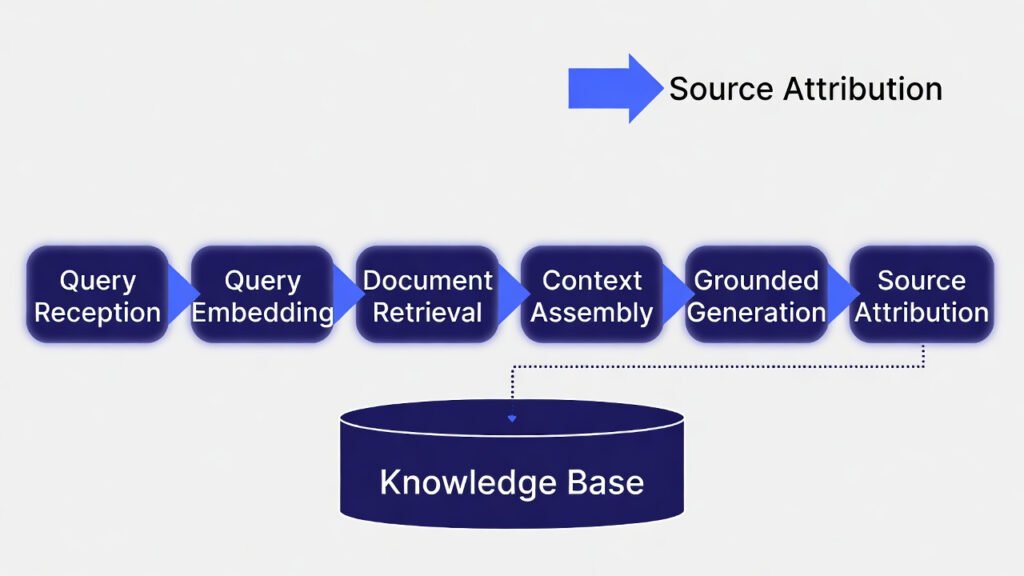
The RAG Workflow: Step by Step
| Step | Stage | What Happens | Module |
| 1 | Query Reception | User or system submits a natural-language task or question | Controller Agent |
| 2 | Query Embedding | Query is converted to a vector representation for similarity search | Retriever Module |
| 3 | Document Retrieval | The Top-k most relevant documents are fetched from the knowledge base | Retriever Module |
| 4 | Context Assembly | Retrieved documents are ranked and assembled as a generation context | Controller Agent |
| 5 | Grounded Generation | LLM generates a response using retrieved context, not training memory | Generative Module |
| 6 | Source Attribution | Response is tagged with source references for transparency | Output Interface |
Use Cases of RAG-Powered AI Agents in 2026
The following deployment contexts illustrate where RAG AI agents are delivering measurable value in 2026 — grounding the architectural concepts above in concrete, observable outcomes.
Enterprise Knowledge Management
Large organisations accumulate vast repositories of policies, procedures, contracts, technical documentation, and institutional knowledge that employees struggle to navigate efficiently. An enterprise RAG AI agent indexes this internal knowledge base and responds to employee queries with answers grounded in the organisation’s own documents — complete with source citations. McKinsey’s analysis identifies enterprise knowledge retrieval as one of the highest-value generative AI applications for knowledge-worker productivity [3].
Customer Support with Product Knowledge
Customer support RAG AI agents retrieve from product manuals, FAQ databases, returns policies, and live customer account records to provide accurate, context-specific responses to support queries. Unlike static chatbots limited to scripted responses, these agents adapt dynamically to each customer’s specific situation — pulling the exact product manual version, the correct policy applicable to their purchase date, and any open case history relevant to their query. Microsoft’s enterprise Copilot deployments demonstrate this retrieval-grounded support model at commercial scale [6].
Research and Scientific Literature Analysis
In research environments, RAG-powered autonomous agents connect to scientific publication databases — PubMed, arXiv, institutional repositories — and synthesise findings across multiple papers in response to complex research queries. The agent retrieves the most relevant recent publications, extracts key findings, identifies methodological patterns, and generates a structured synthesis with full source attribution. Stanford’s AI Index documents substantial AI performance improvements on scientific reasoning benchmarks [1], enabling research AI knowledge retrieval at a depth not previously achievable.
Financial Advisory and Compliance
Financial services RAG AI agents access live market data, regulatory update feeds, company filings, and analyst reports to provide informed, current analysis. Unlike static models that may cite outdated regulatory guidance, a retrieval-grounded financial agent pulls the most recent applicable regulation before generating advice — a critical distinction in a domain where regulatory currency directly affects compliance. The EU AI Act’s requirements for auditability in high-risk AI systems [7] make the source attribution capability of RAG systems particularly valuable for regulated-industry deployments.
Limitations and Challenges of RAG AI Agents
A credible assessment of RAG AI agents requires direct engagement with their documented limitations — the factors that constrain performance and must be addressed in production deployments.
- Retrieval quality dependency: The quality of a RAG AI agent’s outputs is directly bound by the quality of its retrieval. Poorly indexed knowledge bases, noisy or outdated documents, and inadequate embedding models produce retrieval results that mislead generation rather than grounding it. The GIGO principle — garbage in, garbage out — applies to RAG systems with particular force, since retrieved documents that appear relevant but contain errors can actively degrade generation quality compared to no retrieval at all.
- Latency overhead: Adding a retrieval step to the generation pipeline introduces latency that pure generative models do not incur. For real-time applications where response speed matters — live customer support, time-sensitive trading signals — the retrieval latency must be managed through caching, pre-retrieval for anticipated queries, and optimised vector search infrastructure.
- Knowledge base maintenance burden: A RAG system is only as current as its indexed knowledge. Documents that are not updated, regulations that change without triggering re-indexing, and internal knowledge bases that accumulate outdated content all create accuracy risks that undermine the core value proposition of retrieval grounding. Automated re-indexing pipelines and content governance processes are operational requirements, not optional features.
- Context window constraints: While retrieval provides access to a large knowledge base, the context window of the generative model limits how much retrieved content can be provided at once. For highly complex queries requiring synthesis across many documents, the retriever must prioritise effectively, and relevant information beyond the context window limit is unavailable to the generator. Iterative multi-step retrieval architectures partially address this constraint but introduce additional latency and complexity.
- Security and access control complexity: When RAG AI agents retrieve from knowledge bases containing sensitive or access-restricted information, ensuring that agents only retrieve documents that the querying user is authorised to see requires robust access control integration at the retrieval layer. A retriever that does not enforce document-level permissions could expose confidential information through generated outputs — a significant AI agent security risk in enterprise deployments [7].
Strategic Comparison: Standard Generative AI vs RAG AI Agents
| Dimension | Standard Generative AI | RAG AI Agents |
| Knowledge source | Pre-trained static weights only | Dynamic retrieval from live knowledge bases |
| Accuracy | Limited by the training data cutoff | Grounded in current, verifiable sources |
| Hallucination risk | High — relies on parametric memory | Substantially reduced via retrieval grounding |
| Context awareness | Fixed context window of training | Dynamic — retrieves task-relevant context |
| Domain adaptability | Requires fine-tuning per domain | Multi-domain via knowledge base swapping |
| Knowledge freshness | Frozen at the training cutoff date | Real-time — indexes updated continuously |
| Transparency | Opaque — no source attribution | Traceable — outputs cite retrieved sources |
| Update cost | Full model retraining required | Update the knowledge base, not the model |
💡 For more information, explore the complete segments of our AI & Personal Technology Series
The Future of Knowledge-Connected AI
The future of knowledge-powered AI agents extends well beyond the current RAG architecture — three emerging capability frontiers will define the next generation of AI knowledge retrieval systems through 2030.
Federated retrieval systems — architectures in which retrieval occurs across distributed knowledge bases without centralising sensitive data — will enable RAG AI agents to access information from multiple organisations’ systems while preserving data sovereignty and privacy. This is particularly relevant for healthcare, financial services, and research collaboration contexts where valuable knowledge is distributed across institutional boundaries that cannot be crossed by centralised aggregation. DeepLearning.AI identifies federated agentic architectures as a key research direction [5].
Agentic multi-step retrieval — where the controller agent iteratively retrieves, evaluates the sufficiency of retrieved evidence, reformulates queries, and retrieves again before generating — will substantially extend the reasoning depth achievable by RAG AI agents on complex, multi-faceted queries. Rather than a single retrieval step, future AI memory architecture systems will conduct what amounts to a structured research process before generating, approaching the depth of a skilled human researcher for well-scoped analytical tasks. Gartner identifies this multi-step agentic capability as a top strategic trend for 2025–2028 [4].
Explainable RAG and source transparency will become regulatory expectations rather than product differentiators as the EU AI Act’s requirements for high-risk AI auditability mature [7]. Systems that not only cite their sources but expose their retrieval reasoning — showing why specific documents were selected, how they were weighted, and where the generated output derives from each source — will define the governance standard for knowledge-connected AI in regulated industries.
The connection between RAG AI agents and the broader replacement of traditional applications by AI personal agents is direct: agents that can access any knowledge base, stay current without retraining, and provide verifiable outputs are agents that can credibly handle the tasks that apps currently manage in isolation. Learn more in our detailed pillar guide: AI Personal Agents Are Replacing Your Apps Faster Than You Think.
Key Takeaways
- RAG AI agents combine retrieval augmented generation with autonomous agent architectures — enabling access to current, domain-specific knowledge that static training data cannot provide.
- Retrieval augmented AI explained: a retriever module fetches relevant documents from a knowledge base; a generative module produces output grounded in that retrieved context rather than in training memory alone.
- How RAG improves AI agents: substantially reduced hallucination rates, current knowledge access beyond training cutoff, dynamic domain adaptability, and source-attributed transparent outputs.
- AI memory architecture systems in RAG deployments consist of four components: knowledge base, retriever module, generative module, and controller agent — operating through a six-stage workflow.
- High-value use cases include enterprise knowledge management, customer support, scientific research synthesis, and financial compliance — all benefiting directly from AI agents with external knowledge.
- The future of knowledge-powered AI agents points toward federated retrieval, multi-step agentic reasoning, and explainable source transparency — reaching enterprise maturity between 2027 and 2030.
FAQ
Q-1 What are RAG AI agents?
RAG AI agents are autonomous AI systems that combine retrieval augmented generation with agent architectures — retrieving relevant documents from external knowledge bases at inference time and using them to ground generated outputs in current, verifiable information rather than static training data.
Q-2 How does retrieval augmented generation work?
When a query is received, the retriever module converts it to a vector embedding and searches the knowledge base for the most relevant documents. The top results are assembled as context and provided to the generative module alongside the original query. The LLM generates its response using both inputs — producing output grounded in retrieved evidence rather than parametric memory alone. This is retrieval augmented AI explained at the operational level.
Q-3 How does RAG improve AI agents compared to standard models?
On three critical dimensions: factual accuracy (retrieval grounding reduces hallucination substantially), contextual relevance (dynamic retrieval tailors knowledge context to each specific query), and transparency (source attribution makes outputs verifiable and auditable). On knowledge-intensive tasks, RAG AI agents consistently outperform equally capable models without retrieval [2].
Q-4 What are AI memory architecture systems in RAG?
AI memory architecture systems in RAG deployments separate knowledge into two layers: parametric memory (the model’s training weights) and non-parametric memory (the indexed knowledge base). The retrieval step provides controlled access to non-parametric memory at inference time — enabling knowledge updates without retraining the model, and enabling access to proprietary or restricted knowledge that should never enter public training data.
Q-5 What is the future of knowledge-powered AI agents?
Three frontiers: federated retrieval enabling multi-institution knowledge access without data centralisation; multi-step agentic retrieval enabling deep research-style reasoning before generation; and explainable RAG providing full source transparency for regulatory compliance. Gartner projects these capabilities will reach enterprise maturity between 2027 and 2030 [4].
AI & Personal Technology Series
This article is part of the AI & Personal Technology Series — a practical collection of guides exploring how autonomous AI systems are reshaping productivity, privacy, and the future of human-technology interaction.
References
- [1] Stanford HAI — Artificial Intelligence Index Report 2024
- [2] Meta AI Research — Retrieval-Augmented Generation for Knowledge-Intensive NLP Tasks
- [3] McKinsey Global Institute — The Economic Potential of Generative AI (2024)
- [4] Gartner — Top Strategic Technology Trends 2025: Agentic AI
- [5] DeepLearning.AI — How Agents Can Improve LLM Performance
- [6] Microsoft Research — Research at Microsoft 2024 — Copilot and Agentic Systems
- [7] European Commission — EU AI Act — Regulatory Framework for Artificial Intelligence