

The Power of Vertical AI: Why Industry-Specific Agents are Obsolescing Traditional Software (2026)

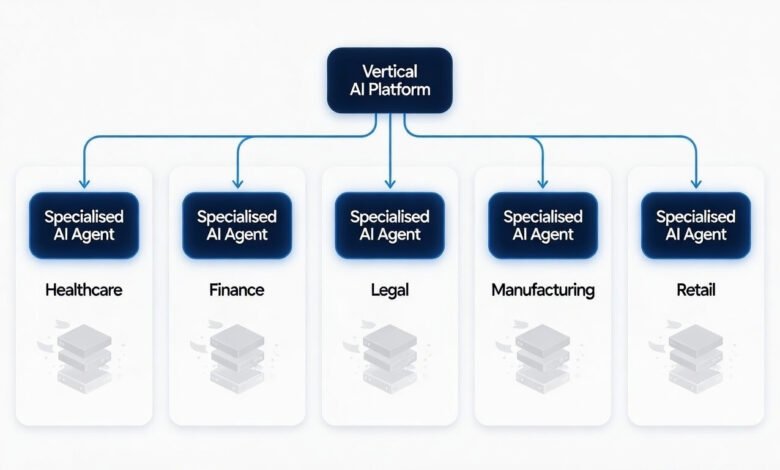
Vertical AI Agents: Industry-Specific AI That Replaces Software
A general-purpose AI agent is a powerful tool. But the physician ordering a differential diagnosis, the compliance officer checking a regulatory filing, and the factory engineer monitoring a production anomaly do not need a general-purpose tool — they need a specialist. Vertical AI agents are that specialist: purpose-built AI systems trained on domain-specific datasets, configured for industry-defined workflows, and capable of operating within the regulatory and terminology constraints that professional environments demand.
⚠️ Tech Disclaimer: This guide explores 2026 AI trends for educational purposes. AI capabilities and software performance vary by platform; this is not professional, technical, or financial advice. Always verify with certified experts for a critical system
The growth of industry AI agents is one of the most commercially significant trends in enterprise technology in 2026. Where general AI tools require substantial fine-tuning and prompt engineering to perform adequately in specialised domains, vertical AI agents arrive with domain competence pre-built — enabling AI industry automation at a precision and compliance level that horizontal tools cannot match without significant additional investment. Stanford’s AI Index 2024 documents substantial improvements in domain-specific AI performance benchmarks across healthcare, legal, and financial tasks [1], providing the capability foundation that is making vertical AI automation platforms commercially viable at scale.
For context on how vertical AI agents fit within the broader shift from traditional applications to agent-based computing. Explore our full pillar guide: AI Personal Agents Are Replacing Your Apps Faster Than You Think.
What Vertical AI Agents Are
Vertical AI agents are autonomous AI systems built for a specific industry domain — trained on that domain’s data, configured for its workflow patterns, pre-loaded with its regulatory requirements, and integrated with the tools and APIs that professionals in that sector use daily. The term vertical is borrowed from the software industry’s distinction between horizontal tools (broadly applicable across industries) and vertical software (built for one industry’s specific requirements).
The defining characteristic of a vertical AI agent is not just its domain knowledge — it is the combination of domain knowledge with autonomous execution capability. A traditional vertical SaaS application knows about a domain but waits for human instruction at each step. A vertical AI agent interprets goals expressed in the domain’s natural language, retrieves relevant domain knowledge, makes domain-appropriate decisions, and executes domain-specific workflows — without requiring a human to translate each task into software actions.
Five Core Characteristics of Vertical AI Agents
- Domain training: Trained on datasets specific to the industry — clinical records and medical literature for healthcare; case law and regulatory filings for legal; financial statements and market data for finance. This domain training produces terminology fluency, contextual judgment, and task accuracy that general-purpose models cannot match on industry-specific tasks.
- Regulatory pre-configuration: Pre-loaded with the compliance requirements applicable to the deployment domain — HIPAA for healthcare, MiFID II for financial services, GDPR for data-processing contexts — enabling specialized AI agents to flag potential violations and enforce compliant workflows without requiring manual policy programming.
- Workflow integration: Built with connectors for the tools that professionals in the target domain use — EHR systems for healthcare, trading platforms for finance, case management systems for legal — enabling industry AI agents to operate within existing workflows rather than requiring workflow redesign around the agent.
- Domain-aware error handling: Configured to treat errors with the risk weighting appropriate to the domain — a diagnostic error in healthcare has different consequences than a scheduling error, and a vertical AI agent in a clinical setting is calibrated accordingly.
- Continuous domain updating: Maintained with updates as domain regulations, clinical guidelines, legal precedents, or market standards evolve — ensuring industry-specific AI agents remain accurate and compliant as their operating environment changes.
🧠 Knowledge Assessment — Vertical AI Agents
- Q1: What is the primary characteristic that distinguishes a vertical AI agent from a general-purpose AI agent?
- A) Vertical AI agents are always less expensive to deploy
- B) They are trained on domain-specific datasets and designed for industry-defined workflows
- C) They operate without any internet connection
- D) They only function within a single organisation’s internal network
- Q2: Why do vertical AI agents outperform general AI tools in regulated industries such as healthcare and law?
- A) They have faster hardware and lower latency
- B) They are pre-trained on domain terminology, regulations, and workflows specific to each industry
- C) They require no integration with existing enterprise software
- D) They operate only in read-only mode to prevent errors
- Q3: Which structural advantage makes vertical AI agents compelling replacements for traditional SaaS software suites?
- A) They are cheaper to license than individual SaaS applications
- B) They consolidate multiple siloed application functions into one domain-intelligent, workflow-integrated agent
- C) They eliminate all human roles in the industry
- D) They require no data to operate
✅ Correct Answers:
- Q1 → B: Domain-specific datasets and industry-defined workflows — vertical AI agents are purpose-built for one industry’s knowledge, terminology, regulatory context, and task patterns.
- Q2 → B: Pre-training on domain terminology, regulations, and workflows — a vertical AI agent in healthcare understands clinical terminology, diagnosis codes, and HIPAA requirements; its general-purpose equivalent does not.
- Q3 → B: Consolidating multiple siloed application functions into one domain-intelligent agent — where an organisation previously ran separate CRM, compliance, analytics, and reporting tools, a vertical AI agent handles all of them within a unified, workflow-aware intelligence layer.
Why Industry-Specific AI Is Growing
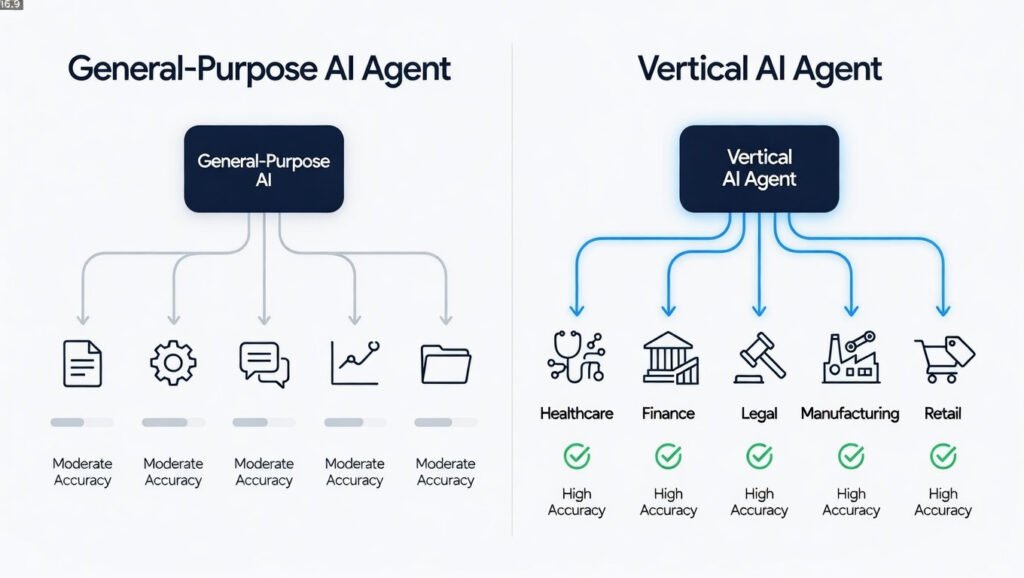
The growth of industry-specific AI agents is driven by three converging forces that are, in 2026, simultaneously pulling enterprise demand toward vertical AI automation platforms and pushing it away from horizontal AI tools.
The Performance Gap in Regulated Domains
General-purpose AI models perform adequately on broadly defined tasks, but regulated industries require precision that generalist approaches struggle to sustain. A legal AI agent that misidentifies the applicable jurisdiction for a contract clause, or a medical AI agent that fails to flag a drug interaction because its training did not include the relevant clinical literature, creates liability rather than value. McKinsey’s analysis of generative AI economic potential identifies domain-specific AI deployments as the configurations producing the highest measurable returns in knowledge-intensive professional services [2].
The SaaS Consolidation Opportunity
Most large enterprises operate dozens of distinct SaaS applications for a single business function — separate tools for CRM, compliance monitoring, analytics, reporting, contract management, and communications within the legal or finance departments alone. Each tool carries licence fees, integration overhead, and training costs. A vertical AI agent that consolidates five or six of these functions into one domain-intelligent system eliminates the per-seat licensing stack while delivering capabilities that none of the individual applications provide. Gartner identifies this SaaS consolidation pattern as a primary driver of enterprise AI adoption for 2025–2028 [3].
Regulatory Pressure for Explainable Domain Intelligence
Regulators in healthcare, financial services, and legal domains are increasingly requiring that AI systems deployed in their sectors be able to explain their decisions in domain-specific terms — not just produce outputs, but demonstrate the reasoning chain that connects inputs to conclusions. Vertical AI agents are better positioned than general-purpose alternatives to satisfy this explainability requirement, because their reasoning is grounded in domain-specific knowledge bases and can be traced back to identifiable domain sources. The EU AI Act’s high-risk classification framework [6] creates the regulatory urgency that is accelerating enterprise adoption of specialized AI agents with built-in audit trails.
“Examples of Vertical AI Agents in Healthcare, Finance, Law, and Manufacturing
The following examples of vertical AI agents are drawn from active commercial deployments in 2026, illustrating the specific workflow and performance advantages that AI agents in healthcare, finance, and law deliver compared to the general-purpose and traditional software approaches they are replacing.
Healthcare: Clinical Decision Support and Patient Management
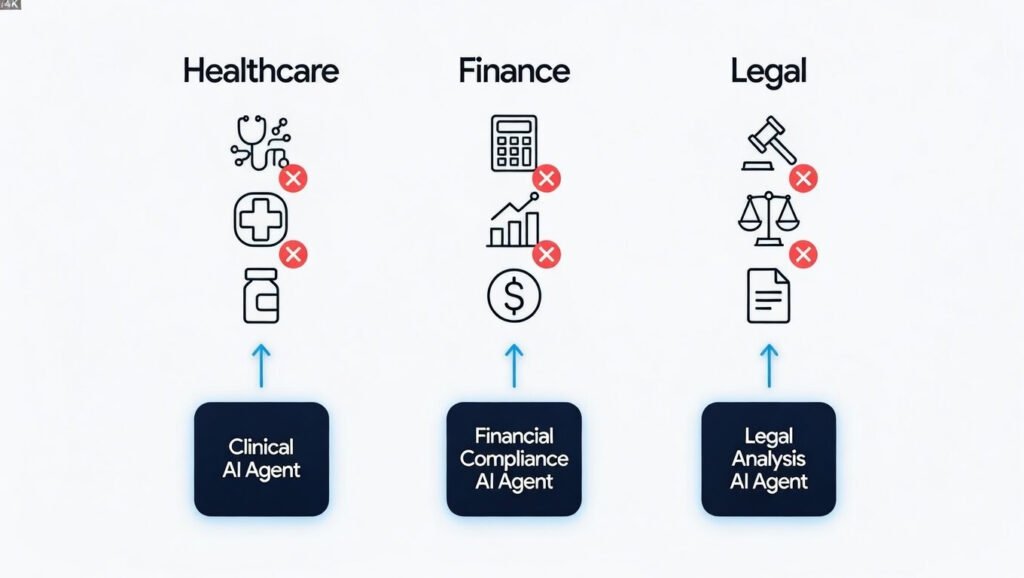
In clinical settings, vertical AI agents are deployed across three primary workflow categories. Diagnostic support agents analyse patient records, lab results, imaging data, and clinical notes to generate structured differential diagnoses for physician review — grounding recommendations in the specific patient’s history and the most current clinical guidelines. Patient management agents coordinate appointment scheduling, medication adherence monitoring, and care pathway tracking across complex multi-specialist cases. Administrative agents handle clinical documentation, coding, and insurance authorisation workflows — reducing the administrative burden that accounts for a significant proportion of clinical staff time.
Stanford’s AI Index documents substantial AI performance improvements on clinical diagnosis benchmarks, with domain-specific models achieving accuracy levels competitive with specialist physician performance on specific diagnostic tasks [1]. These industry AI agents in healthcare operate under HIPAA compliance requirements built into their architecture — not added as post-deployment restrictions but integrated as operational constraints from the ground up.
Finance: Risk Analysis, Compliance, and Portfolio Management
In financial services, vertical AI agents address three high-value automation opportunities. Regulatory compliance agents monitor transaction flows, flag potential violations of jurisdiction-specific financial regulations (MiFID II, Dodd-Frank, Basel [1], generate required regulatory reports, and maintain audit trails with the granularity that regulatory examinations require. Risk analysis agents continuously process market data, counterparty information, and portfolio positions to generate real-time risk assessments that human analysts reviewing static reports cannot match for timeliness. Portfolio management agents optimise allocation decisions within defined investment mandates, balancing risk parameters against return objectives across multi-asset portfolios.
McKinsey identifies financial services as one of the two highest-value sectors for AI industry automation — with compliance automation and risk management representing the clearest near-term return on investment for vertical AI automation platforms [2]. The precision required in these contexts — where a compliance gap or a risk miscalculation can generate significant regulatory and financial liability — makes the domain-specific training of vertical AI agents a direct business requirement, not merely a preference.
Manufacturing: From Reactive Repairs to Autonomous Predictive Maintenance
In the industrial sector, vertical AI agents are replacing traditional Enterprise Asset Management (EAM) software with autonomous predictive maintenance systems. Instead of waiting for a machine to fail or following a rigid manual schedule, these specialized agents continuously analyze real-time IoT sensor data, acoustic patterns, and thermal imaging. By identifying microscopic anomalies before they escalate, vertical AI agents autonomously trigger work orders, manage spare parts inventory, and optimize production downtime—shifting manufacturing from a reactive ‘fix-it-when-it-breaks’ model to a proactive, self-healing ecosystem.”
Legal: Contract Analysis and Compliance Monitoring
In legal practice, vertical AI agents are transforming three workflow categories. Contract analysis agents review commercial agreements to identify non-standard clauses, missing provisions, jurisdiction-specific compliance gaps, and risk items — at a speed and consistency that manual review cannot match for large document volumes. Compliance monitoring agents track regulatory updates across relevant jurisdictions and map changes to an organisation’s existing policies and contracts, flagging required updates before regulatory deadlines. Legal research agents retrieve and synthesise case law, regulatory guidance, and precedent across large legal databases — compressing multi-day research tasks into structured analyses available within minutes.
These AI agents in healthcare, finance, and law share a common structural property: they replace not just the software tools in each domain, but the workflow model itself — shifting from applications that present information to human decision-makers to agents that actively execute domain workflows with humans reviewing conclusions rather than performing every step. This is the industry-specific AI agents’ value proposition that is driving adoption across professional services sectors in 2026 [7].
💡 For more information, explore the complete segments of our AI & Personal Technology Series
Advantages Over Generic AI Tools
The case for vertical AI agents over general-purpose AI tools is strongest in the dimensions that matter most for professional domain deployment: accuracy on domain tasks, regulatory compliance, integration with existing workflows, and time to operational value.
| Dimension | General-Purpose AI Agent | Vertical AI Agent |
| Knowledge scope | Broadly trained in general web data | Deep — trained on domain-specific datasets |
| Task accuracy | Moderate on specialised tasks | High — optimised for industry task patterns |
| Regulatory awareness | None built-in | Pre-configured for industry compliance standards |
| Terminology | General language understanding | Domain vocabulary — medical, legal, financial |
| Workflow integration | Generic API connections | Built-in connectors for sector-specific tools |
| Update mechanism | General model retraining | Domain knowledge base and compliance updates |
| Error consequences | Low stakes in most contexts | Managed — domain-aware error handling protocols |
| Time to productivity | High — requires significant fine-tuning | Lower — domain context pre-loaded at deployment |
The time-to-productivity advantage deserves particular emphasis. A vertical AI agent in a legal or healthcare context arrives with clinical or legal terminology, regulatory context, and workflow patterns pre-loaded — reducing the fine-tuning, prompt engineering, and contextual configuration that deploying a general-purpose agent in the same context would require. For enterprises assessing the total cost of deployment, this pre-configured domain competence represents a substantial reduction in the hidden costs that general-purpose AI tools impose [4].
Business Opportunities of Vertical AI
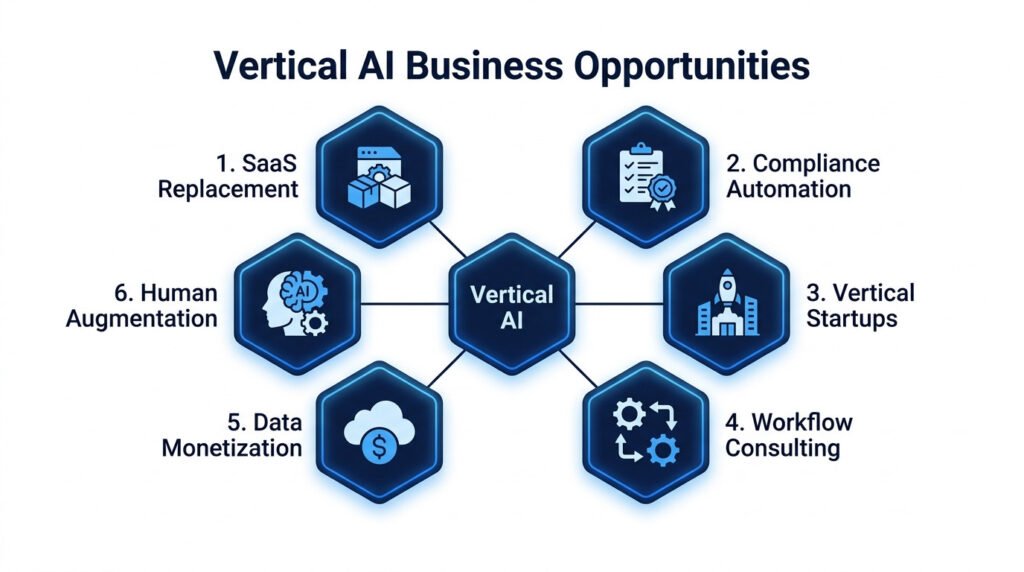
The vertical AI agents market is creating commercially significant opportunities across multiple business model categories — for technology vendors, domain consultancies, and the enterprises deploying these systems.
| Business Opportunity | Value Created | Primary Beneficiary |
| SaaS replacement | One agent replaces 3–7 siloed applications | Enterprise IT — licence cost reduction |
| Compliance automation | Real-time regulatory monitoring and reporting | Finance, healthcare, and legal organisations |
| Vertical AI startups | Niche domain agents as subscription services | Sector-specialist software developers |
| Workflow consulting | Domain agent integration and optimisation services | IT consultancies and systems integrators |
| Training data monetisation | Proprietary domain datasets licensed to AI vendors | Institutions with unique domain knowledge |
| Human-AI augmentation | Staff redeployed from routine to strategic work | Professional services firms |
The most significant near-term commercial opportunity is SaaS replacement — where a vertical AI agent consolidates the function of multiple domain-specific applications into a single intelligent system. For a mid-size financial services firm running eight separate compliance, analytics, and reporting tools, consolidating to one specialized AI agent can reduce software licensing costs substantially while delivering capabilities that none of the individual tools provide. McKinsey projects that AI-enabled software consolidation in professional services will represent one of the largest efficiency gains in enterprise IT spend through 2030 [2].
The vertical AI startup opportunity is equally compelling: organisations with deep proprietary knowledge in a specific domain — a major hospital network, a leading law firm, a specialist financial institution — hold training data assets that general-purpose AI vendors cannot replicate. Licensing that proprietary domain knowledge, or building purpose-built vertical AI automation platforms on top of it, represents a durable competitive advantage for early movers in each sector [3].
Challenges of Specialised AI Systems
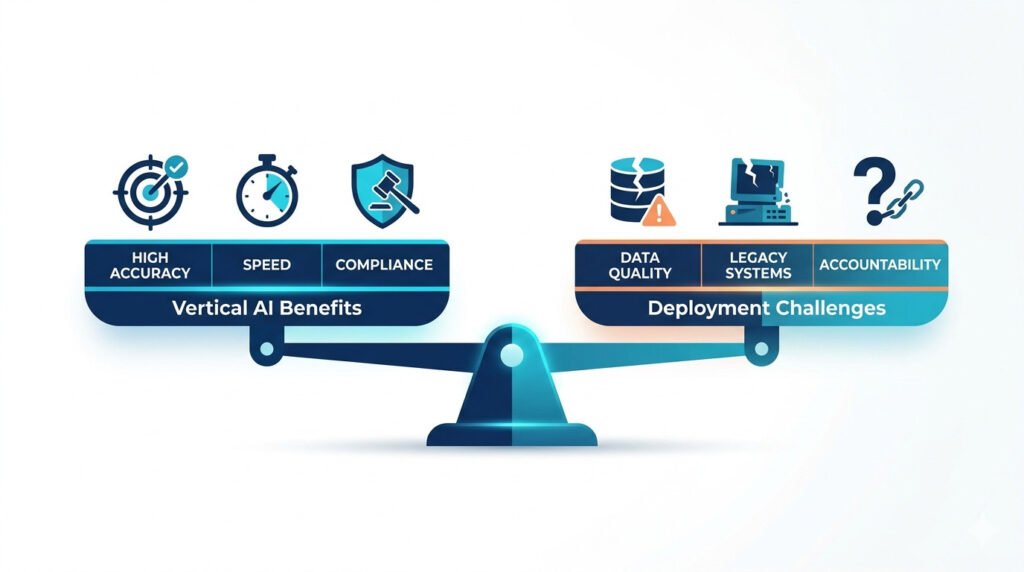
The advantages of vertical AI agents come with deployment challenges that must be addressed honestly — particularly for organisations in regulated industries where the consequences of AI errors are not merely inconvenient but potentially harmful.
- Data availability and quality: The performance of a vertical AI agent is directly bound by the quality and coverage of its domain training data. For rare conditions in healthcare, novel legal precedents, or unusual financial instruments, the agent’s training distribution may not include sufficient examples, producing overconfident outputs in edge cases. Organisations must assess training data coverage before deployment and establish human escalation paths for out-of-distribution scenarios.
- Legacy system integration complexity: Most enterprises operate core domain systems — EHRs, trading platforms, case management systems — that were built before modern APIs were standard. Integrating industry-specific AI agents with these legacy platforms requires custom connectors, data transformation layers, and extensive testing that can substantially extend deployment timelines.
- Regulatory update latency: In rapidly evolving regulatory environments — financial services post-2023, healthcare data governance, AI-specific EU Act requirements [6] — the interval between a regulatory change and a vertical AI agent’s update to reflect that change creates a compliance gap. Organisations must implement continuous regulatory monitoring and rapid agent update processes, or accept that the agent’s compliance knowledge is not instantaneously current.
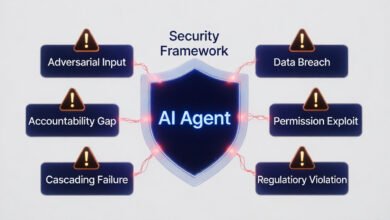
- Accountability in high-stakes decisions: When a vertical AI agent contributes to a clinical, legal, or financial decision that produces a harmful outcome, accountability attribution is legally complex. Who is responsible — the agent developer, the deploying organisation, or the professional who relied on the agent’s output? The EU AI Act [6] and sector-specific professional liability frameworks are beginning to address this question, but the governance landscape is still maturing.
- Skill atrophy risk in professional practice: As industry AI agents automate the routine analytical tasks that junior professionals traditionally performed, the question of how domain expertise develops in the next generation of practitioners becomes significant. MIT Sloan Management Review identifies maintaining meaningful human skill development as a core challenge in professional AI augmentation strategies [7].
The Future of Industry AI Agents: 2026–2030
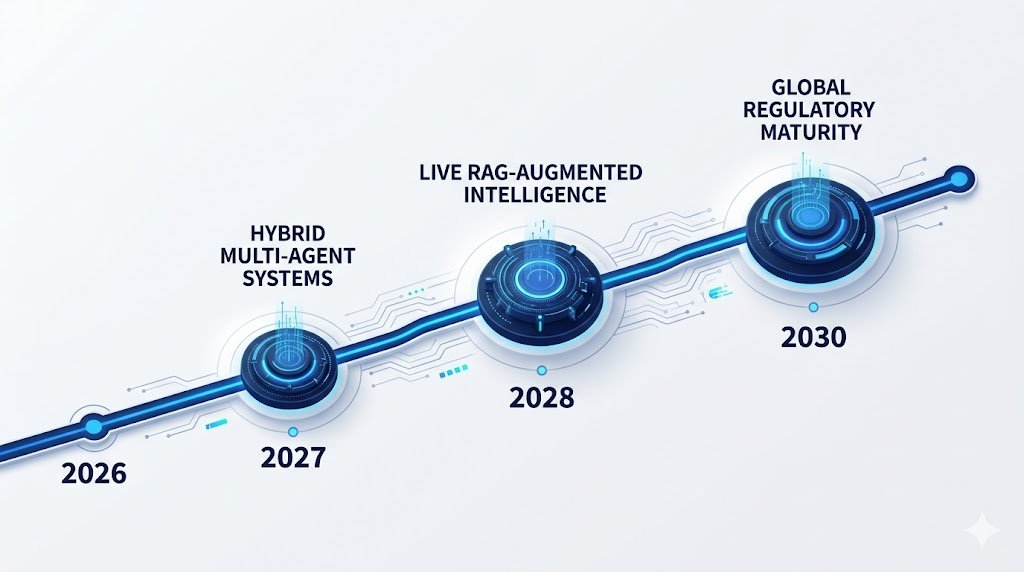
The future of industry AI agents is defined by three converging developments that will substantially extend what vertical AI automation platforms can accomplish through 2030.
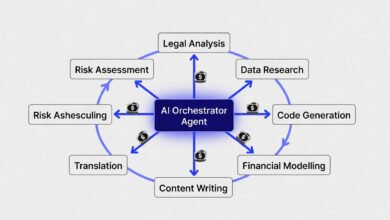
Hybrid multi-agent vertical systems — architectures that combine multiple specialized AI agents, each with deep competence in a specific sub-domain, coordinated by an orchestrating agent that synthesizes their outputs — will extend vertical AI beyond single-function automation to genuinely integrated domain intelligence. A healthcare hybrid system might combine a diagnostic agent, a pharmacology agent, a regulatory agent, and a patient communication agent — each expert in its domain, collectively delivering capabilities no single agent could provide. DeepLearning.AI identifies multi-agent specialisation as the primary mechanism for extending LLM performance on complex real-world tasks [4].
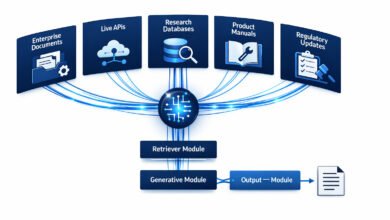
RAG-augmented vertical intelligence — combining vertical AI agents with retrieval-augmented generation architectures that can access continuously updated domain knowledge bases — will eliminate the training cutoff limitation that currently constrains vertical AI accuracy in rapidly evolving regulatory and clinical environments. A legal vertical agent that retrieves from a live case law database updated daily, or a compliance agent that accesses a continuously indexed regulatory change feed, achieves currency that static training cannot provide.
Regulatory maturation for vertical AI will determine the pace of adoption in healthcare, financial services, and legal services — the three domains where the EU AI Act’s high-risk classification [6] and sector-specific professional liability frameworks impose the greatest compliance requirements on deploying organisations. Gartner projects that the governance frameworks required for industry AI agents in regulated domains will reach operational maturity between 2027 and 2029 — with organisations that develop compliant deployment architectures early gaining significant first-mover advantages [3].
As vertical AI agents mature, their relationship to the broader platform shift is clear: they are the specialisation layer of the same agent ecosystem that is replacing the app model at the general level. For the broader picture of this transition, learn more in our detailed pillar guide: AI Personal Agents Are Replacing Your Apps Faster Than You Think.
Key Takeaways
- Vertical AI agents are autonomous AI systems purpose-built for specific industries — trained on domain data, pre-configured for sector regulations, and integrated with domain tools — delivering performance that general-purpose agents cannot match on industry-specific tasks.
- Examples of vertical AI agents in production include clinical decision support in healthcare, regulatory compliance automation in finance, and contract analysis in legal — each replacing multiple siloed software applications with a single domain-intelligent system.
- Industry-specific AI agents outperform general AI on domain accuracy, regulatory awareness, terminology fluency, and time to operational productivity — as documented by Stanford’s AI Index and McKinsey’s generative AI analysis.
- AI agents in healthcare, finance, and law face four primary deployment challenges: training data coverage, legacy system integration, regulatory update latency, and accountability frameworks — all requiring structured governance approaches.
- Vertical AI automation platforms are creating six distinct business opportunities: SaaS replacement, compliance automation, vertical AI startups, workflow consulting, proprietary data monetisation, and human-AI augmentation.
- The future of industry AI agents points to hybrid multi-agent vertical systems, RAG-augmented continuous knowledge access, and regulatory maturation — with enterprise deployment maturity projected between 2027 and 2029.
FAQ
Q1- What are vertical AI agents?
Vertical AI agents are autonomous AI systems built for a specific industry — with domain-specific training data, regulatory pre-configuration, workflow integration, and domain-aware error handling. They differ from general-purpose AI agents in that they arrive with industry competence built in, rather than requiring fine-tuning and prompt engineering to perform adequately on domain tasks.
Q2- What are the best examples of vertical AI agents in 2026?
The clearest examples of vertical AI agents in production deployment are: clinical decision support and patient management agents in healthcare; regulatory compliance, risk analysis, and portfolio management agents in financial services; and contract analysis, compliance monitoring, and legal research agents in law. Each domain’s agents replace multiple specialist SaaS applications with a single workflow-integrated autonomous system.
Q3- How do industry-specific AI agents differ from general AI tools?
Industry-specific AI agents are trained on domain datasets, pre-configured for sector regulations, and integrated with domain tools — making them operational in the target industry from deployment rather than requiring extensive customisation. General AI tools offer broader applicability but require significant domain-specific configuration to perform at the accuracy level that professional environments require.
Q4- What is the future of vertical AI automation platforms?
Three frontiers: hybrid multi-agent vertical systems combining specialised sub-agents for different domain functions; RAG-augmented agents with access to continuously updated domain knowledge bases; and regulatory governance frameworks enabling compliant deployment in high-risk professional environments. Gartner projects enterprise-maturity vertical AI automation platforms in regulated domains reaching production readiness between 2027 and 2029 [3].
Q5- Are vertical AI agents replacing human professionals?
Not replacing — augmenting. The most effective deployments of vertical AI agents in healthcare, finance, and legal services shift professional workflows rather than eliminate professional roles. Routine analytical and documentation tasks are automated; human professionals focus on complex judgment, client relationships, and oversight of agent outputs. MIT Sloan Management Review identifies this augmentation model — rather than replacement — as the deployment pattern producing the highest combined human-AI performance outcomes [7].
AI & Personal Technology Series
This article is part of the AI & Personal Technology Series — a practical collection of guides exploring how autonomous AI systems are reshaping productivity, privacy, and the future of human-technology interaction.
References
- [1] Stanford HAI — Artificial Intelligence Index Report
- [2] McKinsey Global Institute — The Economic Potential of Generative AI
- [3] Gartner — Top Strategic Technology Trends 2025: Agentic AI
- [4] DeepLearning.AI — How Agents Can Improve LLM Performance
- [5] Microsoft Research — Research at Microsoft 2024 — Copilot and Agentic Systems
- [6] European Commission — EU AI Act — Regulatory Framework for Artificial Intelligence
- [7] MIT Sloan Management Review — The Collaborative Intelligence That Humans and AI Can Achieve

Good
Job