Somatic Therapy and Body-Based Healing: A 2026 Guide to Releasing Trauma Stored in the Body


Why the Body Holds What the Mind Cannot Process
Many people starting their burnout recovery journey find that somatic therapy is the missing piece in regulating their nervous system.
In the landscape of modern mental wellness, somatic therapy has emerged as a cornerstone for those seeking deep, physiological resolution. While traditional talk therapy addresses the mind, body-based healing focuses on the nervous system, offering a structured pathway to release the tension that our conscious memory cannot always access
Bessel van der Kolk’s landmark research — summarized in The Body Keeps the Score (2014) and his foundational 1994 paper — established that traumatic experience is encoded in somatic memory and expressed through biological stress responses (van der Kolk, 1994). It is encoded throughout the body in posture, muscle tone, breath patterns, and autonomic nervous system responses. When the mind overwhelms its capacity to process experience, the body steps in as storage[1][2].
⚠️MEDICAL DISCLAIMER: This article provides educational information about somatic therapy, trauma recovery, and body-based healing based on current research (2026). It is not a substitute for a professional mental health diagnosis or treatment. Trauma-related conditions require individualized assessment by a qualified clinician.
The consequence is significant: conventional talk therapy—while invaluable for many presentations—addresses the cognitive and narrative aspects of experience without directly engaging the physiological encoding.
Research suggests that a substantial proportion of trauma survivors who achieve symptomatic relief through talk therapy alone may retain significant somatic symptoms, including chronic muscle tension, hypervigilance, and disrupted interoception. Somatic approaches target these symptoms directly, often producing changes that years of cognitive work could not.
💡 For more information, explore the complete segments of our Mental Wellness Series Overview
Emerging evidence: Neuroimaging research is beginning to demonstrate measurable changes in amygdala activity, hippocampal density, and the insula—the brain region responsible for interoception—following effective somatic therapy. These findings suggest neurobiological correlates associated with body-based healing, though the evidence base continues to develop.
The Science of Somatic Experience: Polyvagal Theory Explained
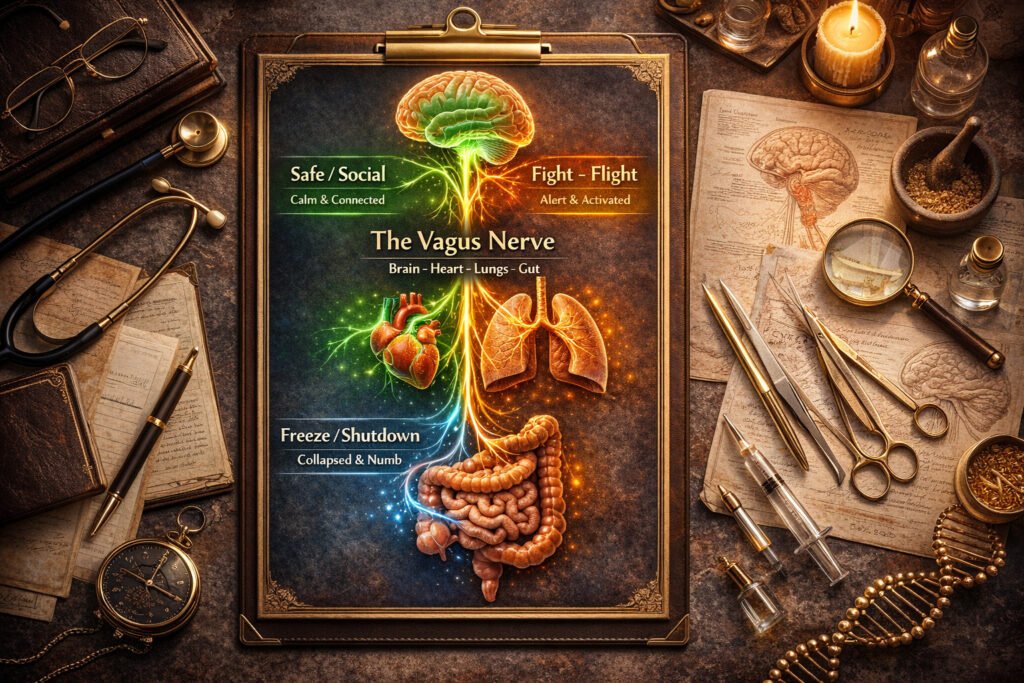
Dr. Stephen Porges’ Polyvagal Theory — introduced in 1994 and elaborated in his 2011 book — provides the scientific foundation for understanding why somatic approaches work (Porges, 2009). The theory identifies three hierarchical nervous system states, each with distinct physiological signatures and psychological experiences:[3]
| State | Physiological Signature | Psychological Experience | Somatic Entry Point |
| Ventral Vagal (Safe/Social) | Slow heart rate; relaxed facial muscles; engaged voice tone | Safety, connection, curiosity, creativity, openness | Slow exhale breath; gentle eye contact; humming; social touch |
| Sympathetic (Fight/Flight) | Elevated heart rate; muscle tension; dilated pupils; cortisol surge | Anxiety, anger, urgency, hypervigilance, reactivity | Vigorous movement; cold exposure; vocalization; grounding exercises |
| Dorsal Vagal (Freeze/Shutdown) | Slowed heart rate; dissociation; numbness; digestive shutdown | Numbness, helplessness, depression, dissociation, collapse | Titrated sensory stimulation; rhythm; gentle warmth; safe connection |
Critical insight: Trauma processing is most effective when the nervous system has access to ventral vagal regulation. Persistent sympathetic or dorsal vagal activation can significantly impair integration capacity — the higher brain centers required for integration are effectively offline. Somatic practices, therefore, establish safety in the nervous system before approaching traumatic material, and this careful sequencing is what distinguishes skilled somatic work from potentially destabilizing approaches.
Somatic Therapy Modalities: A Comparative Guide

| Modality | Core Mechanism | Best Evidence For | Session Format |
| Somatic Experiencing (SE) | Titrated body-sensation tracking; pendulation between distress and resource states | Developmental trauma; PTSD; chronic stress; anxiety | Individual therapy, 50–90 min sessions |
| EMDR | Eye movement desensitization and reprocessing: bilateral stimulation during trauma memory recall facilitates adaptive processing — recommended by WHO and NICE guidelines as first-line PTSD treatment (Simpson et al., 2025) [4] | Single-event trauma; PTSD; phobias; performance anxiety | Individual therapy; typically 8–12 sessions per trauma target |
| Sensorimotor Psychotherapy | Tracking habitual body postures and movements as trauma markers | Complex/developmental trauma; dissociation; attachment wounds | Individual therapy; often longer-term work |
| Trauma-Sensitive Yoga | Interoceptive awareness in a group setting with modified trauma-safe cueing | PTSD; eating disorders; developmental trauma; chronic pain | Group classes or individual sessions; accessible entry point |
| Clinical Breathwork | Controlled breathing patterns to shift autonomic state; process stored emotion | Anxiety; PTSD; emotional numbing; burnout recovery | Individual or group; standalone or integrated with other therapy |
| TRE (Tension & Trauma Release) | Graduated exercises induce neurogenic tremoring to discharge stored tension | Chronic muscle tension, stress, emotional numbing, PTSD | Learned with a practitioner; then practiced independently |
Breathwork: One of the Fastest Accessible Nervous System Reset Tools

Of all somatic tools, breathwork is the most accessible—requiring no equipment, no practitioner, and no special environment. The breath is unique among autonomic functions: it operates automatically, yet is also under voluntary control. This makes it the primary manual override for your nervous system state:
| Technique | Protocol | Primary Effect | Best Used For |
| Extended exhale (4-2-6) | Inhale 4 counts, hold 2, exhale 6 counts | Activates vagus nerve; shifts to parasympathetic state | Daily regulation; pre-sleep; general anxiety management |
| Box breathing (4-4-4-4) | Equal counts: inhale, hold, exhale, hold | Balances sympathetic/parasympathetic; increases heart rate variability | Before high-pressure situations, the acute stress response |
| 4-7-8 breathing | Inhale 4, hold 7, exhale 8 counts | Strong parasympathetic activation measurably reduces cortisol | Sleep onset difficulty; acute anxiety; panic prevention |
| Physiological sigh | Double inhale through nose, long, slow exhale through mouth | Fastest known single-breath intervention for CO2 balance and calm | Acute overwhelm; fastest available immediate intervention |
| Coherent breathing (5.5 BPM) | 5.5 seconds inhale, 5.5 seconds exhale (resonance breathing) | Maximizes heart rate variability; produces deep systemic regulation | Daily 5-minute practice; chronic anxiety; HRV optimization |
Research from Stanford found that cyclic sighing and controlled breathing patterns produce rapid parasympathetic activation and cortisol reduction, with effects comparable to mindfulness meditation in controlled trials (Balban et al., 2023). This makes breathwork particularly valuable for individuals who find meditation difficult due to anxious rumination or restlessness.[5]
Somatic Practices You Can Begin Today
Body Scan for Tension Awareness
Lie down or sit comfortably. Starting from the top of your head, slowly move attention through each body region—noticing (not trying to change) what you find: tension, numbness, warmth, coolness, tingling, or neutral sensation. Practice for 10 minutes daily. Over 3–4 weeks, this builds interoceptive awareness—the foundational skill for all somatic work. Research suggests that daily body scan practice is associated with meaningful reductions in chronic pain scores and anxiety levels (Journal of Psychosomatic Research).
Grounding — The 5-4-3-2-1 Technique
When overwhelmed: Name 5 things you can see, 4 you can physically touch, 3 you can hear, 2 you can smell, 1 you can taste. This technique works by redirecting attention to present-moment sensory experience, activating the prefrontal cortex, and directly reducing amygdala reactivity. Takes under 2 minutes; often effective within a single application during acute distress.
Pendulation Practice (From Somatic Experiencing)
Identify a current area of tension or discomfort in your body. Then deliberately shift attention to a part of your body that feels neutral or pleasant—perhaps your feet on the floor, or warm hands in your lap. Slowly alternate attention between the two for 10 minutes. This teaches your nervous system that distress is tolerable and can coexist with resource and safety. Practiced daily, it gradually expands your window of tolerance.
TRE — Tension and Trauma Releasing Exercises
Developed by Dr. David Berceli, TRE uses a series of graduated exercises to fatigue the hip flexors and psoas muscles—which chronically contract under stress—and induce a natural neurogenic tremoring response. This tremoring (which occurs naturally in animals after threat resolution) discharges accumulated sympathetic nervous system activation. TRE is initially learned with a certified practitioner, then practiced independently. Increasingly available in group and online formats worldwide.
Who Benefits Most from Somatic Approaches
| Population | Why Somatic Approaches Help | Recommended Starting Point |
| Talk therapy non-responders | Cognitive approaches haven’t resolved physical symptoms; somatic targets what was missed | Somatic Experiencing or Sensorimotor Psychotherapy with a qualified therapist |
| Chronic pain sufferers | A significant percentage of chronic pain has central sensitization components with psychological origins | Trauma-sensitive yoga; body scan practices; SE if trauma history is present |
| Burnout recovery | Physical exhaustion and nervous system dysregulation respond better to body-based than cognitive approaches | Breathwork; gentle movement; nature immersion; restorative rest prioritization |
| Complex/developmental trauma | Early relational trauma, encoded pre-verbally, responds poorly to purely narrative approaches | Sensorimotor Psychotherapy or SE; typically longer-term integrated work |
| Male trauma survivors | Some male trauma survivors report greater comfort with body-based modalities that don’t require emotional verbalization as the primary mode | Physical activity-based processing; EMDR; SE; structured breathwork |
💡 For more information, explore the complete segments of our Mental Wellness Series Overview
Integrating Somatic and Talk Therapies
The most effective trauma and anxiety treatment integrates bottom-up (body-to-brain) and top-down (brain-to-body) approaches simultaneously:
- Purely cognitive approaches (CBT, traditional psychodynamic therapy) address narrative and thought patterns but leave physiological encoding largely untouched
- Purely somatic approaches discharge stored nervous system activation but may leave cognitive distortions and relational patterns unaddressed
- Integrated approaches—combining CBT, ACT, or psychodynamic work with somatic practices—consistently show superior outcomes for complex presentations in research literature [6]
When selecting a therapist, ask directly: “Do you integrate somatic approaches into your work, and how do you do that in practice?” A qualified integrated therapist will be able to explain their specific approach and how they sequence body-based and cognitive interventions based on your presenting needs.
Finding a Qualified Somatic Practitioner
Somatic therapy quality varies significantly. Use these certification bodies to identify properly trained practitioners:
| Modality | Certification Body | Search Resource |
| Somatic Experiencing (SE) | Somatic Experiencing International (SEI) | traumahealing.org/practitioners [8] |
| EMDR | EMDR International Association (EMDRIA) | emdria.org/find-a-therapist[7] |
| Sensorimotor Psychotherapy | Sensorimotor Psychotherapy Institute (SPI) | sensorimotorpsychotherapy.org |
| Trauma-Sensitive Yoga | Trauma Center Trauma Sensitive Yoga (TCTSY) | traumasensitiveyoga.com |
| TRE | Tension and Trauma Releasing Exercises (TRE for All) | tre4all.com/providers |
Cost and access: Many somatic practitioners offer sliding scale fees. University training clinics often provide supervised SE and EMDR at significantly reduced rates. Online delivery of both SE and EMDR has been validated by research during and after the pandemic period. It represents a legitimate and increasingly accessible option for those in areas with limited in-person availability.
Trauma is not only remembered—it is embodied. Somatic therapy offers a structured, evidence-informed pathway for restoring nervous system regulation and releasing patterns stored beyond conscious narrative memory. When integrated thoughtfully with cognitive approaches, body-based healing can transform trauma recovery from intellectual understanding into full physiological resolution.
Sustainable trauma recovery requires both nervous system regulation and cognitive integration. When body-based and narrative approaches work together, healing moves beyond symptom relief toward lasting structural change.
FAQ
Q: Is somatic therapy suitable for everyone?
Most people benefit, but approach and timing matter significantly. Active psychosis, severe dissociation, or highly unstable life circumstances generally require stabilization before deep somatic trauma work. A qualified practitioner will carefully assess readiness and adapt the pace accordingly. Gentle practices like breathwork and grounding techniques are broadly safe for most people without specialist oversight.
Q: How is somatic therapy different from massage therapy?
Massage primarily targets muscular release through physical manipulation of tissue. Somatic therapy is a psychological intervention that uses body awareness, movement, and sometimes touch (with clear, ongoing consent protocols) to process emotional and traumatic experience stored in the nervous system. The primary working mechanism is psychological and neurological, not physical manipulation.
Q: Will somatic therapy make me feel worse before I feel better?
Skilled somatic work is titrated—meaning it approaches difficult material in small, carefully managed doses rather than overwhelming flooding. A qualified practitioner works at the boundary of your window of tolerance. Some emotional release or temporary discomfort is normal and part of the processing. Sustained worsening or significant destabilization is a signal to slow down considerably and discuss with your practitioner immediately.
Q: How many somatic therapy sessions does recovery typically require?
Highly variable. Single-event trauma may resolve meaningfully in 8–12 EMDR sessions. Complex developmental trauma may require years of integrated, careful work. Most people notice meaningful shifts within 8–12 sessions of skilled SE work, even if full integration takes considerably longer. Progress in somatic work is rarely linear and often involves periods of apparent plateau followed by significant breakthroughs.
Q: Can I practice somatic techniques safely on my own at home?
Yes—gentle practices like breathwork, body scan, grounding (5-4-3-2-1), and basic pendulation are broadly safe for self-practice. TRE is best learned initially with a certified practitioner before solo practice. For complex trauma, working with a qualified practitioner is strongly recommended for initial work, with self-practice used to supplement and extend between sessions.
Mental Wellness Series Overview
This article is part of the Mental Wellness Series — an evidence-based collection of guides exploring psychological resilience, mental health strategies, and the science behind sustainable wellbeing in 2026.
REFERENCES
- [1] van der Kolk, B. A. (1994). The body keeps the score: Memory and the evolving psychobiology of posttraumatic stress. Harvard Review of Psychiatry, 1(5), 253-265. doi:10.3109/10673229409017088 https://pubmed.ncbi.nlm.nih.gov/9384857/
- [2] van der Kolk, B. A. (2014). The Body Keeps the Score: Brain, Mind, and Body in the Healing of Trauma. Viking/Penguin. (Foundational text on somatic encoding of trauma and body-based treatment approaches)
https://www.besselvanderkolk.com/resources/the-body-keeps-the-score - [3] Porges, S. W. (2009). The polyvagal theory: New insights into adaptive reactions of the autonomic nervous system. Cleveland Clinic Journal of Medicine, 76(Suppl 2), S86-S90. doi:10.3949/ccjm.76.s2.17
https://pmc.ncbi.nlm.nih.gov/articles/PMC3108032/ - [4] Simpson, J., et al. (2025). Clinical and cost-effectiveness of EMDR for treatment and prevention of PTSD in adults: A systematic review and meta-analysis. British Journal of Psychology. doi:10.1111/bjop.70005
https://bpspsychub.onlinelibrary.wiley.com/doi/10.1111/bjop.70005 - [5] Balban, M. Y., Neri, E., Kogon, M. M., et al. (2023). Brief structured respiration practices enhance mood and reduce physiological arousal. Cell Reports Medicine, 4(1), 100895. doi:10.1016/j.xcrm.2022.100895
https://pmc.ncbi.nlm.nih.gov/articles/PMC9873947/ - [6] National Institute of Mental Health. (2024). Post-Traumatic Stress Disorder: Treatment Options and Evidence Base. NIMH, U.S. Department of Health and Human Services. https://www.nimh.nih.gov/health/topics/post-traumatic-stress-disorder-ptsd
- [7] EMDR International Association. (2024). EMDR Therapy: Research Summary, Efficacy Evidence, and Clinical Practice Guidelines.
https://www.emdria.org/ - [8] Somatic Experiencing International. (2024). SE Practitioner Training Standards, Certification Requirements, and Research Evidence Base.
https://traumahealing.org/