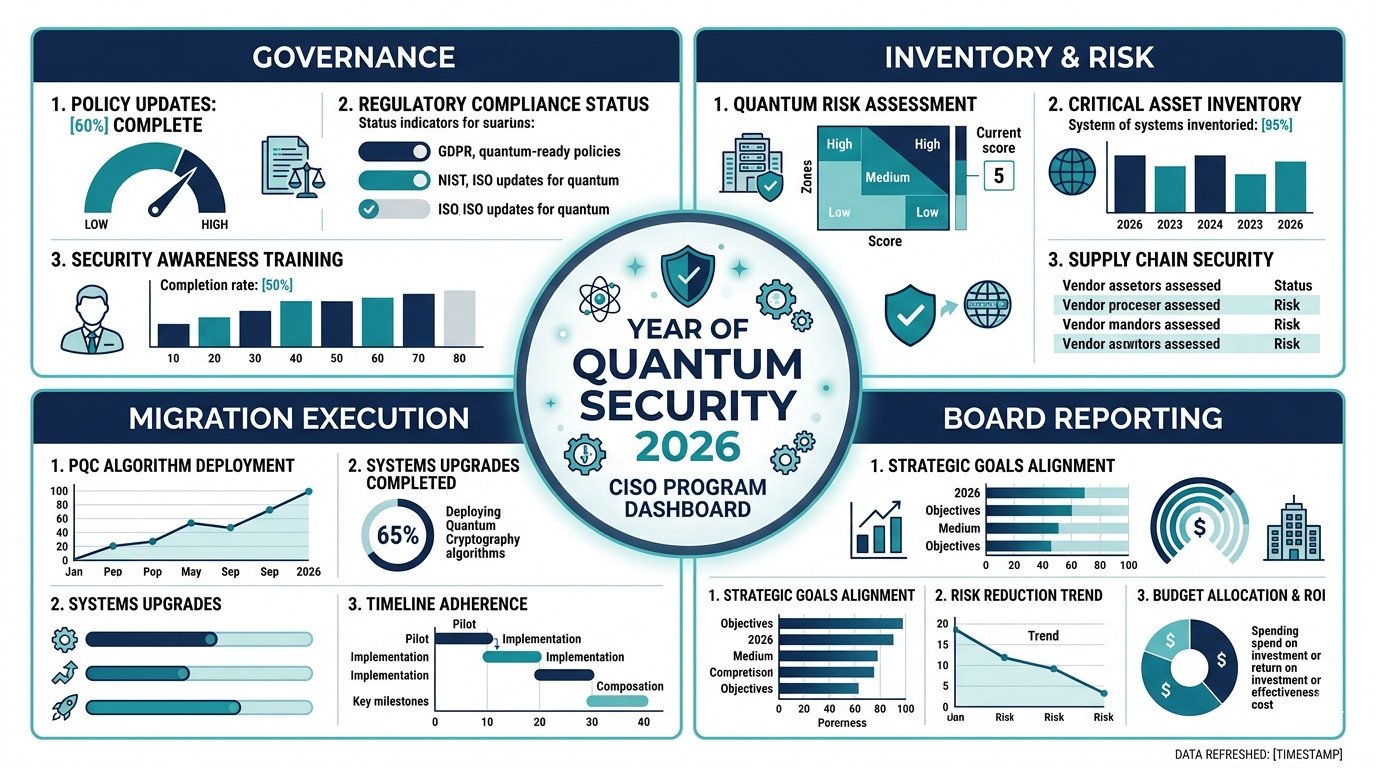
On January 12, 2026, senior officials from the FBI, NIST, and CISA convened in Washington, D.C. to launch the Year of Quantum Security 2026 — a year-long global initiative coordinating government, industry, and critical infrastructure around post-quantum cryptography deployment. [1] The designation is not ceremonial. Federal agencies are treating quantum security as operational guidance, not theoretical discussion. Regional summits are scheduled across the Americas, Europe, and Asia-Pacific.
Sector-specific forums and practitioner workshops run through a capstone gathering at year’s end. For the CISO community, the initiative’s significance is specific: it provides the institutional authority and coordinated timeline to convert quantum threat awareness — which most security leaders already have — into a governed, budgeted, board-reportable program. The gap the Year of Quantum Security 2026 is designed to close is not awareness. It is execution. Fewer than 10 percent of organizations have prioritized quantum security in their budgets, and only 3 percent have implemented all surveyed leading quantum-resistant measures. [2] This guide delivers the complete CISO action plan.
TECHNICAL DISCLAIMER: This article is for educational and informational purposes only. It does not constitute professional cybersecurity, legal, or compliance advice. Regulatory requirements and program timelines vary by organization, jurisdiction, and sector. CISOs should engage qualified cryptography professionals and consult applicable regulatory guidance before implementing the frameworks described here.
Why the Year of Quantum Security 2026 Is a CISO Execution Mandate
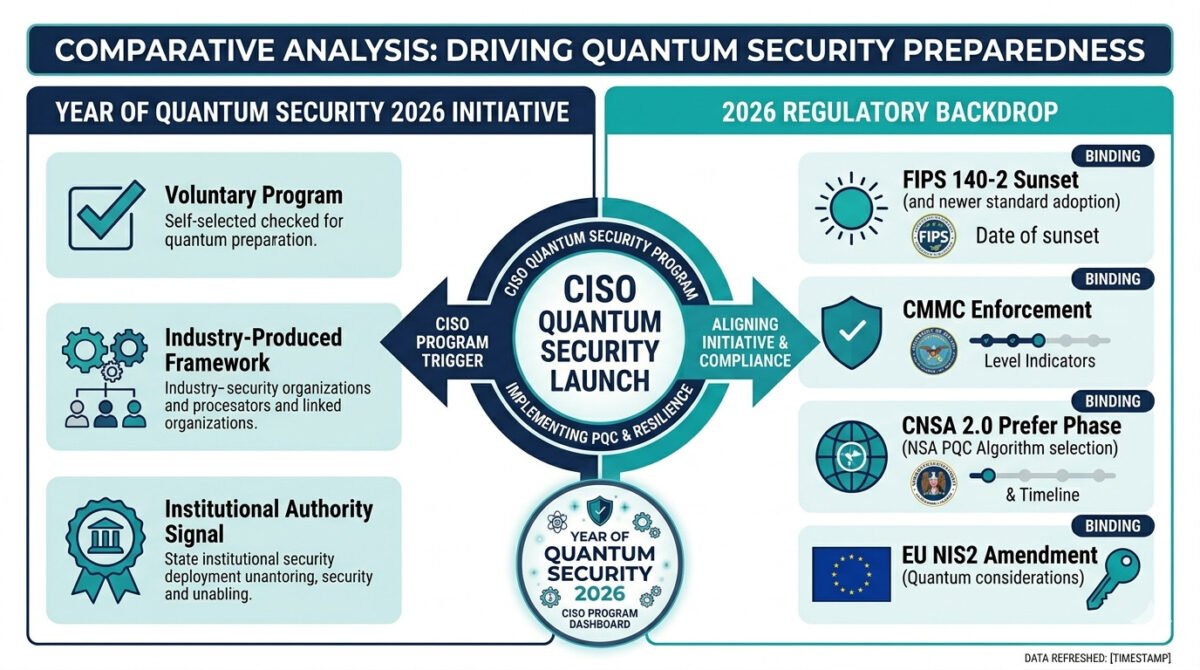
The Year of Quantum Security 2026 initiative, produced by The Quantum Insider with high-level support from the FBI, CISA, and NIST, is explicitly structured as a global program rather than a single moment. [3] Its significance for security leaders is threefold.
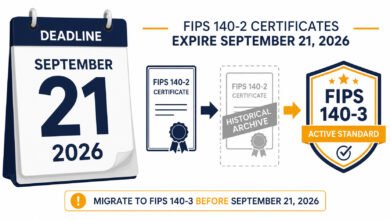
First, the January 12 launch event established institutional authority: when the FBI participates in a security initiative launch, the message to corporate boards is that the threat is credible and the government’s expectation of organizational action is current. Second, the 2026 initiative runs concurrently with two binding regulatory developments — the FIPS 140-2 sunset on September 21, 2026, and the CMMC Level 2 enforcement that began in late 2025 — creating an enforcement backdrop that converts the initiative’s voluntary framing into compliance reality for many organizations. Third, the initiative’s regional summit structure provides CISOs with peer benchmarking data: the Americas, European, and Asia-Pacific summits will surface sector-specific readiness benchmarks that boards will ask about.
The execution gap is the defining challenge of 2026. PwC’s 2025 Global Digital Trust Insights survey found that quantum computing ranks among the top five threats organizations are least prepared to address — despite ranking among the top threats overall. [2] The gap is not informational. Security leaders broadly understand the quantum security roadmap 2026 narrative: HNDL attacks are active, NIST standards are published, and compliance deadlines are binding. What is missing in most organizations is the governance structure, the budget line, and the board-reportable metric set that converts awareness into a program. The Year of Quantum Security 2026 provides the external mandate that CISOs can use to trigger that conversion.
Table 1: Year of Quantum Security 2026 — Key Events and CISO Trigger Points by Quarter
| Quarter | Initiative Event | Regulatory Backdrop | CISO Action Trigger |
| Q1 2026 (Jan–Mar) | January 12 launch: FBI, NIST, CISA, Washington D.C. event | CMMC Level 2 enforcement is active; CNSA 2.0 prefers the phases | Board briefing: Use the launch as an institutional authority for the budget request |
| Q2 2026 (Apr–Jun) | Americas regional summit; sector-specific forums begin | FIPS 140-2 sunset approaching September 21 | Cryptographic inventory program formally launched; vendor PQC roadmap requests issued |
| Q3 2026 (Jul–Sep) | Europe summit; Asia-Pacific preparation | FIPS 140-2 sunset September 21 — all certs move to Historical List | FIPS 140-3 transition status confirmed; System Security Plans updated |
| Q4 2026 (Oct–Dec) | Asia-Pacific summit; capstone readiness gathering | EU NIS2 national strategy deadline end of 2026 | Annual quantum readiness report to board; 2027 migration roadmap approved |
Building the Quantum Security Program Governance Structure
A quantum security roadmap 2026 without governance is a document. The governance structure is what converts it into an operational program with accountability, budget, and measurable progress. IBM’s CISO guidance for quantum-safe readiness identifies three foundational steps: discover your cryptography, observe your cryptography, and transform your cryptography. [4] Each step requires organizational authority that the security team alone cannot assert. Governance provides that authority.
Executive Sponsorship and Working Group Structure
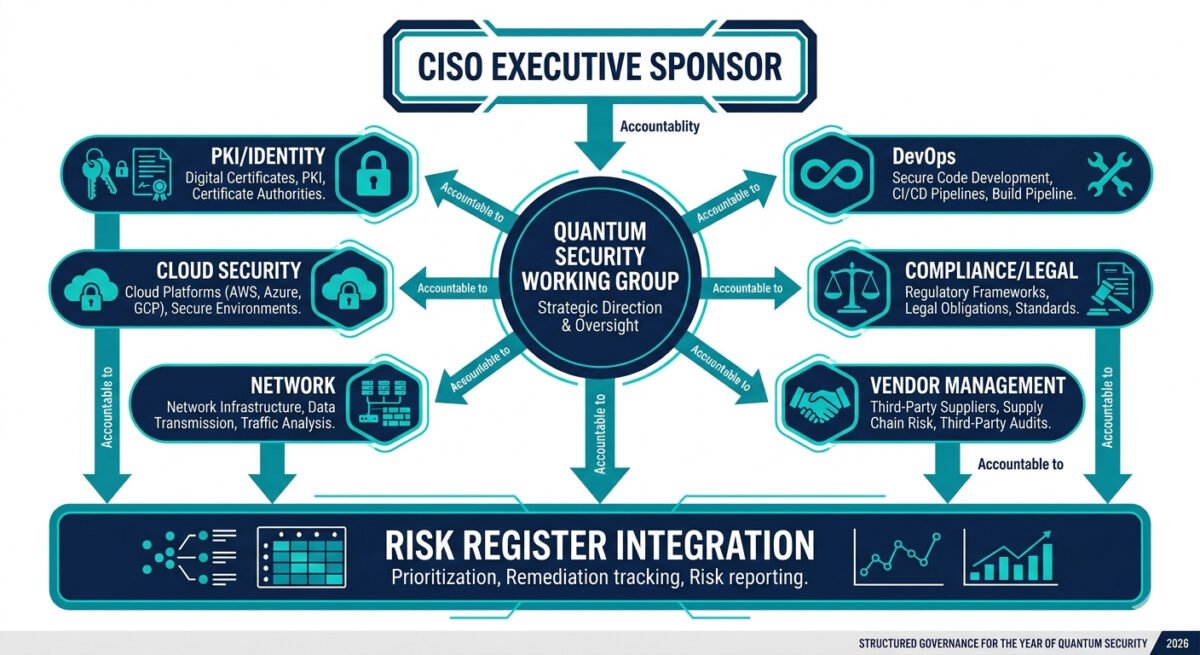
Assign executive sponsorship at the CISO level with a named deputy. Form a quantum security working group that includes: the PKI and identity team; cloud security; network security; DevOps and application security; compliance and legal; and a vendor management representative. Add a formal quantum risk entry to the organizational risk register — this is the governance step that makes the program visible to audit, insurance, and board oversight functions. [5] Organizations building a PQC Center of Excellence — a model now being piloted in Fortune 500 environments — define quantum risk tolerance at the center and coordinate migration sequencing across business units from it.
Program Charter and Risk Register Entry
Draft a program charter that defines: scope (which systems, environments, and third parties are in scope for the 2026 program phase); accountabilities (named owners for each migration workstream); budget allocation aligned to the 2030 critical systems deadline; and a quarterly milestone cadence. The risk register entry for quantum security should include: the HNDL threat as a current risk with a probability and impact rating; the FIPS 140-2 sunset as a near-term compliance risk; and the 2030 deprecation deadline as a strategic risk. Boards are asking about emerging risks. A quantum risk register entry with named ownership and a mitigation timeline is the minimum board-ready documentation for 2026.
Budget Framework
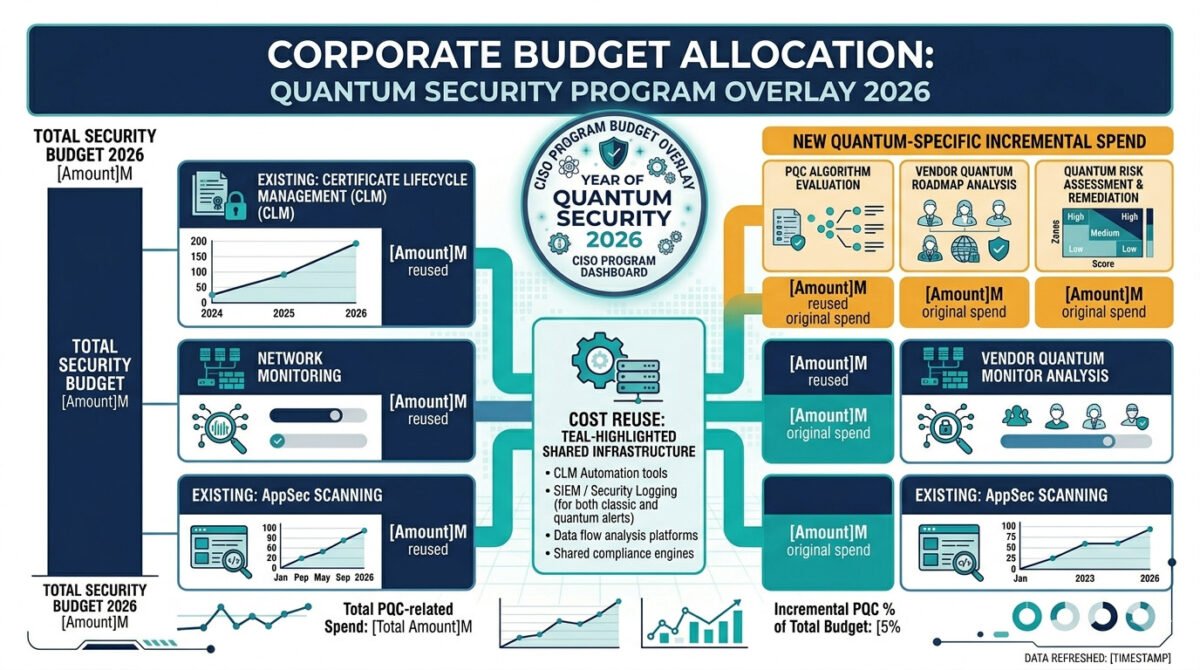
Migration cost estimates project 2 to 5 percent of annual IT security budgets over a four-year window. For organizations beginning in 2026, the 2026 budget line covers Phase 1 (cryptographic inventory tooling and staff time) and Phase 2 (hybrid TLS pilot deployment). These are the lowest-cost phases of the program. Organizations that defer to 2028 compress the remaining budget into two years against compliance deadlines — the highest-cost and highest-risk configuration. The Year of Quantum Security 2026 launch provides the external institutional authority to justify Phase 1 and Phase 2 budget requests in the current fiscal year.
Quantum Security Board Reporting: KPIs and the 2026 Metrics Framework
Boards are no longer asking whether organizations have a security program. They are asking whether it is working. [6] For quantum security, this means CISOs must translate the Year of Quantum Security 2026 initiative into board-reportable metrics that connect cryptographic posture to business risk — not technical indicators that require translation. SEC cybersecurity disclosure requirements, DORA’s resilience testing provisions, and CMMC assessment documentation all create formal accountability channels through which quantum risk board reporting will be reviewed by external parties.
The Five Core Quantum Security KPIs for 2026
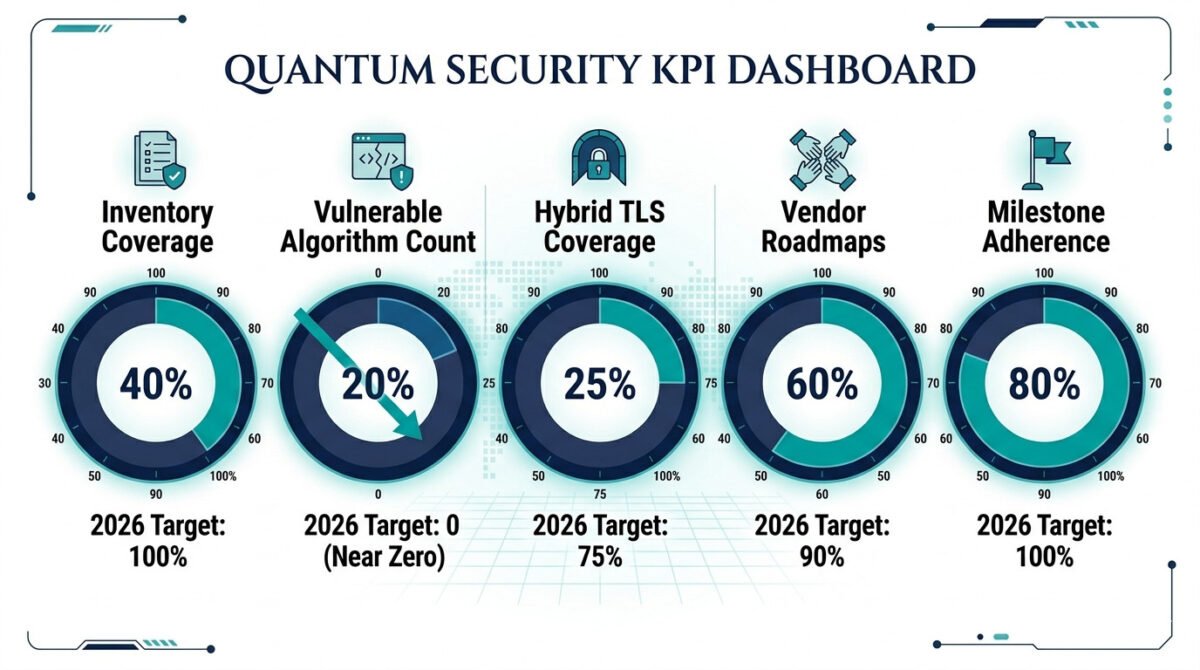
KPI 1 — Cryptographic Inventory Coverage: Percentage of in-scope systems with a completed and validated CBOM entry. Target for Q4 2026: 40 percent of Tier 1 systems (highest data sensitivity) covered. This is the foundational metric — no other KPI is meaningful without it.
KPI 2 — Quantum-Vulnerable Algorithm Exposure: Count of systems using RSA or ECC in key exchange or signature functions with no hybrid or PQC replacement in progress. This metric quantifies HNDL exposure in business terms: each system on the list represents data at risk if a CRQC arrives before migration completes.
KPI 3 — Hybrid TLS Deployment Coverage: Percentage of internet-facing TLS endpoints supporting ML-KEM hybrid key exchange. Target: 25 percent of Tier 1 endpoints by Q3 2026. This is the fastest-moving metric in most programs — hybrid TLS deployment is the lowest-complexity, highest-impact immediate action.
KPI 4 — Vendor PQC Roadmap Confirmed: Percentage of Tier 1 vendors with a documented and dated PQC migration roadmap. Target: 60 percent of Tier 1 vendors by Q4 2026. Vendor cryptographic posture is the most commonly underestimated exposure in enterprise quantum security programs.
KPI 5 — Migration Milestone Adherence: Percentage of quarterly migration milestones completed on schedule. Target: 80 percent adherence. This metric is the board’s proxy for program execution quality — it shows whether the quantum security roadmap is a plan or a managed program.
Table 2: CISO Quantum Security KPI Dashboard — 2026 Targets and Reporting Cadence
| KPI | Metric Definition | 2026 Target | Reporting Cadence | Board Relevance |
| Cryptographic Inventory Coverage | % of Tier 1 systems with validated CBOM entry | 40% Tier 1 by Q4 2026 | Quarterly | Demonstrates program foundation; required for CMMC and FedRAMP compliance documentation |
| Quantum-Vulnerable Algorithm Exposure | Count of systems with unmitigated RSA/ECC key exchange or signature | Decreasing trend each quarter | Quarterly | Direct HNDL risk proxy — translates to data-at-risk if CRQC arrives before migration |
| Hybrid TLS Deployment Coverage | % of internet-facing TLS endpoints with ML-KEM hybrid support | 25% Tier 1 by Q3 2026 | Monthly internal/quarterly board | Fastest-impact action; demonstrates program execution in production |
| Vendor PQC Roadmap Confirmed | % of Tier 1 vendors with dated PQC migration roadmap on file | 60% Tier 1 vendors by Q4 2026 | Quarterly | Supply chain risk visibility — addresses the most underestimated quantum exposure category |
| Migration Milestone Adherence | % of quarterly milestones completed on schedule | ≥80% adherence | Quarterly | Program execution quality — board proxy for whether quantum security is managed or aspirational |
The CISO Quarterly Action Calendar for the Year of Quantum Security 2026
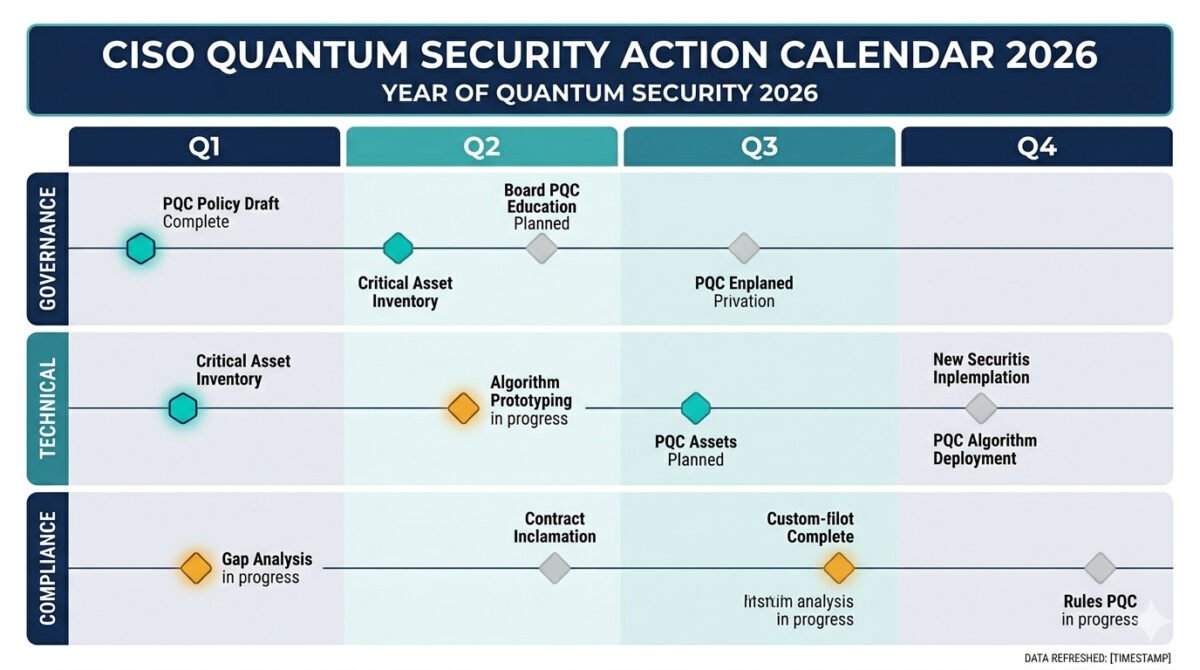
The following quarterly action calendar translates the Year of Quantum Security 2026 initiative into a sequenced execution plan. It is designed to be adapted to organizational context — the milestones are sequenced by dependency, not by organizational size. Larger organizations running parallel workstreams will compress timelines in some phases; smaller organizations with fewer applications will complete inventory phases faster.
Q1 2026 — Foundation (January–March)
Governance: Form the quantum security working group. Draft the program charter. Add quantum risk to the risk register with a named owner and initial assessment. Brief the board on the January 12 launch event as the external institutional authority for the program. Budget: Submit Phase 1 budget request (inventory tooling + 0.5 FTE security architect). Inventory: Begin passive network monitoring deployment across Tier 1 network segments. Vendor: Issue PQC readiness questionnaires to Tier 1 vendors.
Q2 2026 — Discovery (April–June)
Inventory: Launch static code scanning across Tier 1 application stack. Begin PKI and CLM integration — generate initial certificate register with algorithm metadata. Hybrid Deployment: Deploy ML-KEM hybrid key exchange pilot on two to three internet-facing TLS endpoints. Compliance: Audit FIPS 140-2 certificate status across all deployed modules ahead of the September 21 sunset. Vendor: Follow up on Tier 1 vendor questionnaire responses; escalate non-responses to procurement.
Q3 2026 — Compliance and Acceleration (July–September)
FIPS 140-2 Sunset (September 21): Confirm FIPS 140-3 certificate status for all CUI-handling modules. Update System Security Plans. Document risk acceptance for any Historical-status modules remaining in existing systems. Quantum security reporting: Deliver first formal board update with KPI dashboard. Hybrid TLS: Expand ML-KEM hybrid deployment to cover 25 percent of Tier 1 endpoints. Cloud: Complete cloud API cryptographic inventory across primary cloud platforms.
Q4 2026 — Roadmap and Governance Completion (October–December)
EU NIS2 milestone: If EU-scope, confirm that cryptographic inventory progress and migration roadmap documentation satisfy the end-of-2026 national strategy supervisory expectation. Annual board report: Deliver an annual quantum risk board reporting package — CBOM coverage percentage, vulnerable algorithm count, hybrid TLS deployment status, vendor roadmap register, and 2027 migration plan with approved budget. Program: Formalize 2027 program phase — targeting critical systems migration and PKI pilot deployments. Document lessons learned from the 2026 discovery phase for the organizational knowledge base.
Table 3: Year of Quantum Security 2026 — CISO Quarterly Milestone Tracker
| Quarter | Governance Milestone | Technical Milestone | Compliance Milestone | Board Deliverable |
| Q1 2026 | Working group formed; risk register entry created; program charter drafted | Passive network monitoring deployed on Tier 1 segments; vendor questionnaires issued | CMMC compliance posture assessed; CNSA 2.0 vendor obligations documented | Board briefing: Year of Quantum Security launch + budget request |
| Q2 2026 | Phase 1 budget approved; vendor follow-up escalation process active | Static code scanning launched — Tier 1 apps; CLM integration begun; hybrid TLS pilot live | FIPS 140-2 certificate audit completed; FIPS 140-3 gaps identified | Q2 board update: inventory progress + FIPS sunset risk + hybrid TLS pilot results |
| Q3 2026 | Phase 2 budget submitted for 2027; cross-functional milestone review | Hybrid TLS at 25% Tier 1 coverage; cloud crypto inventory complete | FIPS 140-2 sunset complied with; SSP updated; EU NIS2 supervisory expectation documented | First formal KPI dashboard presented to board |
| Q4 2026 | 2027 program phase roadmap approved; PQC Center of Excellence structure defined | CBOM baseline at 40% Tier 1 coverage; vendor roadmap register at 60% Tier 1 completion | Annual cryptographic inventory submitted (OMB M-23-02); EU NIS2 strategy documentation complete | Annual quantum security board report + 2027 migration plan + approved budget |
Counter-Arguments
Objection: The Year of Quantum Security 2026 is an industry marketing initiative. It has no regulatory force and creates no new compliance obligations.
Discussion: Technically accurate. The initiative is produced by The Quantum Insider, not a regulatory body. However, the board-level relevance of the initiative does not derive from its own regulatory status — it derives from the regulatory backdrop against which it launched. The FIPS 140-2 sunset on September 21, 2026, CMMC Level 2 enforcement, the EU NIS2 amendment, and CNSA 2.0 prefer-phase obligations are all binding in 2026, independent of the initiative. The January 12 launch event — featuring the FBI, NIST, and CISA — provides CISOs with external institutional authority to trigger board engagement and budget action that the regulatory documents alone may not have produced. The initiative is a governance accelerant, not a compliance instrument.
.Objection: Quantum security is a 2030 problem. CISOs have more immediate threats competing for the same budget in 2026.
Discussion: The competing priorities objection reflects a genuine constraint, not a misunderstanding. The CISO response is not to argue that quantum security displaces other priorities — it is to demonstrate that quantum security in 2026 is not a future investment but a present-tense risk mitigation. HNDL attacks are capturing data today that will carry confidentiality value beyond 2030. Hybrid TLS deployment — the first and most impactful migration action — is a configuration change, not a multi-year project.
It can be completed within an existing operational budget cycle. The cryptographic inventory, funded as a security operations program with tooling and a partial FTE, is the same capability organizations need to manage certificate lifecycle risk today. Framing quantum security as a standalone future investment is the wrong approach. Framing it as a present-tense risk reduction capability that reuses existing security program infrastructure is the budget-viable path.
Objection: Our organization lacks qualified cryptography staff. We cannot execute a quantum security program without specialized expertise we don’t have.
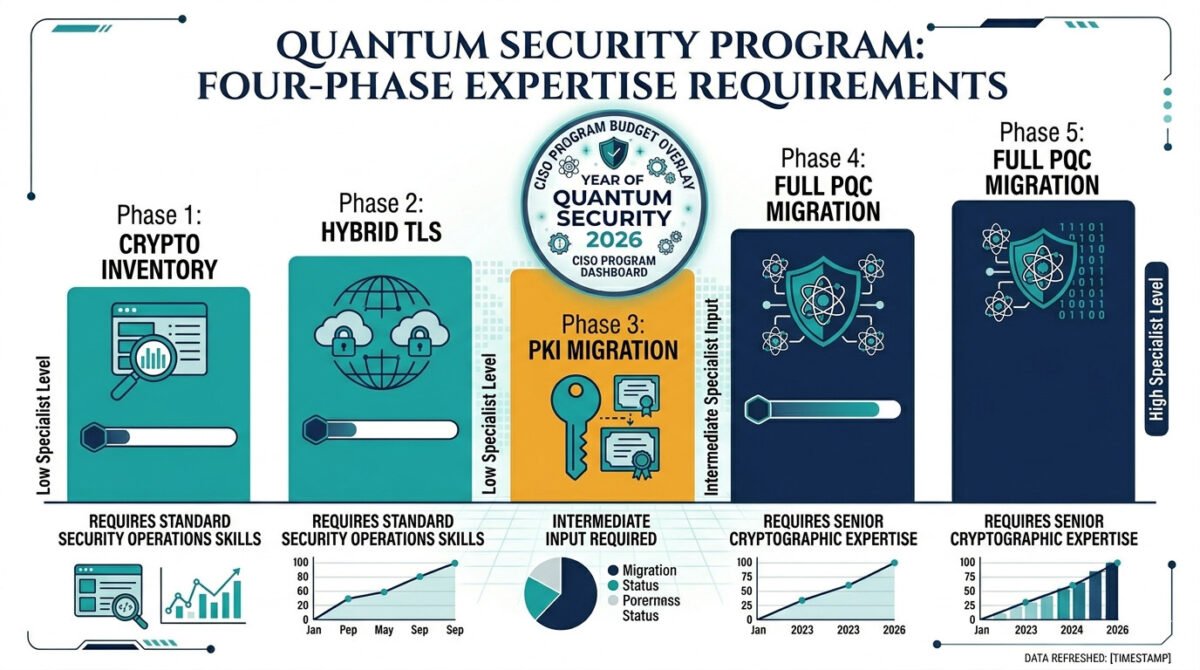
Discussion: The staffing constraint is real and widely shared. CSO Online’s January 2026 survey found that the lack of skilled personnel is among the top obstacles to PQC adoption. The program design for 2026, however, is not contingent on in-house cryptography expertise for most organizations.
Phase 1 — cryptographic inventory — uses commercial tooling (network monitoring platforms, SAST tools, CLM systems) that existing security operations staff can operate. Phase 2 — hybrid TLS deployment — is a configuration change that most network and DevOps teams can execute with vendor documentation. Specialist cryptographic expertise is required for PKI migration design and algorithm selection — that is, Phase 4 or Phase 5, not 2026. Organizations that invest in Phase 1 and Phase 2 now buy time to develop or acquire the specialist expertise Phase 4 requires without compressing that timeline against compliance deadlines.
Objection: We’ll wait for the annual assessment to confirm our quantum security posture before committing to a program.
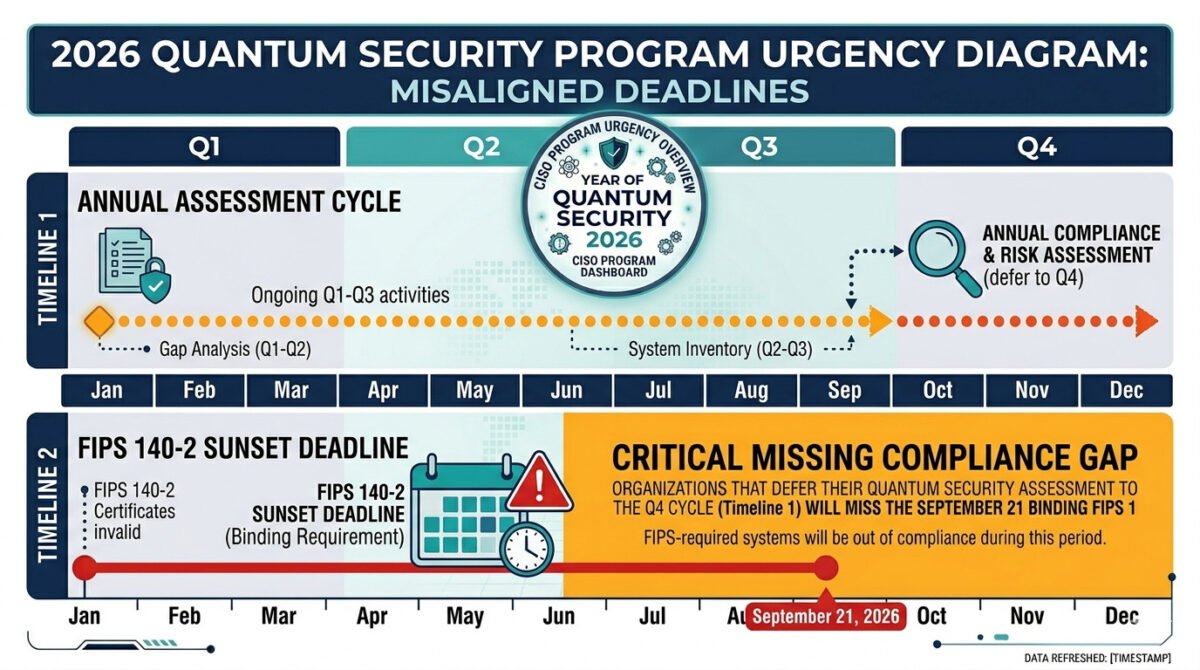
Discussion: Annual assessment cycles are not calibrated to the quantum security timeline for one structural reason: the FIPS 140-2 sunset on September 21, 2026, is a specific calendar date, not an annual cycle event. Organizations that discover FIPS 140-2 compliance gaps in a Q4 2026 annual assessment will have already missed the transition window for new federal procurements requiring Active-status modules.
Similarly, CMMC assessments are triggered by contract timelines, not annual cycles. The cryptographic inventory program — the prerequisite for any quantum security posture assessment — takes 12 to 24 months to produce actionable CBOM data. Every month of assessment deferral is a month of inventory lead time consumed. The annual assessment is the right cadence for reporting quantum security progress to the board. It is the wrong cadence for deciding whether to start the program.
FAQ
Q1: What is the Year of Quantum Security 2026, and who is behind it?
A: The Year of Quantum Security 2026 is a year-long global initiative launched on January 12, 2026, in Washington, D.C., with high-level participation from the FBI, CISA, and NIST. Produced by The Quantum Insider, the initiative coordinates government, industry, and critical infrastructure organizations around post-quantum cryptography deployment through regional summits, sector forums, and practitioner workshops across the Americas, Europe, and Asia-Pacific. For CISOs, its significance is the institutional authority it provides to trigger board engagement and budget action for quantum security programs in 2026.
Q2: What should a CISO do in Q1 2026 as a direct response to the Year of Quantum Security launch?
A: Three Q1 actions are the highest priority. First, brief the board: use the January 12 FBI-NIST-CISA launch event as institutional authority to request the budget and governance structure for a formal quantum security program. Second, add quantum risk to the organizational risk register with a named owner and initial HNDL threat assessment. Third, submit a Phase 1 budget request covering cryptographic inventory tooling and 0.5 FTE security architect time. These actions do not require specialized cryptographic expertise — they require the governance infrastructure that makes the rest of the quantum security roadmap 2026 executable.
Q3: What are the five KPIs every CISO should track for quantum security in 2026?
A: The five quantum readiness KPIs for 2026 are: cryptographic inventory coverage (percentage of Tier 1 systems with a validated CBOM entry); quantum-vulnerable algorithm exposure (count of systems with unmitigated RSA or ECC key exchange); hybrid TLS deployment coverage (percentage of internet-facing endpoints supporting ML-KEM hybrid); vendor PQC roadmap confirmed (percentage of Tier 1 vendors with a dated migration roadmap); and migration milestone adherence (percentage of quarterly program milestones completed on schedule). Each metric connects cryptographic posture to a specific business risk or compliance obligation.
Q4: How does the Year of Quantum Security 2026 relate to binding compliance deadlines?
A: The initiative itself carries no regulatory force. Its board-level relevance derives from the binding regulatory backdrop of 2026: the FIPS 140-2 sunset on September 21, 2026; CMMC Level 2 enforcement; CNSA 2.0 prefer-phase obligations for NSS vendors; and the EU NIS2 supervisory expectation for transition efforts documented by the end of 2026. CISOs can use the Year of Quantum Security 2026 launch — with its FBI, NIST, and CISA participation — as institutional authority to trigger board engagement for budget and governance actions that the regulatory documents alone have not produced.
Q5: How should quantum security be framed for board reporting in 2026?
A: Frame quantum risk board reporting around three risk categories rather than technical metrics: HNDL exposure (how much sensitive data with confidentiality horizons beyond 2030 is currently protected only by quantum-vulnerable algorithms); compliance risk (which binding deadlines — FIPS 140-2 sunset, CMMC, CNSA 2.0 — create near-term audit or procurement eligibility exposure); and program execution (whether the migration roadmap is on schedule against 2030 and 2035 targets). Five KPIs translate each category into board-reportable numbers. Boards in 2026 are not asking for cryptographic details — they are asking whether the organization has a credible plan and whether it is being executed.
Q6: What is the minimum viable quantum security program for a mid-sized organization in 2026?
A: The minimum viable program for 2026 has four components: a formal risk register entry with named ownership; a Phase 1 cryptographic inventory scoped to Tier 1 systems (highest data sensitivity and regulatory exposure); hybrid TLS deployment on internet-facing endpoints using ML-KEM plus the existing classical algorithm; and a vendor PQC roadmap request to Tier 1 suppliers. These four actions require no specialist cryptographic expertise, no major capital investment, and no new compliance framework — they reuse existing security operations capabilities and provide the foundation for every subsequent phase of the quantum security roadmap 2026.
Key Points
What Every CISO Needs to Take Away from the Year of Quantum Security 2026
- The Year of Quantum Security 2026 launched January 12 in Washington, D.C.. with the FBI, NIST, and CISA — providing CISOs with the institutional authority to trigger board engagement and budget action for formal quantum security programs in 2026.
- Fewer than 10 percent of organizations have prioritized quantum security in their budgets. The execution gap — not the awareness gap — is what the 2026 initiative is designed to close.
- Five board-reportable KPIs translate program execution into quantum risk board reporting: cryptographic inventory coverage, vulnerable algorithm exposure, hybrid TLS deployment, vendor roadmap confirmation, and milestone adherence.
- The quarterly action calendar sequences governance, technical, and compliance milestones across 2026, with the FIPS 140-2 sunset on September 21 as the hard midyear compliance deadline every quantum security roadmap 2026 must address.
- Phases 1 and 2 of the program — inventory and hybrid TLS deployment — require no specialist cryptographic expertise and are executable within existing security operations budgets, buying the lead time needed for later, more complex migration phases.
Complete the PQC Series:
- Read the Pillar: Post-Quantum Cryptography (PQC) 2026: Why Your Encryption Strategy Must Change Now
- Read the previous article: PQC Regulatory Compliance 2026: What NIST, EU, and G7 Mandates Mean for Your Organization
- Explore the full series: Q-Day 2026 | FIPS 140-2 Sunset | Cryptographic Inventory | PQC for Blockchain | PQC Regulatory Compliance.
References
- [1] AppViewX. (April 2026). Post-quantum cryptography PQC readiness in 2026: The Year of Quantum Security launch. AppViewX Blog.
https://www.appviewx.com/blogs/pqc-readiness-2026/ - [2] CSO Online. (January 2026). CISOs face a quantum leap in prioritizing quantum resilience. CSO Online. https://www.csoonline.com/article/4074154/cisos-face-quantum-leap-in-prioritizing-quantum-resilience.html
- [3] The Quantum Insider. (January 2026). After a year of quantum awareness, 2026 becomes the Year of Quantum Security. https://thequantuminsider.com/2026/01/06/after-a-year-of-quantum-awareness-2026-becomes-the-year-of-quantum-security/
- [4] IBM. (2025). The CISO’s guide to accelerating quantum-safe readiness: Discover, observe, transform. IBM Think Insights.
https://www.ibm.com/think/insights/ciso-guide-quantum-safe-readiness - [5] CYPFER. (May 2025). The post-quantum security roadmap: A step-by-step guide for CISOs. CYPFER Blog. https://cypfer.com/the-post-quantum-security-roadmap-a-step-by-step-guide-for-cisos/
- [6] HivePro. (April 2026). Cybersecurity metrics every CISO should report to the board in 2026. HivePro Blog. https://hivepro.com/blog/cybersecurity-metrics-ciso-board-reporting/
- [7] QuRISK. (January 2026). 2026: The year of post-quantum cybersecurity planning — CISO to-do list. QuRISK QS Lens. https://www.qurisk.fr/publications/2026-the-year-of-post-quantum-cybersecurity-planning
- [8] Quantumsecurity2026.org. (2026). Readiness — Year of Quantum Security 2026: Practical steps to protect data and innovation now.
https://quantumsecurity2026.org/readiness - [9] COMPLYAN. (May 2026). Post-quantum cryptography compliance: What CISOs need in their 2026 roadmap. COMPLYAN Blog.
https://complyan.com/post-quantum-cryptography-compliance-what-cisos-need-in-their-2026-roadmap/ - [10] ClearanceJobs. (January 2026). 2026 is the year quantum computing gets serious about security. ClearanceJobs News. https://news.clearancejobs.com/2026/01/14/preparing-for-quantum-security-in-2026/